Asean Business logo
SPONSORED BYUOB logo

KL-JB ETS rail service rush puts fares under the spotlight

Chinese New Year seats are nearly gone and Hari Raya demand is building, says rail operator KTMB
Summarise
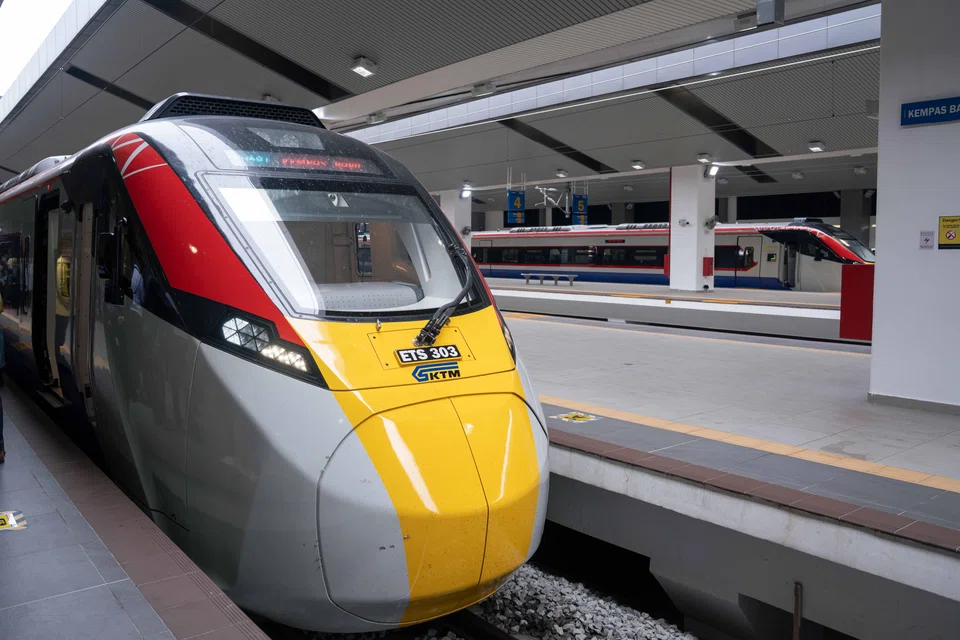
    • The KL-JB ETS now cuts travel time between Kuala Lumpur and Johor Bahru to about 4 hours and 20 minutes, compared with five to seven hours by car or existing diesel services.
    • The KL-JB ETS now cuts travel time between Kuala Lumpur and Johor Bahru to about 4 hours and 20 minutes, compared with five to seven hours by car or existing diesel services. PHOTO: MINISTRY OF TRANSPORT MALAYSIA
    Published Mon, Jan 5, 2026 · 02:53 PM

    [KUALA LUMPUR] Malaysia’s Kuala Lumpur-Johor Bahru Electric Train Service (ETS) is seeing a festive-season rush beyond the December holidays into Chinese New Year and the Hari Raya travel window, that is reviving long-suppressed travel demand.

    It is also reopening the discussion of what value looks like on the southern transport corridor.

    In the festive travel run-up, about 95 per cent of the 18,864 tickets allocated for Chinese New Year travel from Feb 15 to 20 have already been snapped up, said Malaysia’s national railway operator, Keretapi Tanah Melayu Berhad (KTMB), in response to queries from The Business Times.


    Hari Raya bookings – now at 24 per cent of the 31,440 tickets allocated for March – are expected to pick up from mid-January, it added.

    The surge follows a year-end crush. KTMB told BT that all 12,546 tickets for the JB Sentral-KL Sentral route were sold out between Dec 12 and Dec 31, 2025, prompting it to double frequency to eight daily trips from Jan 1, 2026.

    The affordability equation

    Pricing remains a debate, and unless fares better match commuter budgets, the promise of comfortable, traffic-free travel between Johor Bahru and Kuala Lumpur may stay beyond the reach of workers who make the trip most often.

    “If I were to commute every week, it would burn a hole in my pocket... If the ticket price is more affordable, I would definitely opt for the ETS instead of the bus,” said Muhammad Farhan Ronzi, a 26-year-old equipment engineer at GlobalFoundries in Woodlands, Singapore, who makes the cross-border trip on weekends to visit family in Seremban.

    He said the rail fare comes close to the cost of a one-way flight and would strain his RM120 (S$38) weekly transport budget.

    One-way KL-JB ETS fares start from RM82 in economy and about RM150 to RM160 in business class, putting rail above the cheapest buses, but within range of promotional air fares.

    A search of major booking platforms showed return air fares for Kuala Lumpur-Johor Bahru travel from Jan 23 to 25 ranging from RM104 on AirAsia to RM300 on Firefly, excluding baggage fees.

    This means flights can undercut rail at the low end, but also rise quickly once add-ons and peak pricing kick in.

    By comparison, one-way bus fares for the same period range from RM25 to RM105, depending on the service class, keeping road travel the lowest-cost option for many.

    Yet, the appeal is crystal clear. The ETS is positioning itself as a more comfortable alternative – one that could change how people move along the country’s main economic spine. On weekends, the southern transport corridor is often measured not in kilometre distance, but in hours lost to congestion and fatigue.

    For Farhan, who weekly weighs the same options – leave early and crawl through peak-hour traffic, or wait until midnight and hope the roads ease – the potential trade-offs are immediate.

    From the Johor Bahru checkpoint, Farhan takes a bus to Larkin Sentral, then endures a three-hour ride to Seremban on most weekends now. He is home by 11.30 pm on a good weekend, closer to 1 am in peak periods, before repeating the trip in reverse on Monday, costing him 12 to 13 hours of his weekend.

    “I absolutely can see myself taking ETS instead of the bus… It would be more comfortable, and there would be no traffic jams,” he told BT.

    “If I were to commute every week, it would burn a hole in my pocket,” says Muhammad Farhan Ronzi of taking the ETS for his weekly Singapore-Seremban commute. PHOTO: MUHAMMAD FARHAN RONZI

    Rail realities

    Farhan’s predicament captures both the promise and the limits of the new rail link.

    Market observers said the ETS could prove economically consequential – linking two of Malaysia’s most vibrant urban centres, unlocking tourism spillovers and reshaping housing choices – but only if affordability, service frequency and last-mile connectivity improve.

    Transport consultant Wan Agyl Wan Hassan sees the fare as a strategic middle ground. Driving often costs more than RM100 once tolls and fuel are included, while flights can be even costlier when including luggage fees and airport transfer charges.

    “For middle-income travellers, RM82 is fair if it delivers comfort and punctuality... Success hinges on service quality rather than just cost,” he noted, adding that price-sensitive commuters may stick to budget buses.

    The Regent of Johor, Tunku Ismail Sultan Ibrahim (second from left), Malaysia’s Transport Minister Anthony Loke (middle) and Malaysia’s Prime Minister Anwar Ibrahim (second from right), touring the ETS train during the launch. PHOTO: MINISTRY OF TRANSPORT MALAYSIA

    While KTMB does not disclose ridership by nationality, it reports encouraging interest across all segments. The operator is confident the ETS will stimulate tourism beyond Johor Bahru, citing faster journeys and direct access to towns such as Kluang and Segamat.

    “Competitive pricing, such as the JB Sentral to Kluang route at approximately RM23, positions the rail service as a compelling option for domestic travellers and regional visitors, including those arriving from Singapore,” said KTMB.

    A third option

    Having travelled on ETS from JB Sentral to Kuala Lumpur on Dec 21 last year, Wong Sheau Harn values the ETS as a vital third alternative to flights and buses. PHOTO: WONG SHEAU HARN

    For radio broadcaster Wong Sheau Harn, the new southern link fills a critical gap in Malaysia’s rail map. Having travelled on the ETS from JB Sentral to Kuala Lumpur on Dec 21 last year, she values the ETS as a vital third alternative to flights and buses.

    While the four-and-a-half-hour journey isn’t dramatically faster than driving, Wong finds it comparable to flying when factoring in check-ins and delays.

    By comparison, the journey takes five to seven hours by car or existing diesel services.

    Though buses remain cheaper and more frequent, the train offers superior comfort and productivity. “I can enjoy a quiet moment to read or get work done,” she noted.

    However, Wong hopes for increased frequency. Currently, high demand requires booking far in advance, lacking the “on-the-spot” spontaneity that makes bus travel so accessible.

    An underserved corridor

    For Associate Professor Mohd Harridon Mohamed Suffian, an economist at Universiti Kuala Lumpur Business School, the strong early response shows how “underserved and lacklustre” connectivity has been between Malaysia’s primary economic hubs.

    With Johor Bahru serving as a manufacturing epicentre and Kuala Lumpur as the nation’s central spine, the corridor requires transportation that matches its financial vibrancy. Singapore’s proximity adds further intensity.

    “The primary ingredient in sustaining the financial stature of cities is consistent transportation that complements growth,” he said, adding that by providing an alternative cost structure and timeframe, the ETS finally offers a service congruent with the scale of economic activity at both ends of the corridor.

    The ETS’s most transformative impact may lie in intermediate towns rather than the main terminals.

    Drawing parallels to the Tokyo-Yokohama rail corridor, Prof Harridon suggests the service could generate significant economic growth within a decade.

    Towns such as Gemas and Kluang – hubs for agriculture, ecotourism, and light manufacturing – stand to benefit from increased visitor traffic. “The number of customers linked to ecotourism would increase due to effective connectivity,” he noted.

    To capitalise on this, he advises small and medium enterprises to adapt by offering rail-friendly, portable products to expand sales volumes as regional access improves.

    Siva Shanker, chief executive officer of the estate agency at Rahim & Co International, concurred that the ETS has clear potential to support tourism-led activity in secondary towns, but warned that rail alone will not deliver transformation.

    “Places such as Kluang and Segamat are now easier to reach,” he said. “But success can’t rely solely on the ETS. Last-mile connectivity – how people move from the station to their final destination – will be the real decider for tourism and property investment.”

    Promises versus limits

    Where views are more guarded is corporate and talent mobility. With just limited daily trips and a journey time of about four-and-a-half hours, Shanker said the ETS is not yet suited to frequent business travel.

    “For the corporate world, this duration is still too long,” he said. “If I have a 9 am meeting in JB, driving (from KL) remains my only reliable option. Flights risk delays, and the current ETS schedule doesn’t align with business needs.”

    To make a meaningful impact on professional mobility, he said, the railway would need to either increase frequency substantially or reduce travel time to under four hours.

    That distinction matters as Johor positions itself as an investment and talent hub, particularly alongside the Johor-Singapore Special Economic Zone.

    “Faster, more frequent rail could eventually widen commuting choices. But for now, the ETS is better suited to leisure travellers and occasional trips,” he added.

    The ETS is set to complement the JB-Singapore Rapid Transit System (RTS) Link, slated for late 2026, by extending rail connectivity beyond the border.

    While the RTS eases daily cross-border commutes, the ETS anchors Johor to Malaysia’s domestic network, bridging the southern gateway with Kuala Lumpur and key intermediate towns.

    Measuring success beyond ridership

    To evaluate the ETS as a sound investment, Prof Harridon recommends monitoring city prosperity, income levels and passenger volumes. He argues that government agencies must collaborate to ensure the project is multidimensional.

    The ultimate measure of success, he suggested, depends on whether the rail link sparks “positive economic dynamism” in towns along the route, delivering broader peripheral benefits rather than simply moving passengers between destinations.

    For now, Farhan continues his weekly bus marathons while settling into his new Danga Bay rental in January. His experience underscores what Prof Harridon identified as a critical factor: the ETS must be not just faster and more reliable, but economically viable and affordable.

    “I think it would encourage more Malaysians to live further away from their workplace,” Farhan said. “But in terms of rail technology, we’re still behind other countries. If we could improve on that as well as the cost, it would encourage people who want to save on cost of living to live further from their workplace.”