



Malaysia’s Anwar meets with king amid talk of early elections, as tensions in ruling alliance deepen
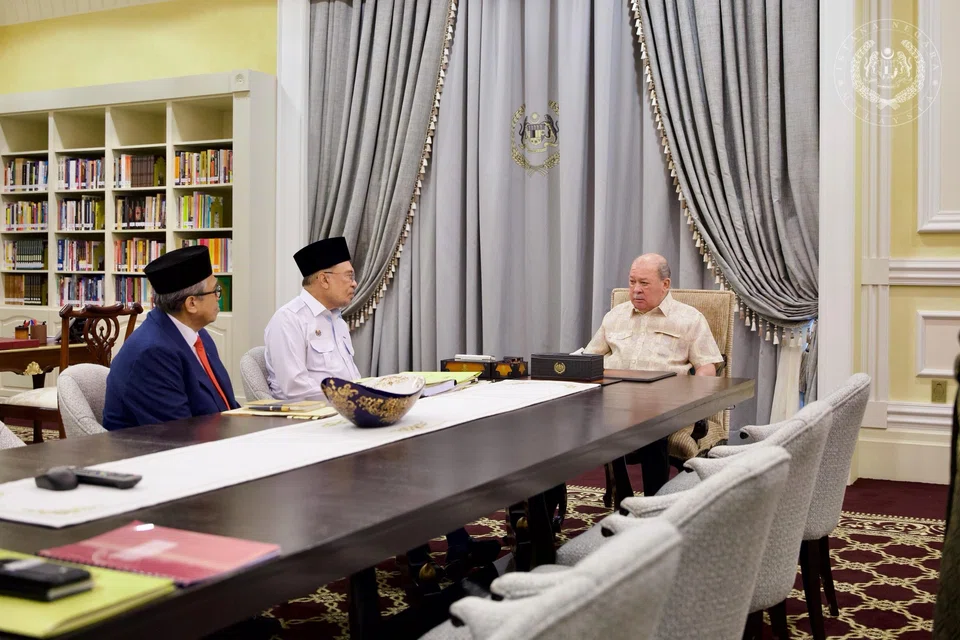
[KUALA LUMPUR] Malaysia’s King Sultan Ibrahim held an audience with Prime Minister Anwar Ibrahim on Monday (May 18), a day after the premier floated the possibility of calling an early election, according to a statement on the monarch’s official Facebook page.
A general election is not due until early 2028 but Anwar is facing pressure to seek consent from the king to call polls ahead of schedule in response to growing tensions within the ruling alliance and to synchronise the vote with several state polls expected in coming months.
Sultan Ibrahim met with Anwar at the national palace, with the chief secretary to the government present, the Facebook post said, without providing further details.
Anwar’s office did not immediately respond to a request for comment. A palace official told Reuters it was a “routine meeting” and part of Anwar’s weekly audience with the king, adding that they were not privy to what was discussed.
Weakening position
This comes as jockeying within the country’s ruling alliance further tested Anwar’s weakening position and raised questions about the country’s political stability.
The Barisan Nasional bloc, led by United Malays National Organisation (Umno), said on Saturday it would contest all 56 seats in the upcoming Johor state election without Anwar’s Pakatan Harapan coalition, its federal ally. The move prompted Anwar to warn his bloc was prepared for a “full-scale” electoral fight if challenged, including in other states.
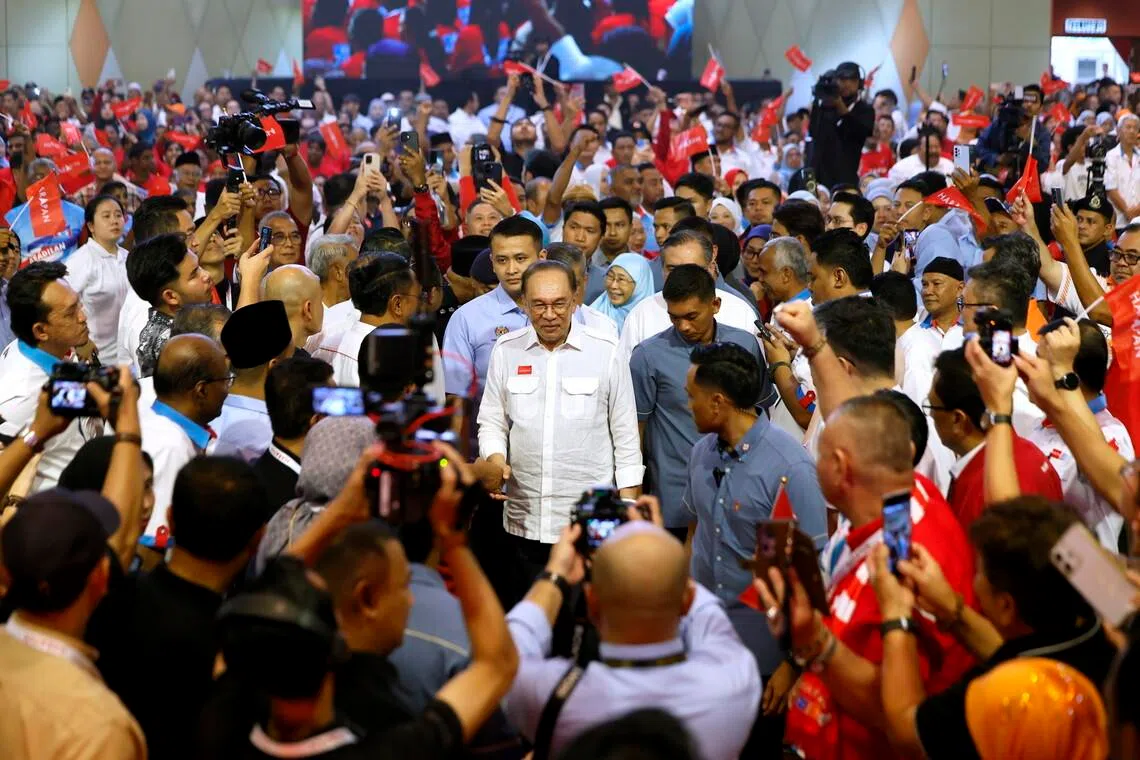
“If this is the way we are slandered and fractious in the government, maybe we should choose to hold elections for the whole country?” Anwar said on Sunday at Pakatan Harapan’s first national convention since 2022, held in Johor.
The devolving political situation threatens Anwar’s success wooing foreign investors amid shifts in global supply chains and the AI boom, and as the rising cost of oil from the Iran war strains the budget.
The ringgit, which was Asia’s best performer in 2025, was one of the region’s biggest losers early on Monday, weakening 0.5 per cent against the US dollar.
SEE ALSO
“While the Malaysian economy has navigated the oil price shock fairly well, any political uncertainty will see investors turn more cautious, especially if there is prospect of an early election which will bring a period of uncertainty,” said Khoon Goh, head of Asia research at Australia & New Zealand Banking Group. “The ringgit could start to underperform if foreign investors start to reduce their exposure to Malaysian assets on increased political uncertainty.”
Although the next general election is not due until early 2028, parties have increasingly shifted into campaign mode amid speculation Anwar could seek a fresh mandate earlier, particularly with state elections in the key states of Johor, Sarawak and Malacca expected in 2027. Malacca’s chief minister hinted that a state poll could happen within four months, Bernama reported.
Anwar has considered calling a general election some time in the third quarter, according to people familiar with the situation, on the expectation that he will need to begin cutting fuel subsidies after that, which would be politically damaging.
To call the election, he would need to petition the country’s monarch to dissolve parliament first.
“If coalition partners become more focused on domestic political positioning, it could narrow the administration’s room to push through unpopular but economically necessary measures,” said Asrul Sani, associate vice-president at The Asia Group. “Most importantly, Prime Minister Anwar’s political margin for error becomes narrower.”
The energy impact of the Iran war is starting to weigh on growth, fuelling expectations Anwar will need to pare back fuel subsidies that are now costing about US$1.8 billion monthly. While data in the week ended May 17 showed the economy expanded at a faster-than-expected 5.4 per cent in the first quarter, growth cooled progressively with March showing a sharp slowdown.
Deeper divisions have emerged recently in the uneasy partnership between Pakatan Harapan and former rival Umno. The two joined forces to form a government after the 2022 election produced a hung parliament, and neither would likely be able to form a government on its own. Anwar is also facing questions over his government’s anti-corruption credentials.
Anwar said on Sunday he planned to meet Ahmad Zahid Hamidi – the head of Umno and Barisan Nasional, as well as the country’s deputy prime minister – to discuss the Johor state election.
“We want to help and rectify the situation if there were any mistakes made,” Anwar said, according to the Malay Mail.
Battlegrounds
Johor is viewed as a key battleground after Anwar’s Pakatan Harapan suffered a heavy defeat there in 2022, allowing Barisan Nasional to secure a supermajority.
Concerns over cohesion within Anwar’s People’s Justice Party, known as PKR, spilled over after party elections in 2025 exposed divisions between factions aligned with the prime minister and former deputy party president, Rafizi Ramli.
Rafizi has become an increasingly vocal critic of both Anwar and PKR after he and former Natural Resources and Environmental Sustainability Minister Nik Nazmi Nik Ahmad resigned from the cabinet. The pair said on Sunday that they will leave PKR and take over the little-known Malaysian United Party, presenting a fresh challenge for Anwar.
A leaked internal PKR electoral analysis has revealed the level of concern within the party. It categorised PKR’s 66 federal parliamentary seats into several risk tiers, with only seven considered safe ahead of the next general election, according to a report by local news outlet Malaysiakini.
Even Anwar’s own seat of Tambun in Perak state was seen at risk, fuelling debate within PKR about its electoral standing and campaign strategy. PKR leaders have sought to downplay the leak, describing it as part of routine internal preparations aimed at strengthening party machinery rather than a sign of weakness. REUTERS, BLOOMBERG
Decoding Asia newsletter: your guide to navigating Asia in a new global order. Sign up here to get Decoding Asia newsletter. Delivered to your inbox. Free.
Share with us your feedback on BT's products and services
TRENDING NOW

LTA proposes combining car COE categories, adding rebate-surcharge system

StarHub to acquire MyRepublic’s mobile business amid ongoing telco consolidation

DBS, OCBC, UOB rout lops billions off STI as inflation, rate concerns spook investors

Grab CEO’s wife Chloe Tong on life with Anthony Tan and finding her purpose

