Negeri Sembilan’s record investment pipeline faces execution test at Aug 1 poll
Malaysian state will need to translate approved projects worth about US$4.7 billion into economic growth
[JOHOR BAHRU] Negeri Sembilan, a small Malaysian state best known for the coastal resort town of Port Dickson, is emerging as an alternative investment destination as data centre and semiconductor projects spread beyond the country’s established industrial hubs.
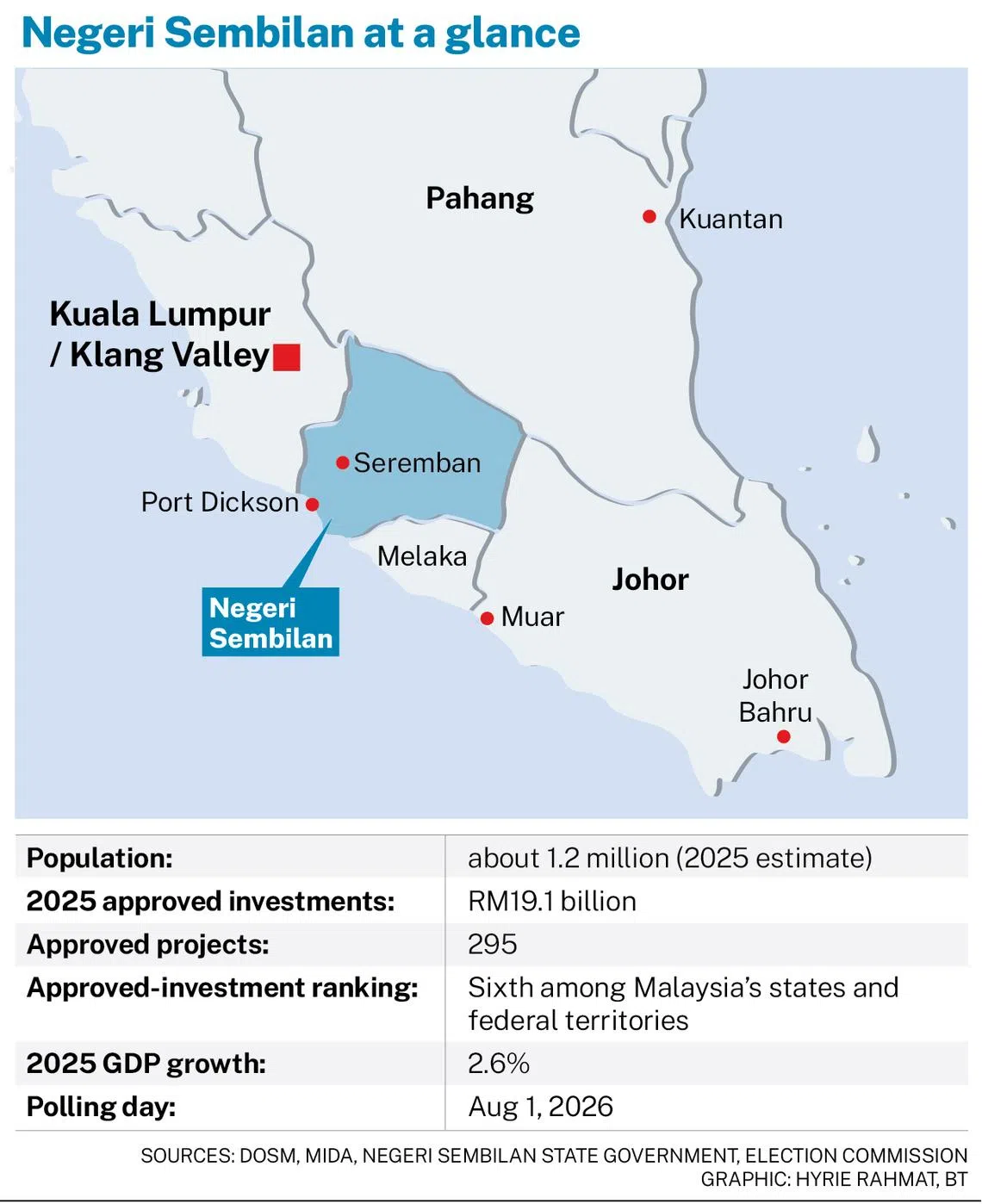
Last year, the state, which is home to about 1.2 million people, drew record approved investments of RM19.1 billion (US$4.7 billion) for 295 projects, according to Malaysian Investment Development Authority (Mida) data released by the state government in March.
This placed it sixth among Malaysia’s states and federal territories by approved investment value. Mida’s approved investment figures represent approved projects rather than investment already realised or capital already spent.
But as Negeri Sembilan heads to the polls on Aug 1, its next government faces a more difficult test: turning that investment pipeline into stronger growth, higher-value jobs and broader gains for local businesses, said Rizal Hamdan, senior programme officer at Merdeka Center, an opinion research firm.
The state’s economy grew 2.6 per cent in 2025, slowing from 4.6 per cent a year earlier, according to figures released by the Department of Statistics Malaysia (DOSM) on Jul 1.
That was also below Johor’s 8 per cent growth and Selangor’s 6.3 per cent expansion in 2025.
Manufacturing expanded by just 1.9 per cent in 2025, weighed down by a 3.9 per cent contraction in the petroleum, chemical, rubber and plastics sub-sector.
Household incomes also trailed those of neighbouring economic centres.
Negeri Sembilan’s mean monthly gross household income stood at RM7,305 in 2024, placing it ninth among Malaysia’s 16 states and federal territories, according to DOSM. This was well below Selangor’s RM13,296, Johor’s RM9,484 and Melaka’s RM8,686.

Rizal told The Business Times that Negeri Sembilan’s next phase of development should focus on moving up the value chain rather than simply attracting more capital.
Centred on the state capital of Seremban, Negeri Sembilan sits between Klang Valley and the southern growth centres of Melaka and Johor. Its relatively affordable industrial land, highway links and proximity to Kuala Lumpur International Airport have made it a potential spillover destination as neighbouring states become more congested.
Malaysia Vision Valley 2.0, the state’s flagship development corridor, is intended to accelerate that shift.
Coalition balance at stake
The Aug 1 election will be the second test in three weeks of the balance of power between Pakatan Harapan (PH) and Barisan Nasional (BN), which govern together federally but are contesting separately at the state level. On Jul 11, BN had a landslide victory in Johor, winning 48 of the state’s 56 seats.
A total of 103 candidates are contesting Negeri Sembilan’s 36 seats, with multi-cornered fights expected across much of the state.
“The bigger question isn’t whether the ‘unity government’ survives in Putrajaya. What matters is the balance of influence within the coalition itself,” Rizal said, adding that the presence of many multi-cornered fights makes the outcome much less predictable than a straightforward PH-versus-BN contest.
A strong BN showing in Negeri Sembilan would strengthen the party’s hand in seat negotiations with PH ahead of the 16th General Election, he added, although he cautioned against reading too much into a single state result.
“State elections don’t automatically predict federal elections.”
Rizal believes that the most likely outcome in Negeri Sembilan is a closely divided assembly that would require post-election negotiations.
While this would not necessarily undermine investor confidence, it could slow decision-making and project approvals while a new administration is formed.

Technology pipeline takes shape
Whichever coalition wins, Negeri Sembilan stands to benefit as demand for data centres and semiconductor capacity pushes investors beyond Malaysia’s established industrial hubs, said Rizal, citing its proximity to Klang Valley, transport links and growing industrial base.
Vena Nexus said in a Feb 4 media statement that it had broken ground on a 63.4-hectare green data centre campus in Senawang, with a targeted initial IT load of about 350 megawatts. The company expects the four-phase project to involve around RM20 billion in capital investment when fully built.
A separate Dutch semiconductor project proposed for Senawang is estimated to involve RM2 billion, including RM300 million in its first phase, Chief Minister Aminuddin Harun told the state assembly in December. The investor was not identified.
BT could not determine whether either project was included in Negeri Sembilan’s RM19.1 billion total for 2025.
Lum Chean Jeeng, a director at solar and battery solutions company AQ Energy, told BT on Thursday (Jul 23) that data centre and industrial developers would typically be required to contribute to the infrastructure upgrades needed to ensure adequate electricity supply when their facilities begin operating.
MSMEs await wider gains
Much of the immediate activity generated by the investment pipeline remains concentrated in construction, said Timothy Teo, director of Seremban-based Golden Hover Furniture Group.
He expects that it will take another two or three years for the benefits to reach smaller businesses as new data centres, industrial facilities, hospitals and retail developments become operational.
Micro, small-and-medium enterprises (MSMEs) should use that time to position themselves for the resulting supply chain opportunities, he added.
Many local businesses need assistance to obtain International Organization for Standardization and halal certification, meet ESG requirements, and finance the associated certification and training costs, Teo said.
“We are desperate to upgrade ourselves,” he added. “We want to become part of the supply chain rather than merely watch these businesses grow.”
Regardless of the election outcome, smaller businesses want political stability, clear policies, better infrastructure and more efficient approval processes.
While the current government has improved the business environment, its success in attracting large investments has yet to translate into broad gains for local operators.
For Rizal, the more important test will come after the election.
“What matters most is consistent execution,” he noted. “Investors are looking for reliable infrastructure, adequate utilities, efficient approval processes and policy continuity.”
The election, he added, matters less for whether it produces a fundamental shift in economic strategy than for what it signals about the state’s ability to deliver projects already in the pipeline.
Decoding Asia newsletter: your guide to navigating Asia in a new global order. Sign up here to get Decoding Asia newsletter. Delivered to your inbox. Free.
Share with us your feedback on BT's products and services