



No Asean country has figured out how to manage AI’s impact on jobs: Jasmin Lau
Uneven adoption could create a ‘two-speed society’, the acting manpower minister warns

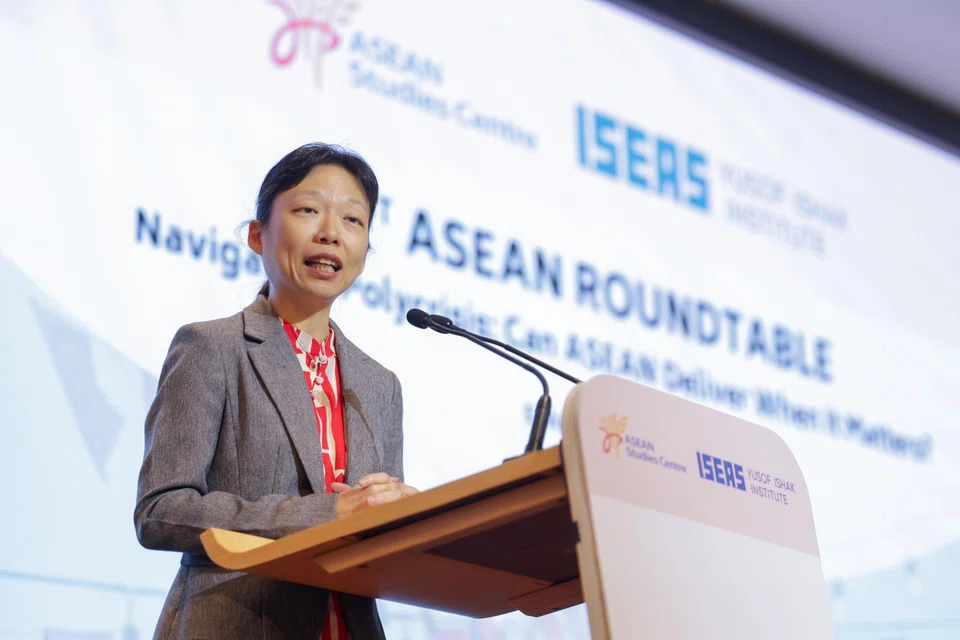
[SINGAPORE] None of Asean’s 11 member states has figured out how to manage the impact of artificial intelligence on jobs – including Singapore, said the Republic’s Acting Minister for Manpower Jasmin Lau.
She noted that the jobs that could be lost are not defined by the salaries, but that these jobs are also crucial to peoples’ identities and plans for their families and futures.
“We cannot stop the technology’s progress, but we also cannot leave its outcomes to chance,” she said.
She was speaking on a panel at the 41st Asean Roundtable held by the Iseas-Yusof Ishak Institute on Thursday (Nov 5), entitled “Built to last? Asean’s growth ambitions in an age of disruption”.
Lau, who is also senior minister of state for digital development and information, added that Singapore will approach the AI transition in a way that empowers both workers and businesses alike.
Within the business world, this means AI must be used to solve real-world problems and raise productivity, rather than simply being applied to summarise reports or act as a search engine, she said.

“(Singapore’s) approach is not only to make the AI available and tell people to try it, but to translate the AI into impact across the economy.”
The Republic updated its National AI Strategy earlier this year, identifying four sectors as priorities to utilise the technology: connectivity, advanced manufacturing, healthcare and finance.
Still, Lau warned that the uneven pace of AI adoption across enterprises could create a “two-speed” society, where larger companies are better placed to use the technology, while smaller companies could struggle to keep up.

She added that this has implications for social cohesion, with small and medium-sized enterprises hiring the majority of Singapore’s workers.
Panellists also pointed out that the investment returns from the AI value chain are also likely to divide the region along similar lines.
Nick Marro, principal economist for Asia at the Economist Intelligence Unit, said countries including Singapore, Malaysia, Thailand and Vietnam have captured the majority of foreign direct investment into the regional AI value chain.
Meanwhile, others such as the Philippines and Cambodia have struggled. He cited factors such as policy predictability, talent and infrastructure as factors explaining this divide.
But the region, he continued, can potentially benefit from a coordinated response to capture these investments. “There’s a ton of room for capacity building, a ton of room for cooperation and coordination across governments.”
Regional cooperation
Lau said that Singapore, which will take on the chairmanship of Asean in 2027, will work to ensure that technological change translates into greater economic security for workers across South-east Asia.
“What I hope we can say a few years from now is that a worker in Manila, Hanoi or Singapore feels more secure about his or her future because of AI, not the other way around.”
She added that Singapore aims to address other regional concerns over AI use during its chairmanship, such as creating opportunities for more widespread adoption of the technology.
Asean, she said, does not need all its member states to adopt AI at the same pace, given that its economies are at various different stages of development.
But she noted that the bloc can collectively enable its businesses and workers to make use of AI tools, such as by sharing use cases, building capabilities and making the technology and safeguards more accessible.
“If we can do this well, then AI becomes a tool that can improve our productivity across the region,” she added.
Meanwhile, Singapore will also work to strengthen regional capabilities in AI governance, testing and assurance, including common testing tools for agentic AI.
“A lot of this is still work in progress,” said Lau.
She emphasised that this is an area where regional cooperation will be key. Rather than leaving different industries to develop their own governance frameworks for agents, the region needs to facilitate frameworks that enable agents to act across systems and organisations.
Decoding Asia newsletter: your guide to navigating Asia in a new global order. Sign up here to get Decoding Asia newsletter. Delivered to your inbox. Free.
Copyright SPH Media. All rights reserved.
TRENDING NOW

Things to know about DBS’ incoming chairman Anthony Lim

DBS eyes prime brokerage business as Q3 profit falls 5% on weaker trading income

Royal Group and Sunset Hospitality abandon plans to open Casa Mett hotel off Orchard Road

George Yeo adds 100,000 Wilmar shares at S$2.97 apiece, taking stake to over 1 million shares

