



Record remittances fail to shield Philippine peso’s slide from mounting external pressures
Steady inflows from overseas workers are outweighed by higher oil prices, capital outflows, trade gap
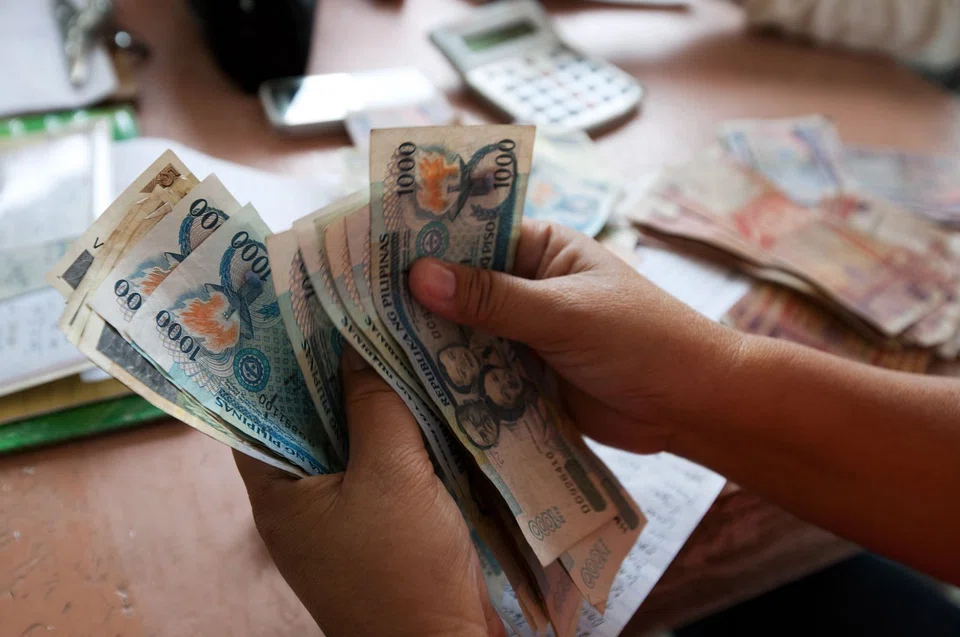

[MANILA] Some US$36 billion of annual remittances from overseas Filipino workers (OFW) have long been a pillar of the Philippines’ finances, providing it with one of its most stable sources of foreign exchange and one of the peso’s most reliable buffers against external shocks.
But that formidable stream is now under pressure. A strengthening US dollar, mounting trade deficits, capital flight and high energy import bills have pushed the peso to record lows, exposing the limits of a source of foreign exchange that has helped cushion the economy through past crises.
These confluence of factors are exposing the fragile underbelly of Asia’s import-dependent economies, analysts said.
The latest balance of payments data show the scale of the pressure. Despite some US$17 billion in first-half remittances, a widening US$30.8 billion trade gap and net portfolio outflows pushed the country’s balance of payments to a US$5.3 billion shortfall in the first seven months of the year.
While remittances help reduce volatility and underpin domestic consumption, they “cannot fully insulate the peso from global market forces”, Ruben Carlo Asuncion, chief economist at Union Bank of the Philippines, told The Business Times.
Even so, “given their scale, stability and resilience, remittances will remain difficult to replace as a source of foreign exchange in the foreseeable future”, he added.
Emerging as one of Asia’s worst performers, the peso has fallen about 7 per cent since the onset of the US-Iran conflict on Feb 28. It slid to record lows near 62 pesos against the greenback despite steady cash inflows from migrant workers that have historically shielded it from market shocks.
Gross international reserves – the central bank’s foreign-currency buffer used to defend the peso and pay for imports – fell for a fifth straight month to US$103.3 billion in July to cover 6.7 months of imports.
“If BoP (balance of payment) deficits persist and reserves continue to fall, external vulnerability could increase and put greater pressure on the Philippine peso,” said Diwa Guinigundo, country analyst at New York-based economic research firm GlobalSource Partners and former Bangko Sentral ng Pilipinas (BSP) deputy governor.
Countercyclical inflows
The US remains the primary source of remittances, contributing 39.4 per cent of total transfers, followed by Singapore at 7.2 per cent and Saudi Arabia at 6.3 per cent.
OFW money transfers have long behaved like a partial shock absorber: when the peso weakens, each US dollar sent home buys more pesos, which helps households.
“While annual growth has slowed to around 2 per cent, remittances still generate about US$36 billion in foreign exchange inflows each year, helping offset pressures from higher oil imports and external shocks,” Asuncion said.
OFW money transfers rose 3.3 per cent to an all-time high of US$35.6 billion in 2025, accounting for 7.3 per cent of gross domestic product, the lowest share in 25 years.
Asuncion added that the declining GDP share of remittances reflects a “more diversified” economy.
Jeremaiah Opiniano, director of the Institute for Migration and Development Issues, pointed to the structural resilience – or countercyclicality – of overseas cash flows.
“Globally, cash remittances are resilient even if economies are slowing down,” since these inflows are driven by family obligation and amplified by foreign exchange, Opiniano explained. “The exchange rate – we are now at 61 pesos plus – means the nominal value of the dollar remitted is higher,” he said.
“Migrant workers budget their money before wiring because the families (they left) behind also need resources,” he said.
Cash remittances in H1 2026 reached US$17 billion, up 2.4 per cent year on year, while Middle East cash flows, in particular, crossed US$3 billion, buoyed by stable overseas hiring and sustained demand for Filipino labour, economists from Maybank noted.
Currency pressure
The peso was branded as Asia’s “weakest link” after economists from global financial services firm ING warned that inflation risks were “outweighing growth concerns”.
The BSP has had to balance weak growth against renewed inflation while GDP more than halved to 2.6 per cent in the first half of 2026, down from 5.4 per cent in the same period last year.
A slumping peso and surging oil costs stoked domestic inflation, prompting the central bank to prioritise price stability with back-to-back rate hikes in April and June.
After a 50 basis point tightening spree, which pushed key borrowing rates to 4.75 per cent, the BSP’s Monetary Board raised its policy by another 25 basis points to 5 per cent as it extended its inflation fight.
Oxford Economics expects one final hike in October before the central bank pauses to support growth. However, the global advisory firm warned that persistent second-round effects – driven by volatile oil, agricultural pressures, and potential wage adjustments – could force the BSP to extend its tightening cycle.
TRENDING NOW

DBS, OCBC, UOB rout lops billions off STI as inflation, rate concerns spook investors

Grab CEO’s wife Chloe Tong on life with Anthony Tan and finding her purpose

OCBC sheds S$8 billion in value as shares close nearly 6% down; analysts cautious on banks

Deal between tycoon friends sparks scrutiny of Philippine power sector

