



Ringgit boleh, rupiah frays: Divergent Asean currencies to hold steady in 2026 amid greenback blues
Renminbi remains anchor for South-east Asian currencies

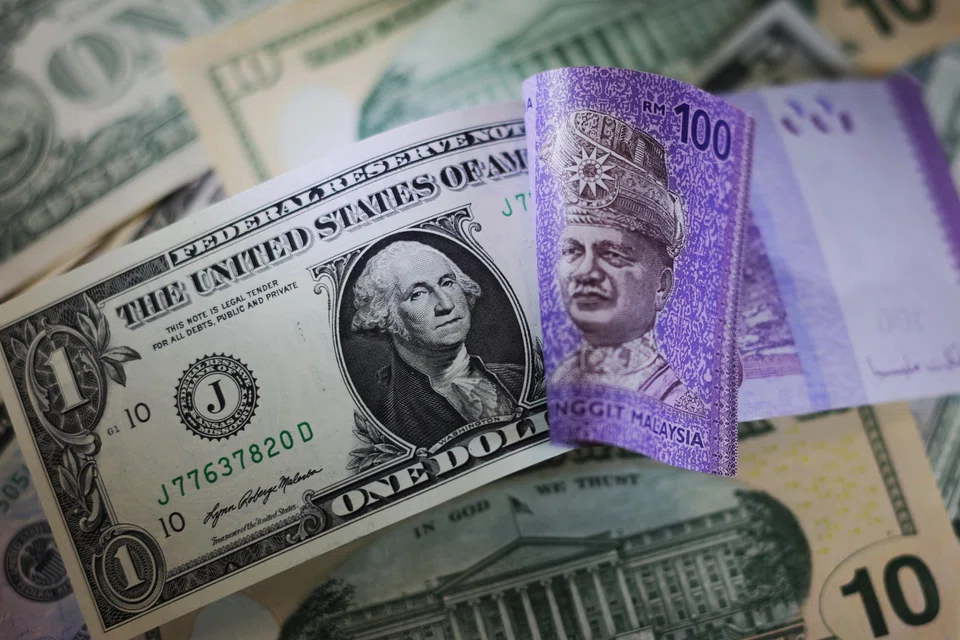
[SINGAPORE] After a year of sharp contrasts that saw the ringgit charting a winning streak while the dong, peso and rupiah clocked one fresh low after another, South-east Asia’s currency majors look set to weather 2026 well – thanks to a softening US dollar and, for some, a steady renminbi.
Next year’s top regional outperformer is no surprise: the ringgit had the most votes of confidence from economists The Business Times spoke with, as it ends the year boasting an 8 per cent gain to date against the world’s reserve currency.
Once the worst performer in emerging Asia two years ago, the ringgit strengthened from 4.473 per US dollar at the start of the year to some 4.1 currently. Forecasts expect it to end next year just shy of the psychologically key threshold of four.
“We are very positive on the ringgit,” said Deutsche Bank’s global head of emerging markets and Asia-Pacific research, Sameer Goel, citing sustained artificial intelligence-related semiconductor demand and steady low-volume fixed income returns that attract more portfolio bond flows.
Broadly speaking, Asian currencies backed by strong structural reform momentum and good macroeconomic stability will thrive in 2026, said MUFG Bank’s senior currency analyst, Michael Wan.
The ringgit falls right into that category, he said, noting Malaysia’s continued commitment to fiscal consolidation and its reduction of subsidies, coupled with strong investment pipelines in key growth sectors, such as electronics and data centres.
Maybank head of foreign exchange research Saktiandi Supaat sees it this way: Malaysia’s recent-year growth dynamics are marked by resilient domestic demand – driven by steady private consumption, an ongoing investment upcycle and growing public-sector spending and capital expenditure – amid volatile net external demand. This will remain the narrative for 2026, he posited.
Standout plays part ways
Hot on the heels of the ringgit is the Singapore dollar and the baht.
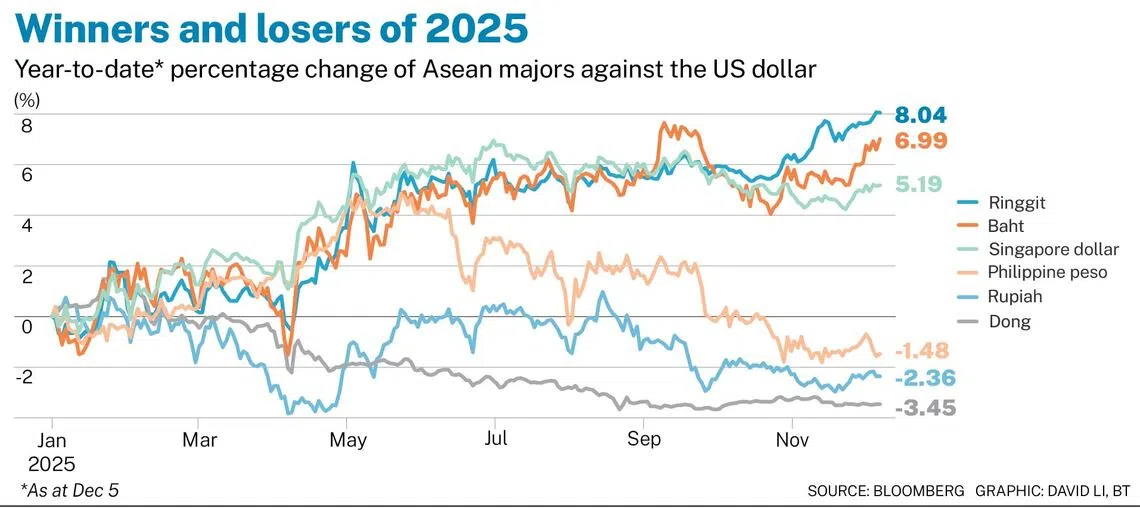
Both currencies held their own this year, notching gains of more than 5 per cent against the greenback. The Singapore dollar climbed to some 1.295 per US dollar today from 1.362 at the start of this year; while the baht rose to 32 against the US dollar from 34.3 earlier.
But their trajectories could diverge next year.
The Singdollar looks set to keep its strength on the back of strong growth and stabilising inflation, said Maybank’s Saktiandi. “There is a chance that USD/SGD could go towards 1.25 levels – or below if certain risks pan out – by mid-next year, if the dollar continues to soften and the US Federal Reserve’s easing intensifies.”
Even if that scenario does not play out, he expects the Singapore currency to hover around the current 1.28 to 1.3 threshold.
On the baht, Maybank’s analysts remain positive too, but Saktiandi pointed out that a strong currency may not bode the best for the Thai economy and, as such, he remains cautious of the risk of intervention.
And to Parisha Saimbi, a foreign exchange and markets strategist for Asian emerging markets at BNP Paribas, the Thai currency may well be a regional underperformer next year.
“We expect a weak baht – reflecting economic and political risks, possible measures to reduce its gold beta and scope for portfolio outflows,” she told BT.
BNP Paribas expects the Thai currency to gradually weaken to 32.5 per US dollar by the end of next year and to 33 in the fourth quarter of 2027.
Asean’s underachievers
Next year’s underperformers are expected to be the rupiah and the dong – for different reasons.
Said MUFG Bank’s Wan on the Indonesian currency: “Continued foreign exchange weakness is likely driven by continued concerns around the Prabowo administration’s fiscal priorities, and how to fund and find resources for them.”
He also flagged concerns about the possible impact on Bank Indonesia’s independence moving forward.
Recall that the rupiah touched a record low of some 16,970 per US dollar in April before eventually recouping the year’s losses with the help of central bank intervention. It went downhill again in August and the currency slipped to 16,650 as at Dec 5, versus 16,100 at the start of the year.
S&P Global Ratings’ senior economist Vishrut Rana told BT that capital outflows continue to plague Indonesia, partly due to policy uncertainty and partly on the compression of yields.
“The premium on Bank Indonesia Rupiah Securities yields has eroded, pushing treasury yields lower (which) means it is better to exit the market rather than enter.”
The dong is expected to fare no better.
Despite the swathe of positive structural reforms in Vietnam, Wan conceded: “The flipside is that the government is pushing for a very ambitious growth target, (which) raises some risks of an overheating economy and excessive credit growth in the near term.”
Deutsche Bank’s Goel concurred, noting that the divergence between its rosy growth outlook and the drag from portfolio outflows will keep the dong under modest depreciation pressure.
This year alone, the beleaguered dong breached its record low several times and looks to be finishing the year some 3.5 per cent weaker against the greenback since the beginning of the year – even as the US dollar index sank nearly 9 per cent in the same period.
Almighty dollar falls, renminbi steadies
One thing is for certain: Economists across the board concur that the US dollar will continue weakening into 2026 amid rate-cut expectations.
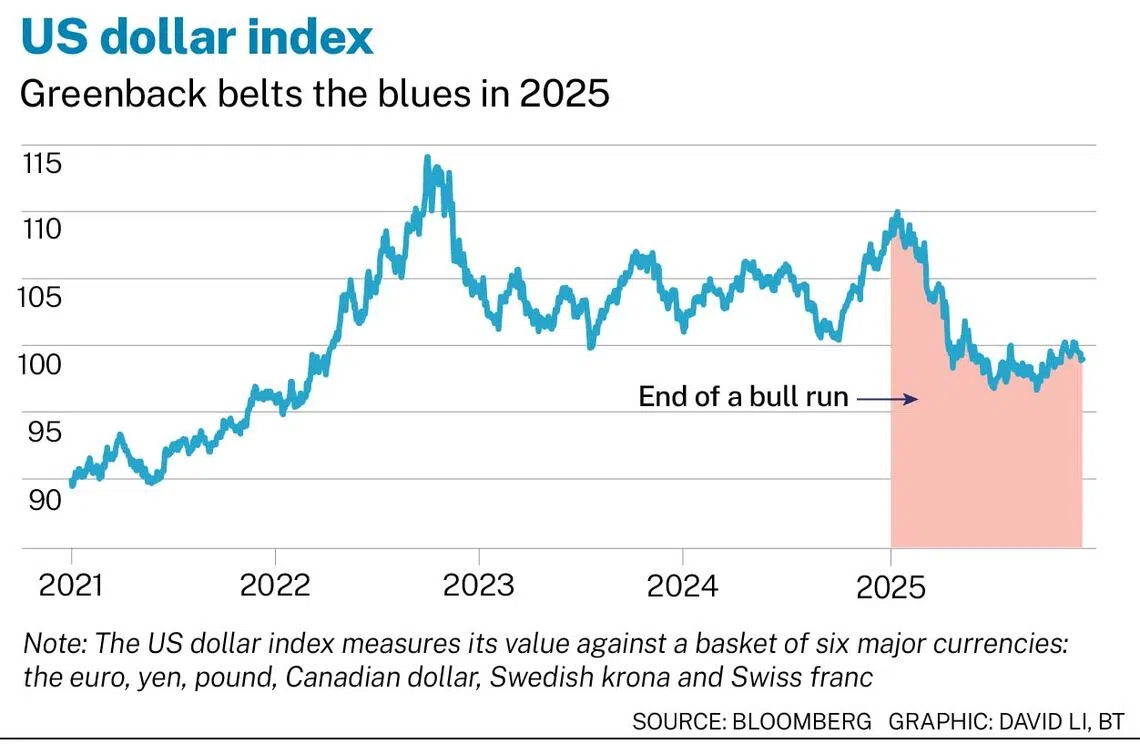
The decade’s unusually long dollar bull run has reached its finishing line, said Goel. “The cyclical resilience of the US economy – expected to persist next year – is supportive of the dollar (but) valuations, balance of payments dynamics and relative monetary policy cycles all argue for further dollar downside.”
That said, Maybank’s Saktiandi acknowledged that America’s midterm elections could introduce volatility and that room exists for some support for the US dollar, especially if interest-rate cuts were to be front-loaded or if other risks materialise.
Asked whether a “de-dollarisation” narrative is still in play or if the greenback’s safe-haven character still dominates, Wan concluded that both co-exist.
“The picture collectively in 2025 tells us that the dollar still remains a safe haven, but we see continued signs of diversification to alternative safe havens, such as gold, and also increasing signs of hedging,” said the analyst.
He added: “We may not see an en-masse selling of dollar assets, but any incremental dollar funds will likely see a rethink of broader overweights in US assets, while there will likely be more conversations in boardrooms and investment teams around increasing foreign exchange hedge ratios moving forward.”
Amid the backdrop of weakening US dollar dominance, another big theme of the year was China’s renminbi shaping up to be a barometer for South-east Asia’s currency swings, underpinned by deepening trade ties and earlier tariff turmoil.
As the curtain closes on the year, the renminbi remains a steadying hand for regional currencies even as its American counterpart exerts the dominant pull on broader foreign exchange moves.
Saktiandi concluded: “The end of the year is largely a US dollar-driven story with a flip-flopping of Fed rate-cut expectations. The People’s Bank of China has continued to fix the renminbi stronger, but the US dollar factor has been more dominant.”
He noted that the renminbi will continue to be an anchor for the region, but its influence will remain largely unchanged.
Deutsche Bank’s Goel believes otherwise: “We think the renminbi’s influence will likely grow, as its internationalisation efforts gather pace as a geostrategic policy initiative to counter de-globalisation trends in trade and financing.”
TRENDING NOW

Analysts cut DBS target price on lower 2027 earnings, but see buying opportunity after share price slide

Waymo founder predicts ‘landslide’ robotaxi adoption in Singapore, driven by high car costs

The limits of China’s trade concessions to Europe

Nvidia CEO Jensen Huang drops from world’s top 10 richest after chips sell-off

