Sijori triangle could drive Asean’s next wave of growth: Danantara executive
SIIA chairman Simon Tay says well-managed cooperation can bring benefits to Singapore, Johor and Riau

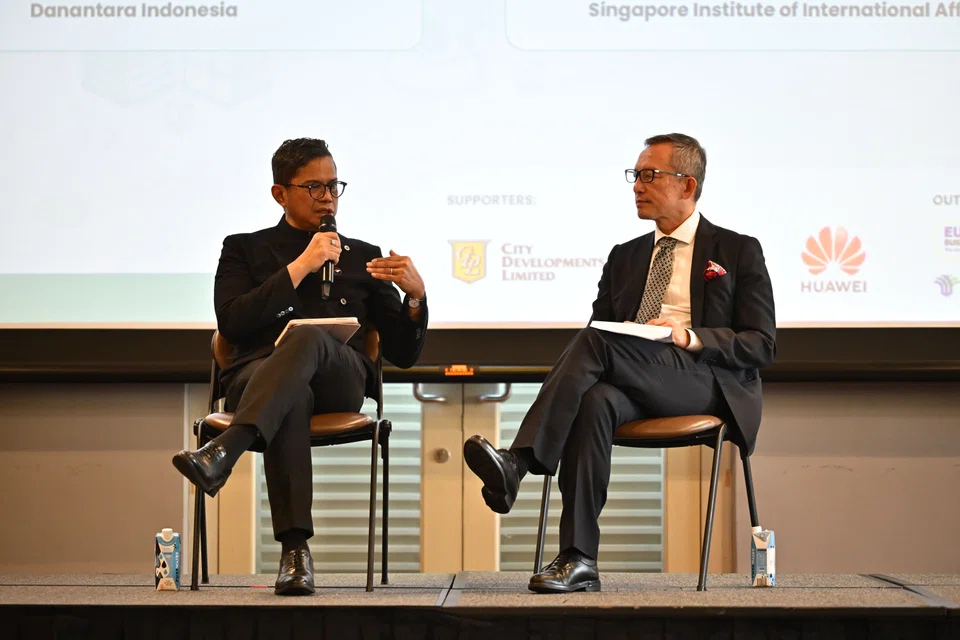
[SINGAPORE] The close economic ties among Singapore, Johor and the Riau Islands of Indonesia could create a regional growth engine and serve as a model of cooperation in Asean, said a senior executive at Indonesia’s sovereign wealth fund Danantara.
Pahala Mansury, Danantara’s managing director for global relations and communications, said that the three-way partnership could build on Asean’s record of ensuring the region’s peace and stability by deepening economic integration.
He added: “We see that the next opportunity of growth globally is really South-east Asia, and most probably also Central Asia … At the core of this growth in South-east Asia is the area within the triangle and bordering it.”
He was speaking at the 3rd Singapore Green Dialogue convened by the Singapore Institute of International Affairs (SIIA) at the Asian Civilisations Museum on Tuesday (Nov 3).
The half-day session, themed “The Green Growth Triangle”, brought together policymakers, business leaders and academics into discussions on how Singapore, Johor and the Riau Islands can leverage their complementary strengths, and how sustainability could drive economic growth in the sub-region.
SIIA chairman Simon Tay said in his opening remarks at the event: “The important part of interdependence is growth. If it is managed well, the dynamics of this triangle can be very positive for all partners.”

He noted: “But sustainability and environmental issues must also be managed. As the haze shows, interdependence can otherwise turn negative.”
Citing key findings from The Business Times Insights: Powering Asean’s Future 2026 – a survey in October that polled 514 corporates in the Asean-6 economies – he noted that 53 per cent of the respondents had delayed or deprioritised their decarbonisation plans.
“This is understandable,” he explained. “But those same uncertainties and high energy prices actually create, for a long-sighted investor, a business case to start to increase the supply of energy and the supply of waste, and to decarbonise growth.”
SEE ALSO






‘Three better than two’
The idea for the “Sijori” growth triangle was mooted in 1989 by Goh Chok Tong, then Singapore’s first deputy prime minister.
By 1994, it had been renamed the Indonesia-Malaysia-Singapore Growth Triangle; the three countries formalised the grouping with the inking of a memorandum of understanding that year.
It concept faded from view in the late 90s and the 2000s as the region grappled with the Asian Financial Crisis, domestic instability and political shifts.
But the decades-old vision has been gaining renewed traction lately.
In July 2025, Singapore’s Deputy Prime Minister Gan Kim Yong disclosed that the three South-east Asian neighbours had floated plans to expand the Johor-Singapore Special Economic Zone (JS-SEZ) to include the Riau Islands and had discussed advancing trilateral cooperation.
Sijori 2.0
The Danantara executive’s points were reiterated by Riena Astuty, minister counsellor and coordinator for economic affairs at the Indonesian embassy in Singapore.
Speaking in a later panel discussion at the Singapore Green Dialogue, she said: “By combining the strengths (of the three areas), Sijori can attract more investments, create jobs and drive sustainable growth and collaboration among these neighbouring economies, and this can be a model for Asean as a whole.”
Singapore’s strengths lie in its role as a financial and tech hub and its business network; Johor’s forte is in its industrial ecosystem, talent pool and manufacturing capacity; Batam, Bintan and Karimun, part of Indonesia’s Riau province, lie in a strategic, resource-rich location with abundant renewable energy, land, a workforce and access to a large domestic market, she noted.
“I believe this is the time to renew the concept as Sijori 2.0, perhaps with this green growth,” she added, citing greener energy use and reduced emissions.
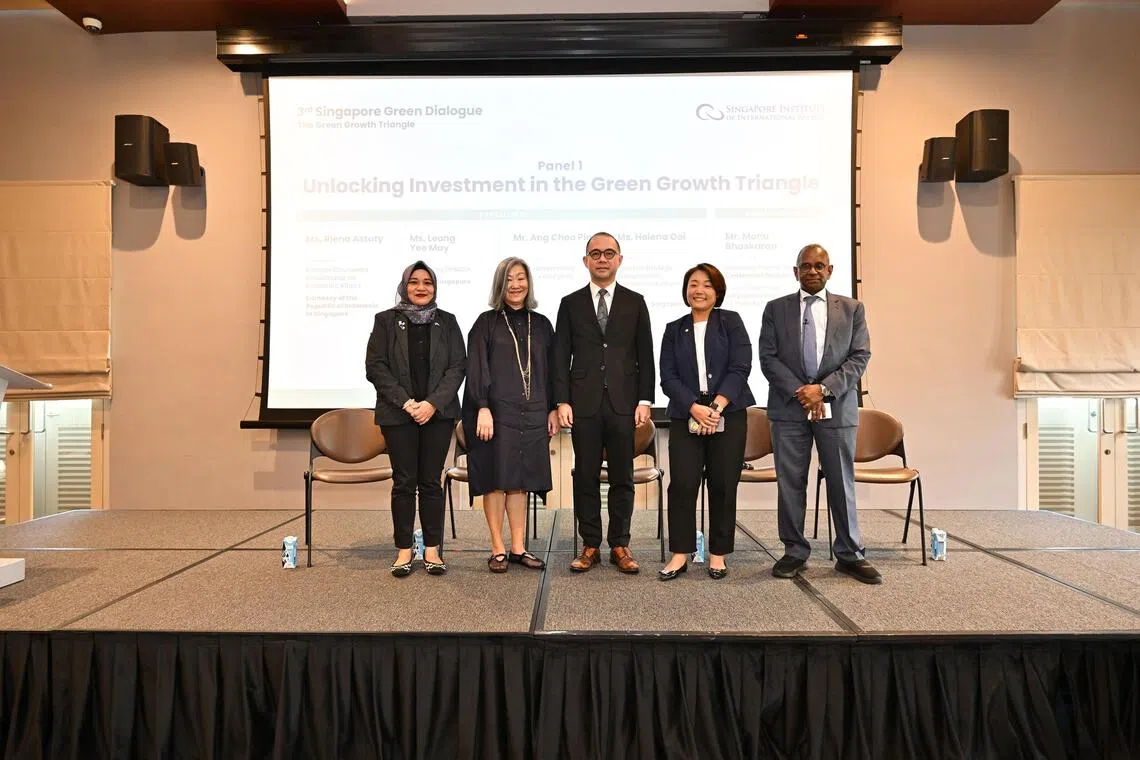
She was speaking at a panel discussion titled “Unlocking Investment in the Green Growth Triangle”, which was moderated by SIIA council member Manu Bhaskaran, who is also founding partner and chief executive at Centennial Asia Advisors.
The other three panellists at this discussion were Leong Yee May, managing director at Equinix Singapore; Ang Choo Pin, chief of government affairs for the Asia-Pacific at FedEx; and Helena Ooi, head of strategy, sustainability, transformation and data at Maybank Singapore.
Said Equinix’s Leong: “Energy availability is what is going to drive where the digital economies reside. Today, it is very clear that that energy is limited by generation… But together in this triangle, we can harness the resources in the region to facilitate this digital growth.”
She noted: “It’s been proven in the JS-SEZ, and I think there’s a great opportunity for us to create that with Indonesia and really open that gateway of opportunities and possibilities.”
JS-SEZ gets power-up
Hasni Bin Mohammad, economic and investment advisor to the state of Johor, said in a later keynote address: “The next horizon should not be just talking about Johor. I believe that the growth triangle is something that will be able to benefit the JS-SEZ.”
He added that RM34.6 billion (US$8.5 billion) in approved green investments came under the purview of the Malaysian Investment Development Authority (Mida) between 2024 and 2025.
He told BT after the dialogue that the sum is for 4,007 projects, with foreign investments accounting for some 51.6 per cent or RM17.85 billion, and domestic investments making up the remaining 48.4 per cent or RM16.75 billion.
This translates into around 16,563 job opportunities, he added.
A joint statement issued on Monday after the conclusion of the inaugural meeting of the Johor-Singapore Cooperation Ministerial Committee revealed that the JS-SEZ recorded a total of RM88.83 billion in approved investments under Mida’s purview between January 2025 and June 2026.
The blueprint for the JS-SEZ Master Plan is also said to be on track for launch at the upcoming Malaysia-Singapore Leaders’ Retreat in December.
Decoding Asia newsletter: your guide to navigating Asia in a new global order. Sign up here to get Decoding Asia newsletter. Delivered to your inbox. Free.
Copyright SPH Media. All rights reserved.