



Singapore, Vietnam need shared model to engage businesses, academia in tech cooperation, says To Lam
The countries’ parallel ambitions create stronger basis for collaboration, adds Singapore Manpower Minister Tan See Leng

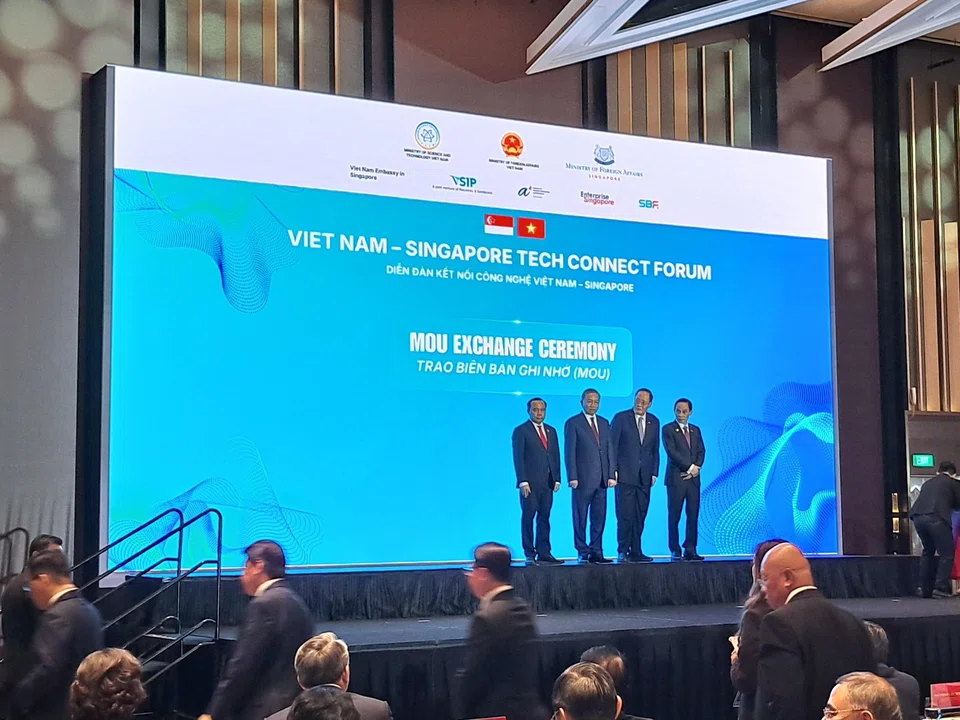
[SINGAPORE] The greatest gap in bilateral collaboration between Singapore and Vietnam today is not a shortage of connectivity, but a lack of institutions to turn such connectivity into concrete projects, said Vietnam’s Communist Party chief and state President To Lam.
He made the remarks in Vietnamese during a speech on Friday (May 29) at the Vietnam-Singapore Tech Connect Forum, as part of his four-day state visit to Singapore. “The spirit of Tech Connect should not just stop at a meeting place,” said the republic’s top leader. “It should become a new cooperation model where the state builds, scientists pioneer and businesses lead the charge, so that we can co-develop, co-research and co-produce.”
He stressed the need for both countries to establish a shared triple-helix model that will pave the way for collaboration between the nations’ respective businesses, universities, research institutions and innovation.
The triple-helix model refers to a framework that outlines how the government, academia and businesses can work together to drive economic growth, development and technological innovation.
“This is a story of data. This is a story about AI. But it is still right now at the level of state administration,” continued Lam. “It has not yet become integrated in the business culture and climate and has not created new value yet for the business community.”
He added that technological cooperation between Singapore and Vietnam will become a key pillar for bilateral relations going forward, with both parties working towards not just receiving technology but developing such capabilities together.
Beyond a forum, Vietnam and Singapore should establish a space for tech cooperation – one where knowledge, data, technology and high-quality human capability are linked effectively to create tech products of regional and international scope, concluded Lam.
The emphasis on collaboration was a sentiment echoed by Singapore’s Minister for Manpower and Minister-in-charge of Energy and Science and Technology Tan See Leng, who delivered the opening remarks.
Tan noted that both countries’ parallel ambitions in the science and technology space create an even stronger basis for collaboration.


The minister highlighted three concrete areas for greater cooperation namely: smart and sustainable advanced manufacturing; the start-up ecosystem; and talent exchange.
To his first point, Tan highlighted fresh plans to build a new advanced manufacturing research centre in Vietnam under an agreement exchanged earlier in the day between Singapore’s Agency for Science, Technology and Research and Vietnam’s state-owned industrial park and township developer Becamex.
“This will provide a platform for companies in Vietnam to pilot and deploy advanced manufacturing solutions in real-world industrial settings, turning research into tangible outcomes for the industry,” said Tan.
On startups, he noted that Vietnamese entities can benefit from Singapore’s capital networks and regional connectivity while local ones can tap and leverage Vietnam’s large and very dynamic market.
As for talent exchange, he brought up the Singapore-Vietnam Innovation Talent Exchange Programme that was launched in 2024 and commenced in October 2025.
The initiative allows young professionals from Singapore and Vietnam the opportunity to take up innovation-related roles in companies based in each other’s countries for up to two years.
“The end deals that we signed today, the conversations that will take place here at Tech Connect – these are even more sure-footed, more concrete steps towards an even deeper diffusion partnership,” concluded the minister.
Decoding Asia newsletter: your guide to navigating Asia in a new global order. Sign up here to get Decoding Asia newsletter. Delivered to your inbox. Free.
Copyright SPH Media. All rights reserved.
TRENDING NOW

LTA proposes combining car COE categories, adding rebate-surcharge system

StarHub to acquire MyRepublic’s mobile business amid ongoing telco consolidation

DBS, OCBC, UOB rout lops billions off STI as inflation, rate concerns spook investors

Grab CEO’s wife Chloe Tong on life with Anthony Tan and finding her purpose

