



Vietnam-Singapore industrial park grid gets power-up amid deals inked during To Lam’s visit
Other developments include a new agrifood trade task force, strategic dialogue forum

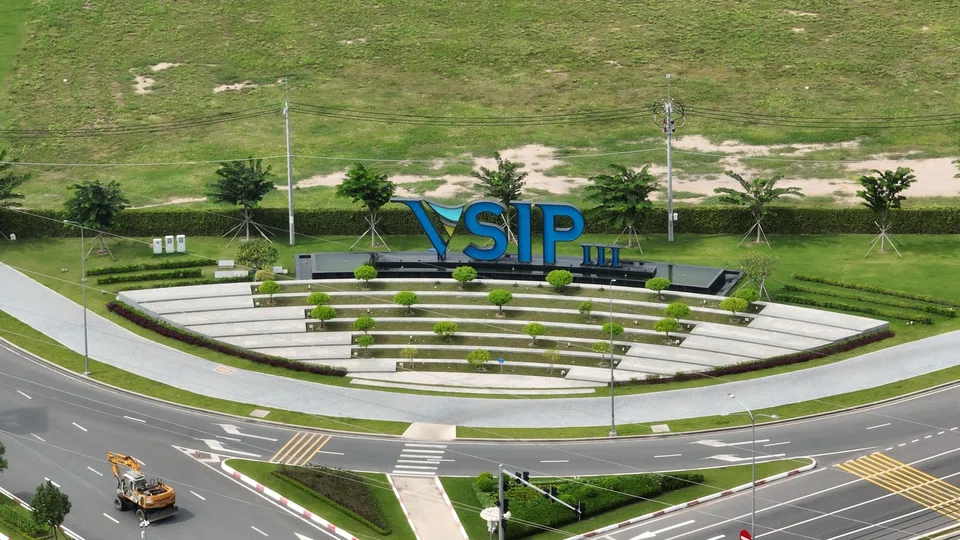
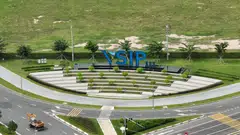
[SINGAPORE] The landmark Vietnam-Singapore Industrial Park (VSIP) initiative is adding four new parks across Vietnam, with a new advanced manufacturing research centre also slated for its premises.
These developments are part of seven deliverables announced on Friday (May 29) during Communist Party chief and Vietnam President To Lam’s four-day state visit to Singapore.
The increase brings the total number of industrial parks to 26, up from an earlier 22, and is in line with the city-state’s target to grow the figure to 30 by the year-end.
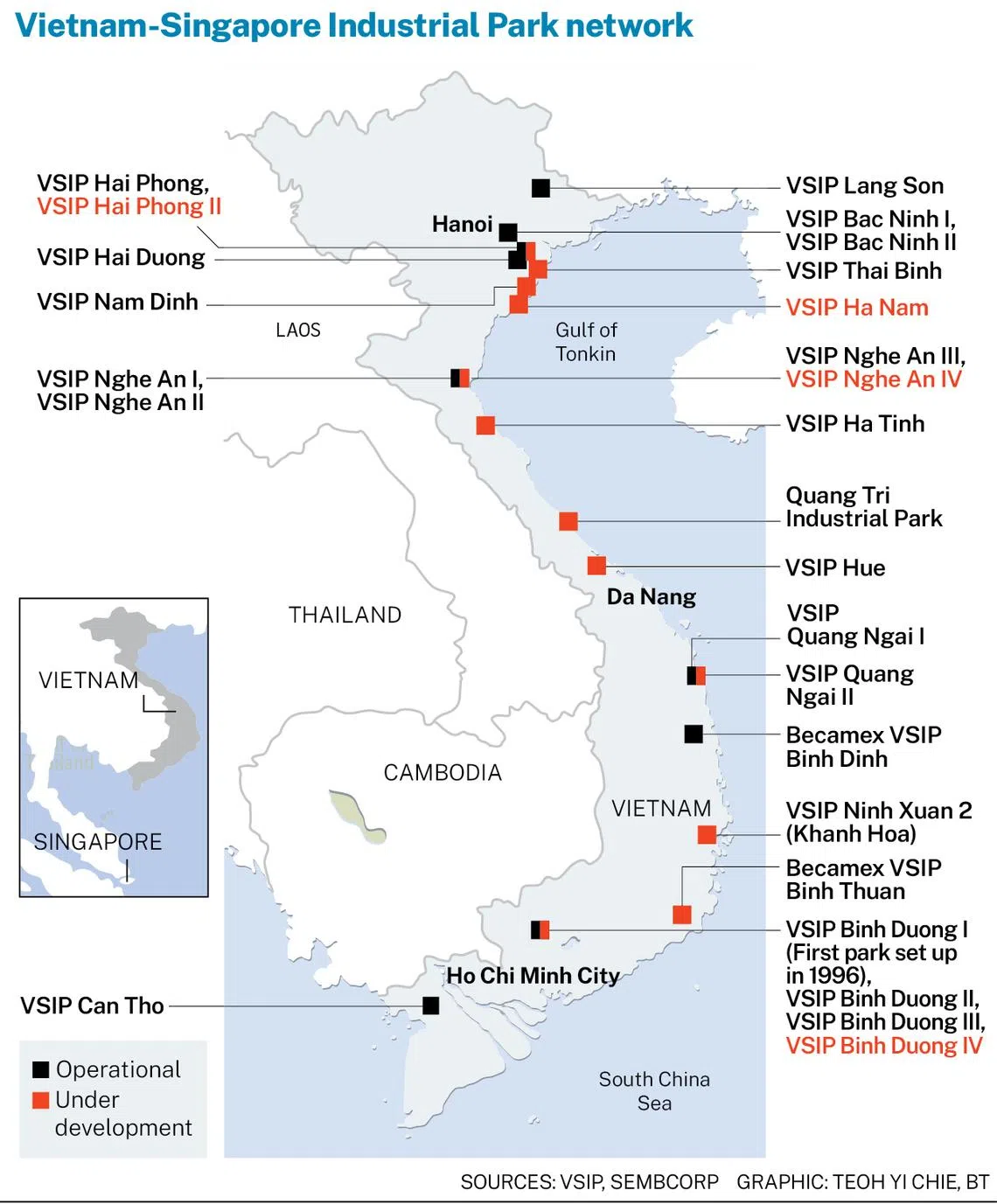
The VSIP network is a joint venture between Singapore’s Temasek-backed energy transition and urban development solutions provider Sembcorp Industries and Vietnam’s state-owned industrial park and township developer Becamex.
It stands as a flagship project of both countries’ economic cooperation.
The four new industrial parks are located in Nghe An province, Ninh Binh province, Ho Chi Minh City and Hai Phong city, based on Sembcorp’s information.
Newly approved VSIP developments
VSIP Hai Phong II
- About 252 hectares (ha)
- Second in Hai Phong, a leading industrial and port city in northern Vietnam
- Supports export-oriented industries through strong international connectivity within an integrated high-tech manufacturing and logistics
- Has eco-industrial approach to support demand for sustainable industrial spaces
VSIP Ha Nam Integrated High-tech Park
- About 630 ha
- In Ninh Binh province
- Focuses on R&D and supports advanced manufacturing sectors including electronics, semiconductors, biotechnology, pharmaceuticals and new materials
VSIP Nghe An IV
- About 80 ha
- Fourth VSIP in Nghe An province in central Vietnam
- Supports growth in electronics and precision manufacturing within an established industrial hub with a large working population and rising foreign direct investment
VSIP Binh Duong IV
- About 500 ha
- In southern Vietnam’s Ho Chi Minh City region
- Builds on the success of earlier VSIPs in the established industrial corridor to meet continued demand from manufacturers
- Focuses on integrating smart and low-carbon solutions
An advanced manufacturing research centre is also slated to be built within the VSIP ecosystem, under another memorandum of understanding (MOU) inked by Singapore’s Agency for Science, Technology and Research (A*Star) and Vietnam’s Becamex.
In response to queries from The Business Times, A*Star shared that the first phase of the development is targeted to begin this year, but would not comment on its exact location.
Under the agreement, both parties pledged to explore collaboration in developing model factories and testbeds within the VSIP to help companies pilot advanced manufacturing solutions, among others.
Becamex will lead the establishment and operations of the Vietnam Advanced Manufacturing Research Centre while A*Star will contribute research and development advice, as well as support the implementation of advanced manufacturing capabilities.
The centre will anchor Singapore-led research and innovation in the region, said a press statement.
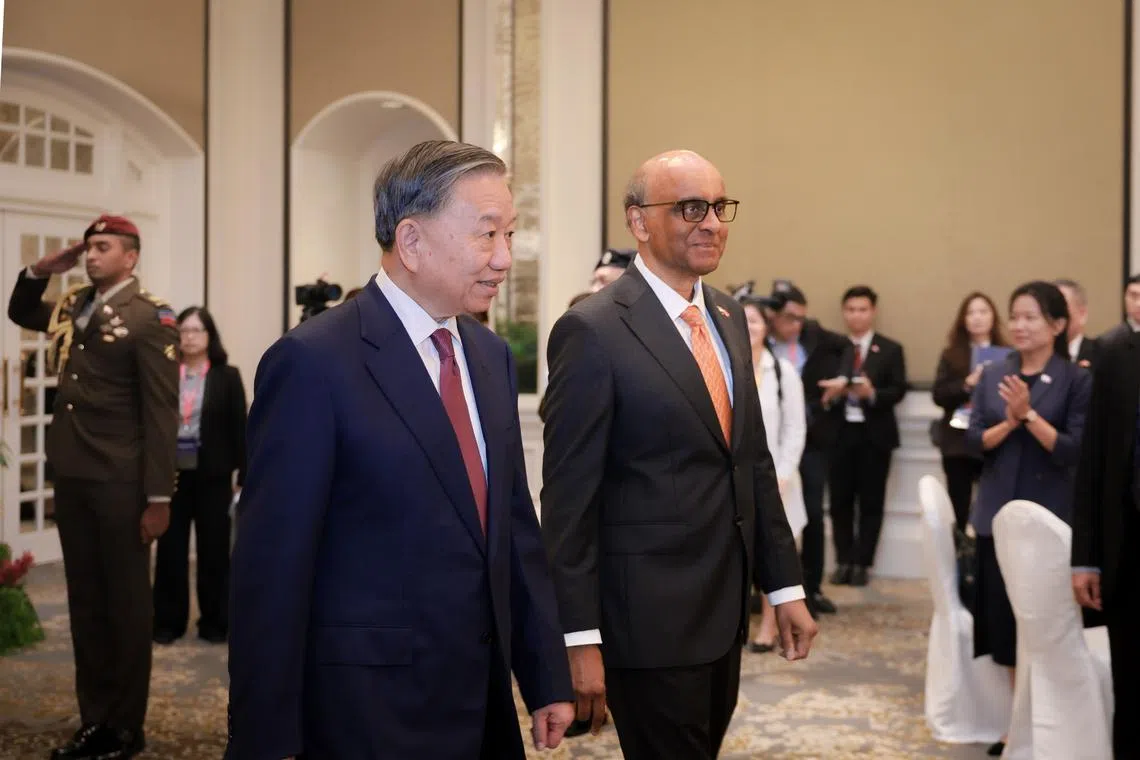
Singapore President Tharman Shanmugaratnam described the VSIP initiative as the anchor in the economic partnership of both countries, noting that this year marks its 30th anniversary.
He made the remarks in his toast speech at Friday’s state banquet – which he hosted in honour of Lam and his wife, Ngo Phuong Ly – adding that these parks create good jobs and attract high-value investments.
To date, the VSIPs drew more than US$28 billion in investments from some 1,000 tenants and created over 340,000 jobs in Vietnam. The VSIP portfolio of 26 industrial parks spans more than 14,300 hectares.
Both sides are working towards developing the next generation of the model – described as VSIP 2.0 – which will focus on integrated smart technology, as well as sustainable and green systems to attract higher-value investments.
Lam’s trip also saw investment registration certificates being awarded to two residential developments within the network.
Strategic dialogue
Both countries also agreed to jointly organise the Singapore-Vietnam Strategic Dialogue under the ambit of the Comprehensive Strategic Partnership which saw bilateral relations upgraded to the highest tier during Lam’s official visit earlier in March 2025.The inaugural forum will be hosted by Singapore in August.
The dialogue will be the first regular, high-level forum that brings together senior political office holders from both countries, and aims to promote such exchanges among leaders and senior officials on national development and bilateral cooperation matters.
The MOU to jointly organise the dialogue was signed by Singapore Coordinating Minister for Public Services and Minister-in-charge of the Public Service Chan Chun Sing, and Vietnam’s Foreign Affairs Minister Le Hoai Trung.
Food security cooperation
Another bilateral development was the establishment of the Singapore-Vietnam Agrifood Trade Task Force, by the Singapore Food Agency and Vietnam’s agriculture and environment ministry.
Both countries have been working towards this initiative, with the joint task force holding its inaugural meeting in Hanoi on May 11, said a press statement, adding that regular bilateral engagements under this platform are to follow.
The task force aims to strengthen food security and food safety cooperation, and address existing and emerging areas concerning bilateral food trade through focused and regular discussions.
Judicial cooperation
Both countries also agreed to cooperate in the development of a specialised international commercial court within the Vietnam International Financial Centre.
The MOU on judicial cooperation was signed by Justice Ang Cheng Hock of the Supreme Court of Singapore and Deputy Chief Justice Le Tien of the Supreme People’s Court of Vietnam.
It builds on a 2017 deal between both judiciaries and serves to deepen the existing framework of cooperation, said a Singapore Courts press statement on Friday.
The release noted that the memorandum reflects the city-state’s commitment to supporting Vietnam’s ambitions in developing a world-class international financial centre.
Higher-education cooperation
In the education field, Singapore’s Nanyang Technological University (NTU) and Vietnam’s education and training ministry inked an arrangement that enhances support for Vietnamese lecturers and administrators working in higher-education institutes to access the university’s existing doctoral research programmes.
NTU is the first university to establish such a partnership under Vietnam’s Project 89 initiative, which aims to develop a pool of qualified university lecturers through doctoral training and expand postgraduate research opportunities for Vietnamese students.
The university’s Nanyang Business School will be first to take in the scholars once the agreement comes into effect, said a media release.
Supply chain resilience
A joint statement on supply chain resilience by Singapore’s Minister-in-charge of Energy and Science and Technology Tan See Leng as well as Vietnam’s Minister of Industry and Trade Le Manh Hung was also issued on Friday.
Expressing serious concern over the ongoing situation in the Middle East and its implications for global peace and stability, both ministers reaffirmed commitment to working closely to manage the impact of the developments on the region.
Vietnam was Singapore’s 10th largest trading partner in 2025, with bilateral trade in goods reaching some S$40 billion. The city-state was Vietnam’s largest foreign direct investor in 2024, having injected nearly US$10.2 billion.
The ministers collectively reaffirmed the importance of freedom of navigation and overflight, as well as the right of unimpeded transit passage, in accordance with the United Nations Convention on the Law of the Sea.
Decoding Asia newsletter: your guide to navigating Asia in a new global order. Sign up here to get Decoding Asia newsletter. Delivered to your inbox. Free.
Copyright SPH Media. All rights reserved.
TRENDING NOW

DBS, OCBC, UOB rout lops billions off STI as inflation, rate concerns spook investors

Grab CEO’s wife Chloe Tong on life with Anthony Tan and finding her purpose

OCBC sheds S$8 billion in value as shares close nearly 6% down; analysts cautious on banks

Deal between tycoon friends sparks scrutiny of Philippine power sector

