



South-east Asia has weathered tariff uncertainty, but needs to integrate to prepare against future shocks: analysts
One issue raised at a seminar was the low utilisation rate of free trade agreements

[SINGAPORE] The initial fears of the economic fallout from US President Donald Trump’s “Liberation Day” tariffs in April last year have arguably not fully materialised, at least for South-east Asia.
But analysts speaking on the panel on navigating global uncertainties at a seminar organised by the Asian Development Bank (ADB) and the Iseas-Yusof Ishak Institute in Singapore noted that the current uncertain global economic environment is likely to persist.
They also said that the way forward for Asean should be a concerted effort to further integrate to support continued economic growth and resiliency.
“There’s a lot of noise in this system but we just can’t define what’s the signal,” said Eduardo Pedrosa, the executive director of the Asia-Pacific Economic Cooperation Secretariat. “The metaphor I would put forward is that we’re trying to tune the radio but we just can’t find the station.”
The uncertainty could also extend beyond trade, and more “nuanced and innovative” forms of protectionism could also emerge in other areas, such as people-to-people exchanges or in the digital sector, warned Amitendu Palit, senior research fellow and research lead for trade and economics at the Institute of South Asian Studies at the National University of Singapore.
The ADB also presented their annual Asian Integration report on Thursday at the seminar. The report noted Asian economies showed “great resilience” on the trade front as they adjusted to the constantly evolving environment, and added that “most Asean economies maintained robust export momentum – including to the US”.
That view that Asean and some Asian economies managed to weather the tariff uncertainty was also shared by the analysts at the panel discussion on navigating global uncertainties moderated by the ADB’s chief economist Albert Park.
The region and the wider Asia-Pacific have already made strides in integrating their economies, as noted by the ADB in its report.
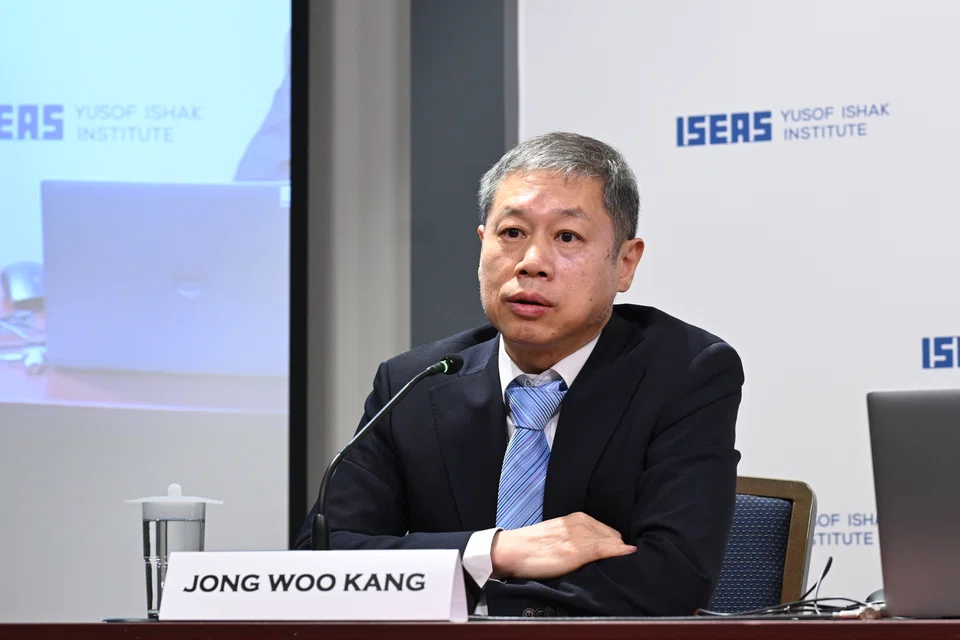
Kang Jong Woo, director for the regional cooperation and integration division at the ADB, noted that there is a low utilisation rate for the regional free trade agreements (FTAs) signed by Asian economies, due to various reasons including a lack of commitment.
Implementation and education regarding these FTAs could also be improved to encourage businesses to actually leverage them, said Elizabeth Chelliah, who has a trade consultancy role at the Singapore Business Federation and is a former principal trade specialist at Singapore’s Ministry of Trade and Industry.
She added that “Liberation Day” has ironically forced businesses to look into these FTAs to see how they can save their bottom lines.
Kang also said that besides utilising FTAs, cross-border digital transaction flows may also be affected by Asean’s heterogeneity in terms of digital regulation, as well as by the digital divide between countries and even between rural and urban areas.
However, he noted that the impending Asean Digital Economy Framework Agreement could help enhance regional integration in terms of digital regulations.
Kang also said mobility of high-skilled labour within the Asia-Pacific could be improved by embracing mutual recognition and skills recognition arrangements.
Decoding Asia newsletter: your guide to navigating Asia in a new global order. Sign up here to get Decoding Asia newsletter. Delivered to your inbox. Free.
Copyright SPH Media. All rights reserved.






