



Vietnam’s stock market liquidity dries up after VN-Index’s record run in May
Trading activity in the country’s equities has quietened significantly


[HO CHI MINH CITY] Vietnam’s stock market is losing steam after a stellar rerating sent its benchmark up more than 40 per cent in 2025 and to a record high last month, with trading activity plunging by more than half from the first-quarter average to levels last seen around 2020.
The VN-Index closed at about 1,791 points on Friday (Jun 12), up 0.4 per cent for the year and well below its mid-May record of more than 1,927 points, suggesting the earlier rally has lost momentum even as trading activity continues to dry up.
Nguyen The Minh, head of investment banking and deputy head of brokerage at ABS Securities, said that the weakness reflects a combination of prolonged geopolitical tensions, inflation pressure, high domestic interest rates and heavy foreign outflows.
Liquidity also has a seasonal element, he added, with June and July often being low points for trading activity. Average daily trading value dropped to about 17 trillion dong (S$829 million) over the past week.
On Thursday, daily trading value on the Ho Chi Minh City Stock Exchange (HoSE) slid to about 10 trillion dong, the weakest session since April 2025.
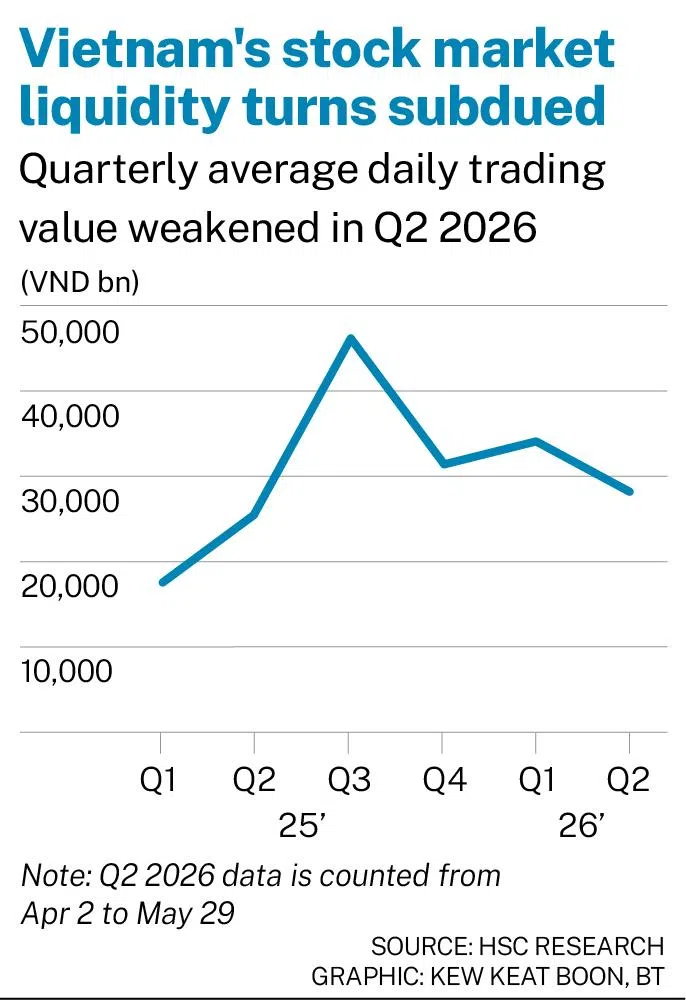
The pullback in liquidity had already begun even as the VN-Index hit a record high, with average daily trading value easing to around 28 trillion dong in April and May, from 35 trillion dong in the first quarter.
Retail interest slipping
Foreign investors offloaded close to US$2.9 billion of Vietnamese shares on the HoSE so far this year, after record net selling of about US$5 billion in 2025.
Sentiment in the domestic market, where retail investors play a significant role, has also been hurt by waning retail interest.
Ho Chi Minh City Securities (HSC) analysts wrote in their mid-2026 strategy note that individual investors have been reallocating capital towards alternative asset classes, particularly bank deposits and gold.
SEE ALSO




“Despite resilient corporate earnings and increasingly attractive valuations, stronger market participation has yet to materialise,” they said. “This shift reflects a preference for capital preservation and lower-risk assets amid ongoing uncertainty.”
Strong domestic retail participation was the main driver of the 2025 rally, fuelled by a sharp rebound from tariff-related shocks, optimism surrounding Vietnam’s market-upgrade prospects, and outsized gains in a handful of large-cap stocks.
Excluding the influence of Vin-related stocks including Vingroup, Vinhomes, Vincom Retail and Vinpearl, the VN-Index rose by just over 9 per cent last year.
Quan Trong Thanh, head of research at Maybank Investment Bank Vietnam, believes that retail investors are waiting for a clearer breakout, while institutional and foreign investors are waiting for stronger macro confirmation.
“The biggest macro variables affecting market liquidity are inflation and interest rates,” he said.
Vietnam’s annual inflation rate rose above 5 per cent in April and May, while domestic funding costs have also risen sharply this year.
Thanh believes the upgrade story remains a catalyst this year, but the real money may be visible only when Vietnam is actually added to FTSE emerging-market indices from September.
Investors are also watching whether MSCI – the more influential index provider – will place Vietnam on its emerging-market watch list in its June market classification review.
“Most of the bad news is being priced into June,” he said. “If the war in Iran eases, inflation peaks and then softens from the third quarter, and MSCI gives an upgrade signal – those three factors could help bring the market back to life.”
A mixed showing
The regional comparison also shows the gap.
The average daily trading value of Vietnamese stocks so far this year has reached around US$789 million, much weaker than that of peers such as Thailand (US$1.5 billion), Singapore (US$1.2 billion) and Indonesia (US$1 billion).
Still, the year-to-date figure is stronger than Malaysia’s US$694.5 million and the Philippines’ US$82.3 million.
The VN-Index has been among the weaker performers in the Asean-6 this year, although it has fared far better than Indonesia’s JCI Index, which has fallen by more than 30 per cent.
Thailand’s SET Index leads with a gain of about 24 per cent, followed by Singapore’s Straits Times Index, which is up 7.9 per cent.
The HSC analysts said that while the headline VN-Index has been “supported by the strong performance of the Vingroup-related stocks”, the broader market has “remained subdued”.
Many sectors and stocks, they added, are not reflecting their underlying earnings growth and valuation appeal.
Decoding Asia newsletter: your guide to navigating Asia in a new global order. Sign up here to get Decoding Asia newsletter. Delivered to your inbox. Free.
Copyright SPH Media. All rights reserved.
TRENDING NOW

GCash parent Mynt rises in market debut after South-east Asia’s top 2026 IPO

In the age of AI, what is a university education for?

Singapore to use ‘every legal and regulatory lever’ against companies linked to haze: Shanmugam

‘IPOs are not the only vehicle’: KKR heads for record exits even as firms stay private for longer

