



Vietnam seeks US$76 billion a year from capital markets to ease reliance on banks
Hanoi rolls out comprehensive capital-market reform to support high economic growth through 2045

VIETNAM is bundling long-promised capital-market reforms into a broader overhaul aimed at “a more balanced financial-market structure and reducing dependence on bank credit” to finance the country’s ambitious long-term growth targets.
The sweeping programme, signed by Deputy Prime Minister Nguyen Van Thang on Monday (Jul 27), brings banking, equities, bonds, insurance and emerging financial products under a single reform framework envisioned for 2045.
The country aims for funds raised through capital markets to average two quadrillion dong (US$75.95 billion) a year by 2030, and to account for 30 to 35 per cent of the country’s total realised social investment between 2031 and 2045.
This includes a target for businesses to raise 5.4 quadrillion dong through the stock market between 2026 and 2030 – a sum that is roughly twice that raised through that channel from 2020 to 2025.
The 2045 goal is to lift stock-market capitalisation to the equivalent of 120 per cent of gross domestic product, from 82.3 per cent at the end of 2025, going by official data.
By comparison, the proportion in 2025 stood at 66.4 per cent in Indonesia, 95.3 per cent in Malaysia, and 134.2 per cent in Singapore, CEIC Data indicated.
Vietnam also aims to nearly double outstanding bond value to 60 per cent of GDP by 2030, from 30.7 per cent at the end of 2025.
Corporate bonds alone accounted for just 11.4 per cent of GDP at the end of last year, falling well short of the government’s previous target of reaching 20 per cent by end-2025.
Tyler Nguyen, head of market strategy research at Ho Chi Minh City Securities (HSC), wrote in a note on Jul 28: “We have not seen such a strong policy directive focused on the capital market in quite some time, making this a welcome shift and signalling that capital-market development is now firmly on the national agenda.”
SEE ALSO





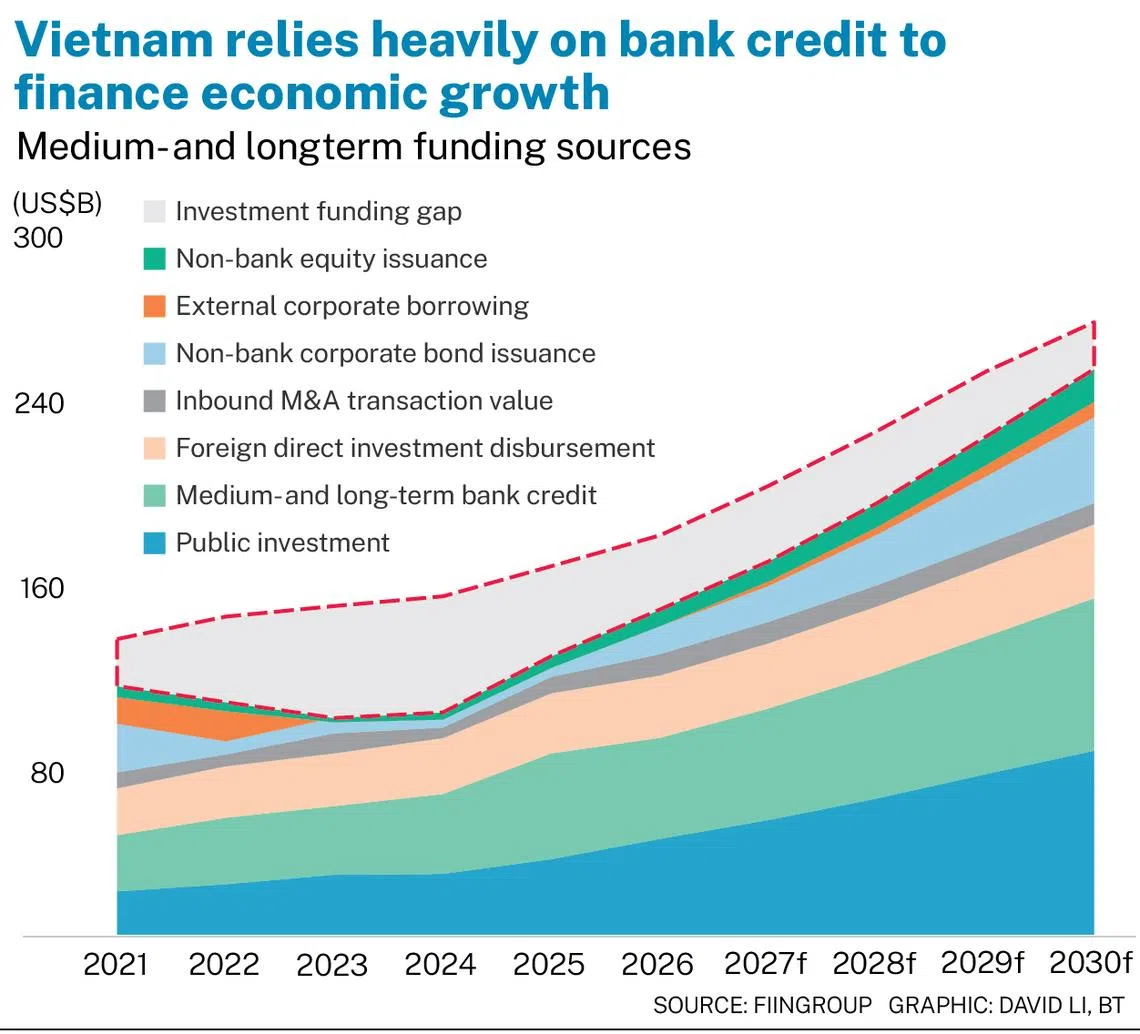
Vietnam’s economy has long relied heavily on bank lending, straining commercial banks as they shoulder much of the financing needed by companies and the large infrastructure projects underpinning the country’s double-digit growth ambitions.
The credit-to-GDP ratio had already hit 145 per cent in 2025, the highest in Asean, World Bank figures indicate.
Earlier this year, Hanoi-based financial service provider FiinGroup estimated that Vietnam would face an annual shortfall of US$20 billion to US$30 billion in medium- and long-term funding if it is to achieve GDP growth of more than 10 per cent over the next five years.
The firm noted in its Vietnam Economic Outlook 2026 report: “In this context, shifting capital mobilisation towards the capital markets, specifically the corporate bond and stock market, is essential to unlocking long-term funding... (and) a prerequisite for achieving high, sustainable economic growth in the coming years.”
New products and market infrastructure
The government’s programme pushes for the listing of companies established through foreign direct investment, along with expedited state divestments and the introduction of index options, futures and single-stock options in the derivatives market.
It also plans to roll out a central counter-party (CCP) clearing mechanism for the stock market in 2027, operate pilot markets for crypto assets and carbon credits, as well as establish a specialised trading platform dedicated to innovative startups.
Other measures include exploring a gold exchange and a central bank digital currency under a drive to broaden products in the country’s monetary and credit markets.
The government also wants to modernise the banking system by developing several large-scale lenders capable of competing regionally and fully adopting Basel III – a more comprehensive and stringent set of international banking standards.
It also envisages greater use of technologies such as artificial intelligence for the delivery of banking products, supervision and the collection and processing of credit information.
The insurance sector is expected to play a larger role as a source of long-term capital. The government wants the market’s revenue to reach the equivalent of 3.3 to 3.5 per cent of GDP by 2030, and to expand at an average annual rate of 6 to 8 per cent through 2045.
The authorities will look into allowing insurers to invest in infrastructure bonds and real estate investment trusts (Reits).
Meanwhile, the government also plans to diversify its bond offerings, including green, sustainability-linked and floating-rate instruments, to strengthen its fundraising capacity.
The breadth of the programme marks a shift from previous initiatives that dealt separately with areas such as financial-sector strategy, developing a dual-city international financial centre and the pursuit of emerging-stock-market classification.
Nguyen The Minh, who heads investment banking at An Binh Securities (ABS), compared Vietnam’s strategy with lessons from the capital-market reforms of Malaysia, South Korea and India.
Malaysia sought to reduce its reliance on bank financing after the Asian financial crisis in 1997; South Korea overhauled its financial system following excessive corporate borrowing in the 1990s, and India modernised its capital markets after its 1991 balance-of-payments crisis.
Minh wrote in a Jul 29 note: “Judging from the successful experiences of Malaysia, South Korea and India, the approval of the programme is only the beginning.
“The biggest obstacle – and the factor that will determine its success or failure – is the speed of institutional implementation.”
Building an institutional-investor base
One of the more notable changes in the latest programme is the greater attention paid to the composition of investors, reflecting efforts to reduce a market structure still dominated by domestic retail investors.
Under the programme, by 2030, the government wants foreign investors’ assets in Vietnam’s capital markets to reach about 15 per cent of GDP.
Net assets held by stock investment funds are targeted at 5 per cent of GDP, while total pension-fund assets are expected to grow by an average of 11.5 per cent a year between 2026 and 2030.
It also aims to make it easier for foreign investors to open accounts, convert currencies and repatriate profits, while gradually broadening their access to the Vietnamese market.
Vietnam plans to lift its corporate-governance standards out of the lowest-ranked group in Asean by 2030; it also wants to expedite the adoption of International Financial Reporting Standards (IFRS) to “enhance transparency, international comparability and support the attraction of long-term foreign investment”.
ABS’ Minh cited Vietnam’s planned adoption of CCP infrastructure and IFRS as “prerequisites” for attracting large pools of foreign capital, including from pension funds and sovereign wealth funds.
“The development of robust pension-fund systems and domestic investment funds provides a stable liquidity base and curbs herd behaviour among retail investors,” he added.
He also called for forceful enforcement and greater transparency, citing the strict sanctions imposed by regulators in South Korea and India against market manipulation and accounting fraud.
HSC’s Nguyen struck a similar note, saying the policy direction alone was unlikely to trigger a sustained rerating of Vietnamese assets.
The benchmark VN-Index has fallen 4.5 per cent in the year to date, after surging more than 40 per cent in 2025. Foreign investors have also net sold about US$3.5 billion in Vietnamese shares so far this year.
“The (policy) direction is encouraging, but the market will ultimately look for concrete policy actions and execution milestones before pricing it in as a meaningful catalyst,” he said. THE BUSINESS TIMES
Decoding Asia newsletter: your guide to navigating Asia in a new global order. Sign up here to get Decoding Asia newsletter. Delivered to your inbox. Free.
Share with us your feedback on BT's products and services
TRENDING NOW

Grab CEO’s wife Chloe Tong on life with Anthony Tan and finding her purpose

Hwa Seng Builder, two China companies win S$1.2 billion Tuas Road Viaduct phase two contracts

Deal between tycoon friends sparks scrutiny of Philippine power sector

Canada is upping oil flows to Asia, but South-east Asia’s refineries aren’t ready to handle them yet

