



Vietnam-Singapore partnership seen as catalyst for scaling sustainable innovation
Singapore-backed initiatives such as UniVentures strengthen bilateral ties by preparing Vietnamese startups for regional expansion

[HO CHI MINH CITY] Closer alignment between Vietnam and Singapore is emerging as a critical lever to scale sustainable innovation beyond domestic markets, as companies and investors seek models that combine climate goals with commercial returns.
Moderating a panel at the UniVentures gala dinner in Ho Chi Minh City on Thursday (Jan 29), The Business Times editor Chen Huifen opened the discussion on Vietnam-Singapore innovation integration, noting that Singapore is often described as a hub for capital and global logistics and Vietnam as an engine for manufacturing and resources – two systems that work only if “the gears are properly meshed”.
Dang Huynh Uc My, chairwoman of agriculture group TTC AgriS and food producer Betrimex, said that deeper integration requires Vietnamese companies to be proactive instead of waiting for foreign capital to flow in.
“With AgriS, we have come out of Vietnam to invest into Australia, Singapore and other countries,” she noted, citing more than a decade of working with Singapore government agencies and programmes.
Since 2011, AgriS has operated a trading hub in Singapore, using it to refine governance and data systems and enable its sugar to reach global commodity exchanges in London and New York, My pointed out.
“What happens commercially in Vietnam needs the attention and support of what sits behind merchandising in Singapore,” she added, underlining that the partnership could help introduce a competitive Asian model, particularly to bring agricultural products made locally to international markets.
Lim Hwee Hua, chairwoman of Singapore investment firm Tembusu Partners and a former minister in the Prime Minister’s Office, highlighted governments’ critical behind-the-scenes role in making such integration work.
Singapore’s experience shows the value of a whole-of-government approach, she said, including dedicated agencies for business incorporation, electronic registration systems, English-language processes and clearly defined grants and support programmes.
Need for a sound business case
The other key question for investors is how sustainable innovations can be scalable beyond domestic markets. While capital exists, Lim noted that execution is often hampered by weak business cases. “Everyone still needs a sound business case, with clear rates of return and profit projections,” she said.
SEE ALSO

Nguyen Do Dzung, co-founder and chief executive officer of agritech startup EnFarm, agreed, stressing that startups must first prove unit economics at the deployment level to secure funding. “You need to make sure that you can make money, control costs and know how to do it at scale,” he explained.
In agriculture, he added, profitability also depends on integrating the entire value chain. Partnerships with larger players such as AgriS can give startups access to systems that “improve the whole value chain, connecting farm output to markets at scale”.
Dzung said structured cross-border programmes can also help close the gap. His firm graduated from an incubation programme led by Block71, an initiative of National University of Singapore (NUS) that operates 11 hubs globally, including one in Ho Chi Minh City.
“I hope to see more (programmes and competitions) linked to procurement opportunities, especially in areas where Vietnam has scale and Singapore can benefit directly, such as food production,” he noted.

Structured platform
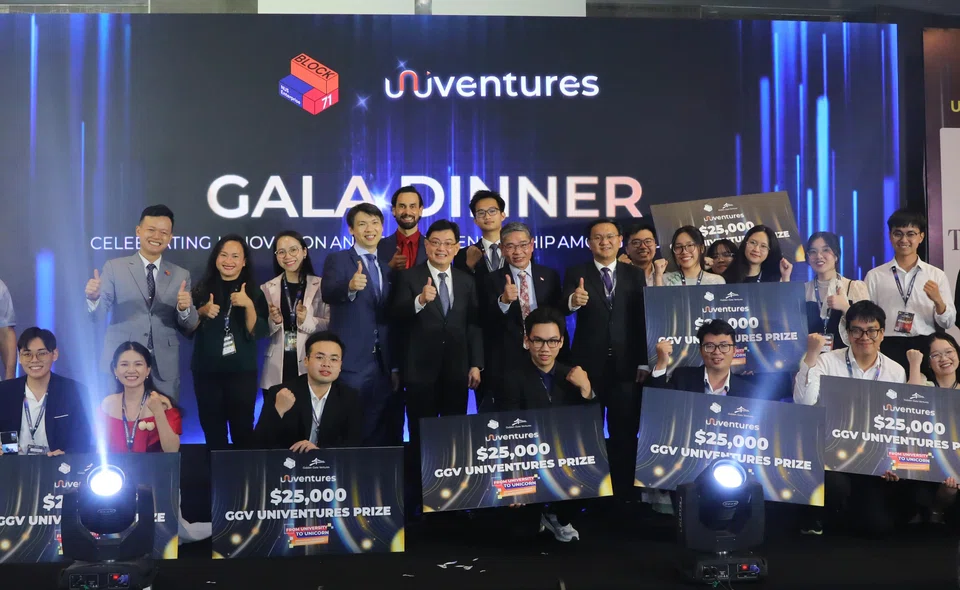
At the gala dinner, 10 Vietnamese university-linked startups were named winners of UniVentures, a regional startup programme led by Block71 in partnership with Temasek Foundation.
The teams, representing nine universities across Vietnam, shared prizes totalling US$250,000 funded by Singapore-headquartered venture capital firm Golden Gate Ventures; they will enter a three-month incubation programme at Block71 Vietnam.
Participants will receive co-working spaces, mentorship and structured training focused on product-market fit, commercialisation strategies and fundraising readiness.
A subsequent phase of UniVentures will involve another round of selection for teams prepared to expand regionally, including follow-on incubation opportunities through Block71 Singapore.
“With the right mindset, capabilities and networks, they can build companies that create real economic value for Vietnam and the region,” said Edward Lim, Vietnam country director for NUS Enterprise and Block71 Vietnam. “The response, close to 1,500 applications (to UniVentures), reflects both the depth of talent and the growing role of universities as engines of innovation.”
Vietnam’s startup ecosystem is entering a new phase of maturity, said Vinnie Lauria, founding partner at Golden Gate Ventures. He added that founders are becoming more focused on solving concrete problems aligned with market demand. “UniVentures provides a structured platform that brings together capital, mentorship and regional exposure to help them grow beyond their home market.”
Deepening ties
In March 2025, Vietnam and Singapore elevated ties to a Comprehensive Strategic Partnership – the highest tier in Vietnam’s diplomatic hierarchy and the first of its kind for Singapore with an Asean member state.
On the occasion, UniVentures was unveiled by National University of Singapore (NUS) president Tan Eng Chye during a meeting with Vietnam’s Communist Party chief To Lam, signalling high-level institutional commitment to strengthening bilateral innovation cooperation.
The programme reflects a broader push to integrate universities more closely into national startup ecosystems, particularly in emerging markets such as Vietnam. It particularly targets founders drawn from universities, including students, alumni and researchers developing practical, market-ready solutions to regional challenges.
Priority sectors include healthcare access, environmental sustainability, workforce productivity and skills development, and financial literacy.
Professor Benjamin Tee, vice-president for innovation and enterprise at NUS, said: “By anchoring this unique early-stage incubation programme in Vietnam and giving high-potential teams the chance to scale in Singapore and globally, we continue to enhance our Singapore-Vietnam partnership for bilateral innovations to flow between the two countries.”
UniVentures also showcased strong public-private alignment in promoting cross-border innovation.
In a keynote address, Heng Swee Keat, chairman of Singapore’s National Research Foundation and former deputy prime minister, reaffirmed Singapore’s commitment to collaboration with Vietnam.
“Singapore and Vietnam can do more together because our strengths are complementary,” he said, highlighting Vietnam’s scale, talent and dynamism alongside Singapore’s connectivity to regional and global markets, access to capital, research commercialisation pathways and corporate partnerships.
Heng pointed to initiatives such as The Business Times’ expansion through BT Global, which tells South-east Asia’s growth stories through a regional lens and provides intelligence and insights to help businesses and investors make informed decisions and meaningful impact.
“In a more fragmented global economy, South-east Asia needs to work more closely to be resilient,” he added. “Singapore will continue to be a trusted partner for Vietnam and build win-win opportunities across the region.”
Decoding Asia newsletter: your guide to navigating Asia in a new global order. Sign up here to get Decoding Asia newsletter. Delivered to your inbox. Free.
Copyright SPH Media. All rights reserved.






