To Lam retains Vietnam’s top job in pivotal leadership refresh
At least two other leaders will no longer be part of the country’s four ‘pillars’ of collective power structure in the next five-year term
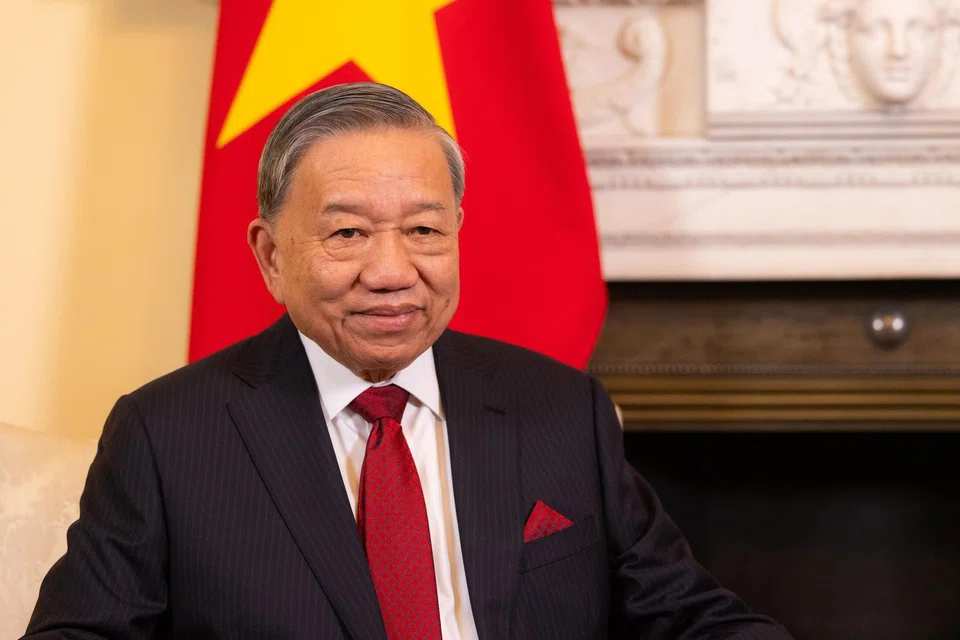
VIETNAM’S ruling Communist Party confirmed To Lam as general secretary for the 2026-2031 term, cementing his position as the country’s most powerful figure.
It also signals continuity for a pro-growth reform agenda aimed at strengthening Vietnam’s status as one of Asia’s fastest-growing economies and achieving high-income status by 2045.
The decision came at the conclusion of the 14th National Party Congress in Hanoi on Friday (Jan 23), a tightly choreographed twice-a-decade political event where top leadership cohorts and five-year development strategies are decided.
President Luong Cuong and Prime Minister Pham Minh Chinh – along with most deputy prime ministers – did not secure positions on the new 200-seat Central Committee, meaning they will not continue in key leadership roles for the next five years.
Their terms will formally end in April 2026, when the 16th National Assembly convenes in a largely procedural step to approve the replacements nominated from the 19-member Politburo – the Communist Party’s highest decision-making organ which has also been elected by the newly formed Central Committee.
“This is not incremental change,” Nguyen Phuong Linh, lead analyst for South-east Asia at global specialist risk consultancy Control Risks, wrote in a recent commentary, noting that power has concentrated with the dominance of Lam.
“But the point is not ideological victory. It is to tighten control, narrow internal disagreement and impose discipline across the system after a long period of economic strain and declining legitimacy,” she added.
How powerful is To Lam?
At the congress opening, Politburo member and standing member of the party secretariat Tran Cam Tu, the fifth highest-ranking official in Vietnam’s political hierarchy, described the general secretary as “the nucleus of leadership”, “the centre of unity” and “a model who inspires trust and mobilises the strength of the entire party, political system and nation”.
Lam, 69, first assumed the top party post in August 2024 following the death of long-time leader Nguyen Phu Trong.

The general secretary is the de facto highest official in Vietnam’s political system, a role that became increasingly dominant under Trong’s 13-year tenure. Trong had expanded the position’s authority through a far-reaching anti-corruption campaign known as the “Blazing Furnace”.
Lam, as a former public security minister under Trong, had orchestrated much of that campaign, which targeted high-profile figures across the party, government, as well as state-owned and private sectors for short-comings and violations.
Over the past 18 months in the top post, he has also launched a broad overhaul of the state apparatus, cutting layers of bureaucracy, merging administrative units, pushing for faster policy execution, boosting private-sector roles, and pursuing industrial policies aimed at moving Vietnam beyond low-cost manufacturing.
These reforms accelerated in the year leading up to the congress – a period when policy execution usually slows. The reappointment of Lam gives him a clear mandate to shape Vietnam’s political and economic direction through the end of the decade.
“The direction is clear: faster, more executive-style reforms and a stronger mandate to implement the restructuring he’s already started,” said Nguyen Khac Giang, visiting fellow at Iseas-Yusof Ishak Institute’s Vietnam Studies Programme.
“The real challenge is execution: keeping momentum without creating policy whiplash,” he added.
Leadership transition elsewhere
Vietnam has long maintained a tradition of collective leadership across its top four positions – general secretary, state president, prime minister and National Assembly chair – ensuring no single individual dominates.
Along with Lam’s re-election as general secretary, standing member of the party secretariat Tu has also retained his post, which has recently been elevated to create the “five-pillar” leadership structure.
With at least two of the other three top posts set to be replaced, some expect new appointees to emerge to preserve the balance of power for operational continuity and leadership sustainability, while others forecast that Lam could take on the state presidency and further consolidate authority.
The president represents the state on the international stage and, as commander-in-chief of the armed forces, is traditionally backed by the military.
President Cuong, a senior military figure, was appointed in October 2024, two months after Lam became party chief, reflecting a delicate power-sharing arrangement between Lam’s public security network and the military.
“For business and investors, the real issue isn’t factional balance, but how decisions are tested and adjusted in practice,” Control Risks’ Linh said. “As authority concentrates, decisions may come faster. The real test is whether the system can still surface problems and correct course when things go wrong.”
Meanwhile, Chinh became prime minister in 2021 after serving as head of the Central Organization Commission and deputy public security minister.
He successfully navigated a turbulent term marked by the Covid-19 pandemic and rising geopolitical tensions that threatened Vietnam’s export-oriented economy. The departures of top leaders, including former presidents Nguyen Xuan Phuc and Vo Van Thuong and former National Assembly chair Vuong Dinh Hue, added further complexity to domestic governance.
Despite the convergence of unprecedented headwinds, Chinh has won general public support for his deft handling of foreign affairs as well as approachable style.
Although he began with limited experience in national governance, Chinh has led the government to deliver strong economic results, culminating in Vietnam’s 8 per cent growth in 2025, partly driven by a infrastructure push including the completion of more than 3,000 km of expressways and Long Thanh International Airport, as well as addressing energy bottlenecks.
“Under his leadership, Vietnam has achieved the most significant infrastructure development progress in decades,” said Quan Trong Thanh, head of research at Maybank Securities Vietnam. “It has created momentum that is likely to carry forward into the next phase.”
Next five-year agenda
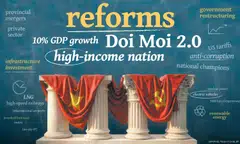
The political transition coincides with Vietnam’s most aggressive development agenda since the Doi Moi liberalisation of the 1980s, against a backdrop of rising trade uncertainty and geopolitical tensions.
Party documents highlight the position of the private sector as a key growth engine for the coming phase, with a focus on cultivating large, competitive Vietnamese conglomerates, while state-owned enterprises are expected to play a leading role in guiding and orienting strategic direction.
“Vietnam isn’t choosing between state and private, it’s trying to run a dual-track system,” noted Giang, pointing to state-owned enterprises (SOEs) being framed as “pillars” in strategic sectors while the private sector is expected to drive dynamism.
“Whether that balance works depends on implementation – especially governance, competition and whether SOEs crowd out private capital,” he added.
Vietnam also plans to invest heavily in emerging industries such as semiconductors, automation and robotics, as it seeks to move up the global value chain.
All this is in pursuit of an ambitious economic blueprint targeting annual growth of at least 10 per cent over the next five years and gross domestic product per capita of US$8,500 by the end of 2030, from about US$5,000 in 2025. “The global economic and geopolitical uncertainties have pushed not only Vietnam but many countries to realise they need to build internal strength to safeguard sovereignty,” said Maybank’s Thanh.
“Slowing down would mean losing momentum. I believe that reform momentum is now in place in Vietnam and must continue with even greater public feedback and faster policy responses in the coming period.” THE BUSINESS TIMES
Decoding Asia newsletter: your guide to navigating Asia in a new global order. Sign up here to get Decoding Asia newsletter. Delivered to your inbox. Free.
Share with us your feedback on BT's products and services