Vietnam’s domestic chip push gains ground as Viettel, FPT unveil new capabilities
Viettel launches domestically designed security chip platform; FPT starts trial operations at testing plant
VIETNAM’S Viettel Group and FPT Corporation unveiled new semiconductor design and testing capabilities on Tuesday (Nov 3), marking progress in the South-east Asian nation’s efforts to build a domestic chip industry and reduce its dependence on foreign technology.
Military-run Viettel and the Government Cipher Committee (GCC) unveiled what they described as Vietnam’s first domestically developed security semiconductor platform, alongside a security chip built using a mature 28-nanometre manufacturing process.
Separately, FPT began trial operations at a semiconductor testing facility in northern Bac Ninh province – about 30 km north-east of Hanoi – with a maximum designed capacity of 300 million chips annually.
The developments highlight efforts by Vietnamese companies to expand their presence across different stages of the semiconductor supply chain, from chip design to testing and packaging.
This is as the government seeks to strengthen domestic capabilities in a strategically important industry still dominated by foreign-invested firms.
Earlier in January, Viettel and FPT announced plans to jointly develop artificial intelligence chips for cameras, drones and other smart devices, as part of a broader partnership spanning semiconductor design, manufacturing, testing and packaging.

Viettel is also developing what is intended to be Vietnam’s first domestic semiconductor wafer fabrication plant in Hanoi, with trial production targeted for 2027 and full operations by 2030.
Security chips for strategic applications
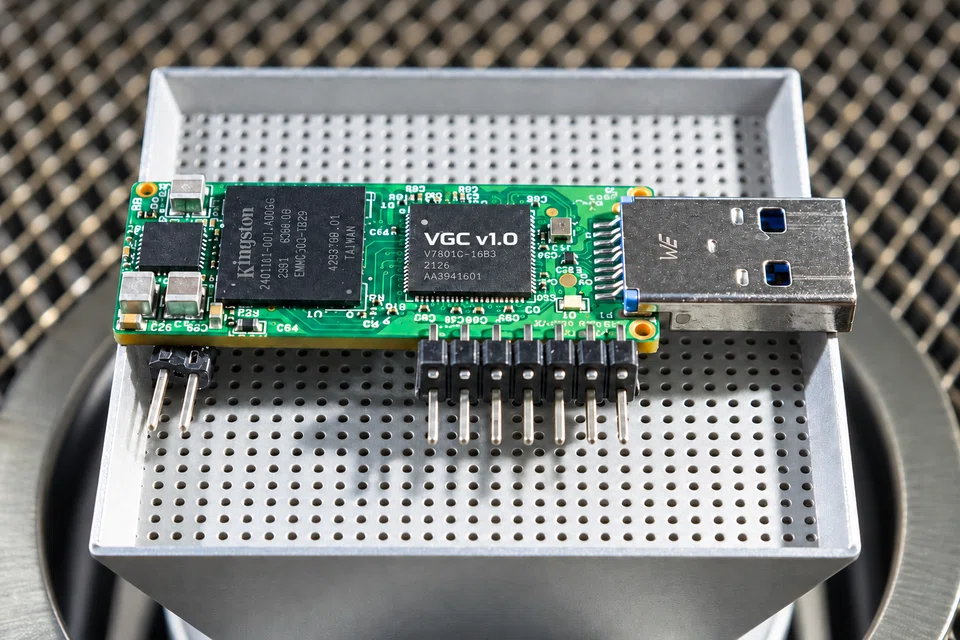
Viettel’s security chip, known as VGC v1.0, incorporates Vietnamese-developed cryptographic algorithms directly into its hardware, allowing sensitive data to be encrypted and decrypted without relying solely on software.
The approach is intended to strengthen domestic control over sensitive data security, and address concerns about potential vulnerabilities associated with imported chips.

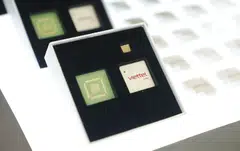
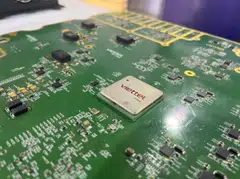
The chip, containing 300 million transistors and housed in a 10 by 10 mm package, is designed for government and defence applications. Its developers said tests showed it could encrypt and decrypt data about 15 times faster than a software-only solution performing the same tasks.
The chip has already been deployed in secure USB storage devices used by government and defence agencies, the company said. Viettel plans to expand its use to applications supporting Vietnam’s national digital signature certification system, which currently has more than two million digital certificates in circulation.
Meanwhile, the security semiconductor platform, developed jointly by Viettel and GCC, uses the open-standard RISC-V instruction set architecture. This allows Vietnamese engineers to independently design and modify processors while retaining control over core design and verification processes.
Viettel said its engineers had also developed safeguards to protect the chip design before transferring it to a semiconductor foundry, to reduce the risk of information leakage and reverse engineering.
Viettel and GCC also signed an agreement on Tuesday to develop plans for volume production of VGC v1.0 and work on a multicore security chip platform incorporating dedicated cryptographic components. The partnership also covers technical testing and training semiconductor engineers.
Viettel plans to expand its semiconductor design capabilities to develop chips for both civilian and military applications, including AI, 6G telecommunications, smart cameras, drones and robotics, as part of efforts to reduce Vietnam’s reliance on imported semiconductors.
“Being a latecomer does not mean accepting dependence on others,” Viettel chairman and CEO Tao Duc Thang said.
“With the right strategy, focused resources and sustained commitment, we can progressively close the gap and ultimately gain control over technologies of strategic importance to our country.”
In October 2023, Viettel unveiled its first domestically designed 5G digital front-end chip, designed to handle signal processing and control functions in 5G base stations.
Building domestic testing capacity
Meanwhile, FPT’s new testing facility builds on its existing semiconductor design capabilities, including the development of specialised chips for Internet of Things and AI applications.
This is as the company seeks to expand its presence across the chip value chain and strengthen Vietnam’s role in global semiconductor supply chains.
The 1,600 sq m testing facility at Yen Phong II-C Industrial Park features six testing lines equipped with automated systems to assess chip functionality, quality and reliability.
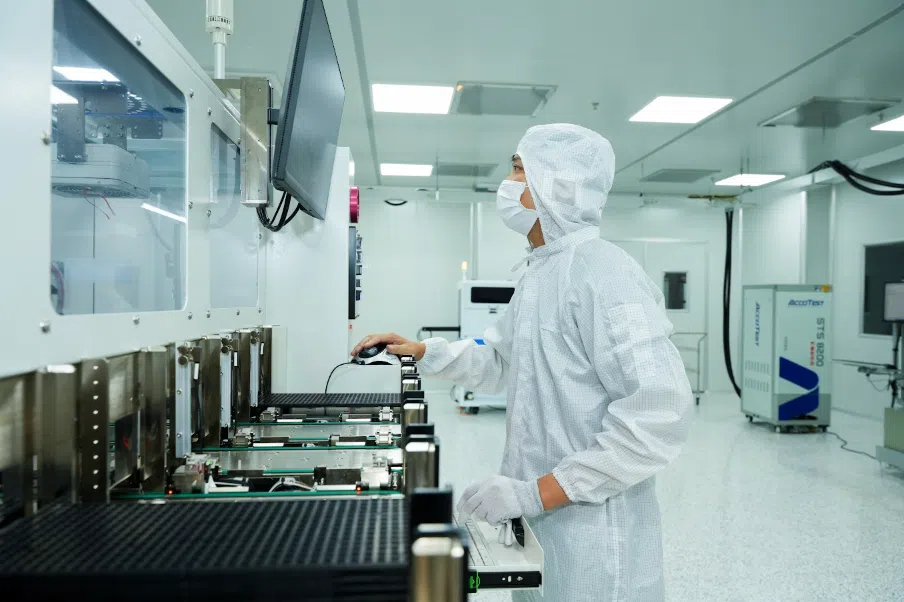
FPT expects to undertake its first chip-testing order for a South Korean partner during the initial operating phase, aiming to serve both domestic and international semiconductor companies.
The company said its engineers are developing customised testing programmes for different chip designs and researching the use of AI to automate testing processes. It also plans to expand into more advanced testing and packaging technologies.
The new facility is expected to support workforce development as well, with practical training programmes for students planned from December.
The missing piece: wafer fabrication
Vietnam has emerged as a growing hub for semiconductor design, assembly, testing and packaging, with chip-design operations by companies including Marvell Technology, Synopsys and Renesas Electronics.
These are alongside major assembly and testing investments from US-based Intel and Amkor Technology, as well as South Korea’s Hana Micron.
More recently, Samsung Electronics outlined plans to invest up to US$4.1 billion in memory-chip testing facilities, while its affiliate Samsung Electro-Mechanics announced a US$1.9 billion expansion of semiconductor substrate production.
LG Innotek is also developing a US$1 billion semiconductor substrate plant in the northern port city of Hai Phong.
However, Vietnam has yet to house a semiconductor wafer fabrication plant.
Citing people familiar with the matter, Reuters reported on Oct 26 that Viettel’s US$1.3 billion semiconductor fabrication plant was unlikely to meet its 2027 target, with construction yet to begin and negotiations over lithography equipment from Dutch supplier ASML still unresolved.
Viettel, however, maintained that the project was progressing according to schedule.
The Ministry of Science and Technology said that as at late 2025, Vietnam had about 60 chip design companies, eight semiconductor packaging and testing projects, and more than 20 suppliers of semiconductor materials and equipment.
Under its national semiconductor strategy, Vietnam aims to expand its ecosystem to at least 100 chip design companies, one small-scale fabrication plant, and 10 packaging and testing facilities by 2030.
Longer-term targets for 2050 include 300 design companies, three fabrication plants and 20 packaging and testing facilities. THE BUSINESS TIMES
Decoding Asia newsletter: your guide to navigating Asia in a new global order. Sign up here to get Decoding Asia newsletter. Delivered to your inbox. Free.
Share with us your feedback on BT's products and services