



Vietnam’s stock-market rally has one name behind it
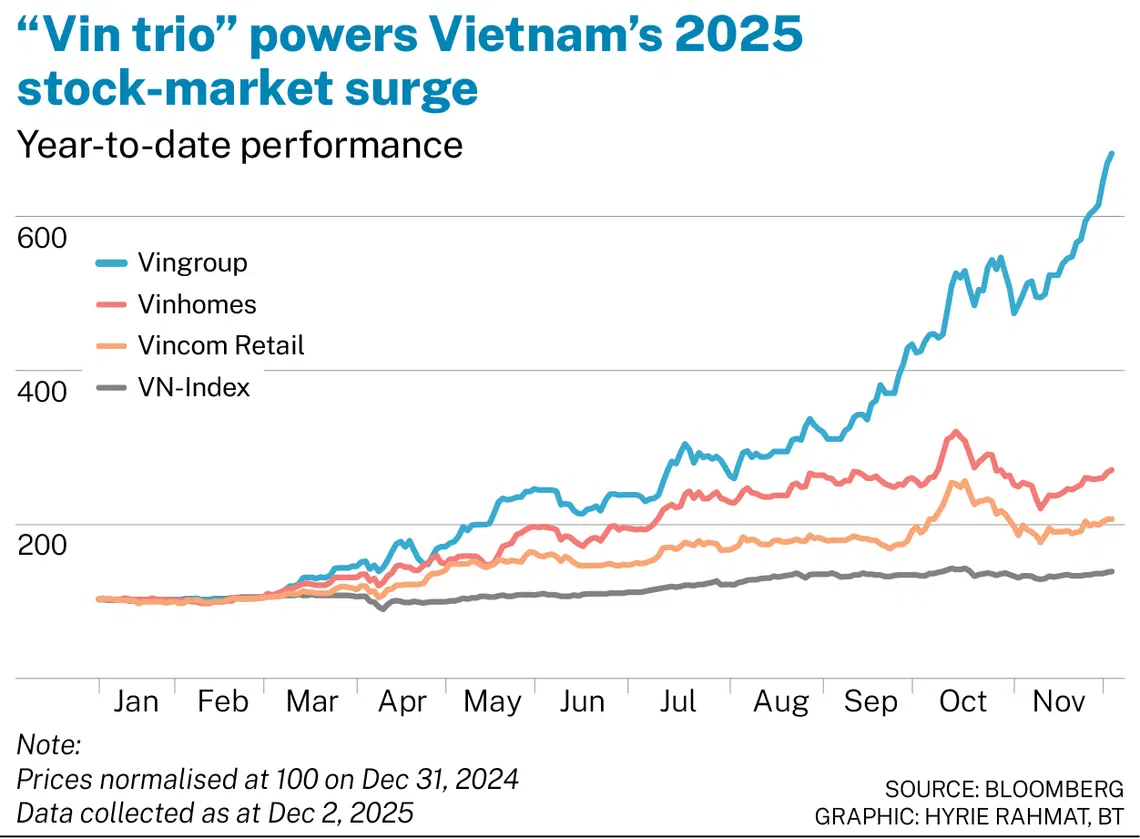
Vingroup and its two listed offshoots are behind much of the VN-Index’s 36% gain this year


[HO CHI MINH CITY] Vietnam’s stock market may be the region’s star so far this year, but its shine mainly comes from a single source – Vingroup, whose companies are behind about three-fourths of the key VN-Index’s gains.
Strip out Vingroup and its two listed subsidiaries – Vinhomes, Vietnam’s biggest property developer, and Vincom Retail, the country’s largest mall operator – and the benchmark’s 35.6 per cent rally so far this year shrinks to just about 9 per cent.
While news of Vietnam’s soon-to-be-upgraded stock market, upbeat macro prospects and better-than-expected outcome of the trade pact with the US have also helped lift the benchmark index, the rally owes far more to the outsized gains in the Vin-related counters.
Together, the “Vin trio” make up more than a fifth of the Ho Chi Minh City Stock Exchange’s total market capitalisation.
Vingroup – the country’s largest private conglomerate – alone accounts for about 14 per cent of the exchange’s current market value.
This followed a rally that sent its share price soaring nearly seven times in the year to date, and pushed its market value past the 1,000-trillion-dong (S$49.3 billion) on Nov 28 – the first Vietnamese company to cross that threshold.
Its founder and chairman Pham Nhat Vuong has now been listed among Forbes’ top 100 wealthiest individuals in the world, with a net worth of close to US$25 billion as at Dec 2.
Heavy reliance on the “Vin trio”, however, makes VN-Index returns particularly sensitive to any correction in these stocks in 2026, said Quan Trong Thanh, head of equity research at Maybank Investment Bank Vietnam.
Meanwhile, Tyler Nguyen, chief market strategist at Ho Chi Minh City Securities Corporation (HSC), said in a note on Nov 20 that excluding Vingroup-related stocks, Vietnam’s economic outlook and the relative valuations of VN-Index constituents remain attractive over a four to six-month horizon.
What is driving the euphoria?
Since the middle of this year, market chatter has grown around Vingroup’s interest, through its railway arm VinSpeed, in vying for Vietnam’s US$67 billion North-South bullet train project. The planned railway line will run the length of the country and link its two largest metropolises – Hanoi and Ho Chi Minh City.
Set up in May 2025, VinSpeed has also sought opportunities in two other proposals: high-speed routes connecting Hanoi to the northern province of Quang Ninh, and downtown Ho Chi Minh City to the coastal area of Can Gio.
Some market observers say participation in these projects could open the door for Vingroup to expand its land bank for lucrative transit-oriented developments, tap robust financing channels, and further cement its role in Vietnam’s broader nation-building agenda.
This, combined with consistent capital inflows from quant funds, positive sentiment around the expected inclusion of Vingroup stocks in FTSE emerging-market indices, and supportive government policies for real estate and electric vehicles (EVs), has led to Vingroup trading at a trailing price-to-earnings ratio of about 120 times.
Thanh said: “Vingroup is a ‘narrative stock’ that benefits directly from Vietnam’s ambitious growth story.”
He added: “Securing approval to develop the North-South high-speed railway would be like holding the golden token of immunity, guaranteeing Vingroup’s integral role in the nation’s growth for decades to come.”
Vietnam is aiming for double-digit annual economic growth over the next five years, anchored by the private sector as the main engine for the country’s accelerated industrialisation and modernisation. The long-term goal is to escape the middle-income trap and achieve high-income status by 2045.
Over the past year, besides railway, Vuong and Vingroup have set up various new businesses to expand into sectors such as steelmaking, energy, logistics and even entertainment. Some of these firms have their registered capital funded by Vuong’s Vingroup shares.
“Vingroup’s current expansion is strategically planned, complementing its existing industries,” noted Thanh. “These also align with the areas that the government is encouraging local private enterprises to step up to support Vietnam’s broader economic transformation.”
However, analysts warn that any setback in Vingroup’s bid to participate in the long-planned North–South high-speed rail project – which several other major firms are also pursuing – could sour market sentiment.
Coupled with the bumpy global ambitions of its EV manufacturing arm VinFast, such risks could prompt a sharp re-rating and weigh on the broader Vietnamese stock market.
Is the value too rich?
HSC has recently downgraded the Vingroup stock to “sell” due to growing concerns over its elevated leverage levels, wider losses in the manufacturing segment, as well as its substantial capital needs for upcoming infrastructure initiatives.
“(These) collectively suggest that the group may face heightened vulnerabilities, should external conditions shift,” HSC analysts Ho Thi Kieu Trang and Pham Ngoc Trung said on Nov 20.
The broker’s target price of 125,000 dong for the stock, a 19 per cent increase from its previous target, remains less than half of Vingroup’s current share price, which closed at 275,000 dong on Tuesday and suggested a potential overvaluation relative to the company’s fundamentals.
HSC analysts flagged that the consolidated loss before tax for Vingroup’s manufacturing segment – largely represented by VinFast – had increased two times year on year to 18.3 trillion dong in the third quarter. They also noted Vingroup’s increasing leverage to an all-time-high net debt-to-equity ratio of 1.5 times in Q3.
“The share price appears to be ahead of the company’s underlying cash-flow performance,” they said, adding that their valuation model has not priced in VinSpeed’s high-speed rail plan “given its very-early-stage status and lack of details”.
HSC analysts noted, however, that there is potential upside to Vingroup’s valuation should the transit-oriented development projects around stations generate value exceeding the cash outflows from the railway development and operations.
Maybank’s Thanh compared how Vingroup is currently valued with how Tesla is priced in the US, with investors there betting on the tech titan’s long-term potential in artificial intelligence, autonomous driving and robotics.
“Everyone wonders if it’s a bubble; yet money keeps flowing in and prices keep rising,” he said.
TRENDING NOW

Once staunchly pro-China, Malaysian Chinese businesses are now distancing themselves from Beijing

Cliff Tan has 7 million followers and a 4-month waitlist. Why won’t he expand his business?

Grab CEO’s wife Chloe Tong on life with Anthony Tan and finding her purpose
Singapore F1 to proceed despite haze; no changes planned to outdoor entertainment

