Vingroup’s rail retreat sparks VN-Index rout, exposes strain in Vietnam’s mega-project push
The move raises concerns about private-sector limits, after recent exits by other private developers

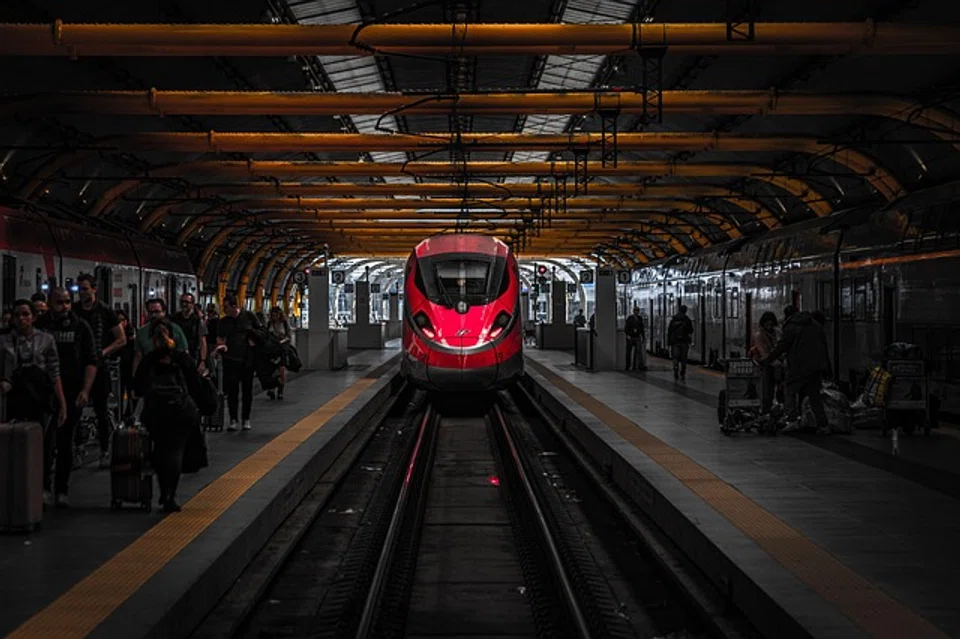
[HO CHI MINH CITY] Vietnam’s stock market suffered one of its most violent swings this year after the country’s most influential corporate group abruptly shifted gears on a flagship infrastructure ambition, barely seven months after first expressing interest.
Shares of Vingroup and its three core listed affiliates plunged for two consecutive days after the conglomerate formally withdrew its registration to invest in the US$67 billion North-South high-speed railway linking Hanoi and Ho Chi Minh City.
The group’s stocks, with three hitting their floor prices, accounted for more than two-thirds of the VN-Index’s nearly 40-point drop on Thursday (Dec 25), or a 2.2 per cent decline, highlighting how the market heft of Vin-related stocks has dragged broader losses.
“We view this as a healthy correction following the recent overheated rally on news (of Vingroup’s companies),” said Vietcap analysts.
They earlier noted that the group’s share price had already moved ahead of the company’s fundamental earnings outlook, before factoring in its proposed investment in the North-South high-speed railway.
The VN-Index’s decline extended by another 3 per cent on Friday morning, before rebounding to close down 0.7 per cent.
The market rout has trimmed the benchmark index’s year-to-date gain to 36.6 per cent, from a peak of 40.7 per cent just two days earlier.
A calculated exit?
On Thursday, Vingroup submitted a formal request to the government to withdraw from the North-South high-speed rail project, describing the decision as a carefully considered move to concentrate resources on other national-scale infrastructure priorities already under execution.
Those priorities are formidable.



At the top of the list is the US$35 billion Olympic Sports City in Hanoi, a more than 9,000-hectare development anchored by the proposed Trong Dong Stadium – envisioned as the world’s largest and framed as a new national symbol.
Alongside it sit two high-speed rail lines – Ben Thanh-Can Gio and Hanoi-Quang Ninh – plus an expanding slate of industrial and energy projects including the VinMetal steel factory, offshore wind power plant in Ha Tinh, liquefied natural gas power facility in Hai Phong and the Can Gio sea-encroachment megacity.
“The sheer scale of these simultaneous commitments raises inevitable questions,” said Do Cong Nguyen, Vietnam country manager at France-headquartered business consultancy Altios.
“By stepping back from the North-South backbone, Vingroup avoids a potential ‘resource trap’, but the concentration of risk (in the other projects) remains significant.”
Speaking to Thanh Nien on Nov 24, Vingroup vice-chairman and chief executive Nguyen Viet Quang said that losing the North-South railway bid would “alleviate a great deal of pressure” on the group from a business standpoint.
He added that the firm would also opt out if the government adopted an investment model other than its proposal, under which the company would self-mobilise 20 per cent of project costs while the remainder would be financed through a zero-interest, 30-year loan directly provided by the state to the firm.
Even as it now retreats from the country’s most politically symbolic route, Vingroup’s long-term rail commitments remain strong.
Just days earlier, its rail development arm VinSpeed signed a comprehensive strategic partnership and technology transfer agreement with German rail technology giant Siemens Mobility.
The framework explicitly includes the supply of rolling stock and respective sub-systems for VinSpeed’s two other rail projects, the Ben Thanh-Can Gio and Hanoi-Quang Ninh lines.
On Thursday, VinSpeed also increased its charter capital to 45 trillion dong (S$2.2 billion), from 33 trillion dong previously.
Confidence shaken
What rattled markets was what the move may imply about private-sector limits, as Vingroup’s pullback did not happen in isolation.
On the same day, MIK Group formally exited the investor consortium for Hanoi’s US$32.5 billion Red River Scenic Boulevard. Other major domestic conglomerates, including T&T Group and steelmaker Hoa Phat Group, remain in the investor consortium, with Dai Quang Minh acting as the lead coordinator.
Days earlier, Deo Ca Group – instrumental in reviving the project after years of dormancy – also stepped aside, citing the need to conserve social resources and clarify accountability rather than “beating the drum for name recognition”.
Together, the exits form a pattern: Vietnam’s largest private developers are narrowing their focus, even as the country embarks on the most ambitious infrastructure push in its history.
Le Truong Giang, an analyst at London-based risk consultancy Control Risks, said undertaking these projects “would push the groups out of their comfort zones into areas where they have limited technical expertise and project management experience”.
Commercial viability is a key consideration, he added, as private firms seek adequate returns on massive financial investments, along with appropriate risk-sharing mechanisms or incentive structures from the government.
He also noted that political considerations factor into private conglomerates’ decisions to join or withdraw from these mega-projects.
“The Vietnamese party-state, especially under the current leadership, possess the ‘sticks’ – besides ‘carrots’ – to compel certain private conglomerates to take on nation-building projects,” he said.
Meanwhile, Quan Trong Thanh, head of research at Maybank Investment Bank Vietnam, expressed caution about Vietnam’s large-scale projects proceeding without the involvement of highly capable firms to safeguard timelines and funding.
“I rate Vingroup’s and Deo Ca’s execution capabilities very highly. Especially Vingroup – no other player in Vietnam can build an entirely new city like them,” he said, highlighting the group’s strong capacity for commercially viable transit-oriented development that can offset losses from high-speed railway construction and operations. “If they withdraw, the success of these mega-projects would become very questionable, both in terms of completion timelines and financial viability,” he added, citing experiences from similar large-scale railway projects in China and Japan.
Despite Vingroup’s pullback and the funding conundrum, the North-South rail project almost certainly will proceed.
At a Wednesday meeting, Prime Minister Pham Minh Chinh ordered ministries to finalise technical standards, investment mechanisms and land-clearance guidance for the project by January 2026.
Chinh also emphasised that the North-South high-speed rail must adopt the “most optimal, transparent and feasible” investment model – whether it be public, public-private partnership or fully private – balancing technology transfer, national security and long-term operability.
Other heavyweights, including Thaco, Vietnam Railways and Vietnam Investment and Development Group, remain in the running for the project, while the government continues its push to keep the broader construction timeline on track for completion by 2035.
Decoding Asia newsletter: your guide to navigating Asia in a new global order. Sign up here to get Decoding Asia newsletter. Delivered to your inbox. Free.
Copyright SPH Media. All rights reserved.