

Chinese consumers open wallets as malaise lifted during holidays
The five-day Labor Day break see a 14.3% jump in consumer sales from the same holiday last year
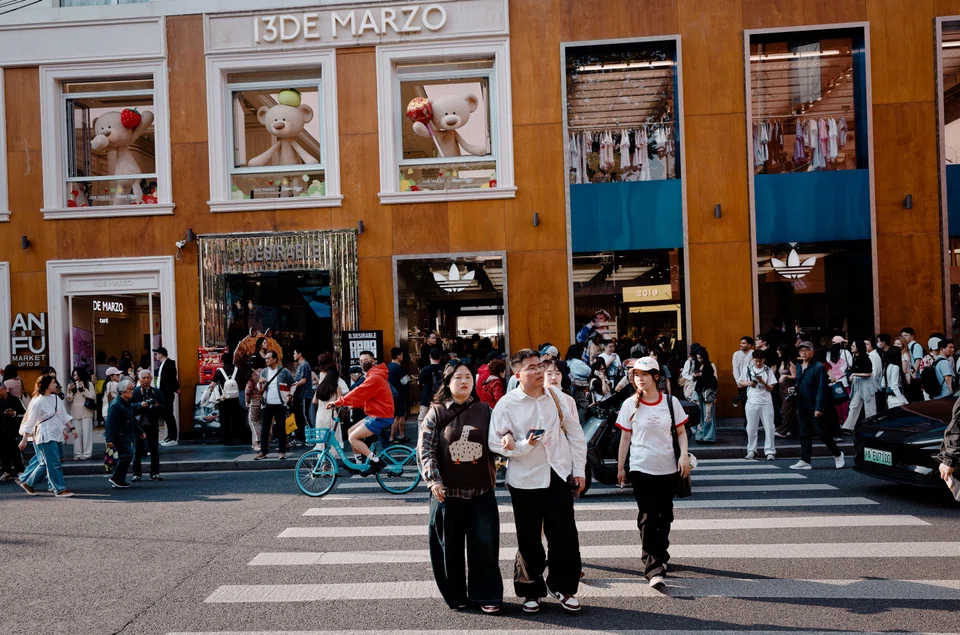
[BEIJING] Chinese households picked up their pace of spending over the recent Labor Day extended holiday weekend, according to preliminary figures economists are assessing for a turnaround from a disappointing March.
The five-day break saw a 14.3 per cent jump in consumer sales from the same holiday last year, based on value-added tax invoices from the State Taxation Administration, the official Xinhua News Agency reported. That ’s slightly faster than the 13.7 per cent increase seen at the last major holiday – the February Chinese New Year break – the data showed.
While an encouraging sign for what has been a stubbornly weak link in the world’s second-largest economy, household spending over holidays can be volatile, and big-ticket purchases remain subdued, economists said. Without a strengthening in consumption, China would likely continue to rely on exports and advanced manufacturing to propel growth.
“The data suggests there should be some improvement in spending versus April, but not strong enough to suggest a turnaround,” said Michelle Lam, Greater China economist at Societe Generale. Retail sales figures have tended to pick up during holiday seasons only to falter afterwards, she said.
The most recent official retail sales figures were for March, when they were up just 1.7 per cent from a year before, the latest in a string of sub-2 per cent readings. One potential factor: the government has scaled back funding support for its flagship consumer goods trade-in programme this year.
“I would expect spending growth to slow again after the holiday period, given the still-soft labour market,” said Duncan Wrigley, chief China economist at Pantheon Macroeconomics, pointing to climbing youth unemployment rate and the country’s struggling property market.
“Parts of the economy are thriving – like high-tech manufacturing – but they hire relatively few people compared with still struggling sectors like local self-employed and family businesses,” he said.
The figures for the Labor Day weekend could have got a boost from one of the latest government initiatives to encourage consumption. Policymakers kicked off a lottery programme in 50 cities in February using VAT invoices as an entry ticket to offer prizes on purchases of goods and services including tourism and sports.
The central government provides subsidies ranging from 100 million yuan (S$18.6 million) to 300 million yuan for each participating city depending on size.
SEE ALSO




“Although data showed a slight increase in travel and retail spending during the Labor Day holiday in early May, broader high-frequency data for April indicated that economic activity remained weak,” Bloomberg Economics economist David Qu. “In particular, oil shocks due to the Iran war continued to weigh on production.”
Some figures from the break signalled caution. The average number of daily inter-regional trips rose 3.5 per cent over the break, the Ministry of Transport said in a social media posting. That was slower than an increase of 4.3 per cent during the Chinese New Year break and less than half the rate a year earlier.
The Ministry of Culture and Tourism has yet to publish the broader, full domestic tourism spending figures.
Box office revenue edged up 1.5 per cent from the previous year, to 758 million yuan – that’s less than half of the levels seen in 2024 and 2023, according to data compiled by ticketing platform Maoyan Entertainment.
Still, Ministry of Commerce figures for retail sales at outlets it monitors were up 5.3 per cent in the first four days of the break from a year before, a separate Xinhua report showed.
Societe Generale’s Lam said that confidence levels in the housing market will be key to watch going forward, after Shenzhen – the giant tech hub neighbouring Hong Kong – loosened homebuying restrictions in core areas recently.
“We have seen more improvement in consumer confidence in Tier-1 house prices, which if sustained, can gradually support consumption momentum,” she said. BLOOMBERG
Decoding Asia newsletter: your guide to navigating Asia in a new global order. Sign up here to get Decoding Asia newsletter. Delivered to your inbox. Free.
Share with us your feedback on BT's products and services
TRENDING NOW

DBS, OCBC, UOB rout lops billions off STI as inflation, rate concerns spook investors

Grab CEO’s wife Chloe Tong on life with Anthony Tan and finding her purpose

OCBC sheds S$8 billion in value as shares close nearly 6% down; analysts cautious on banks

Deal between tycoon friends sparks scrutiny of Philippine power sector

