



Chinese economy stuck in slow lane as consumption heads for drop
Higher energy prices stemming from the war in Iran are adding further risk to what’s already a bumpy outlook
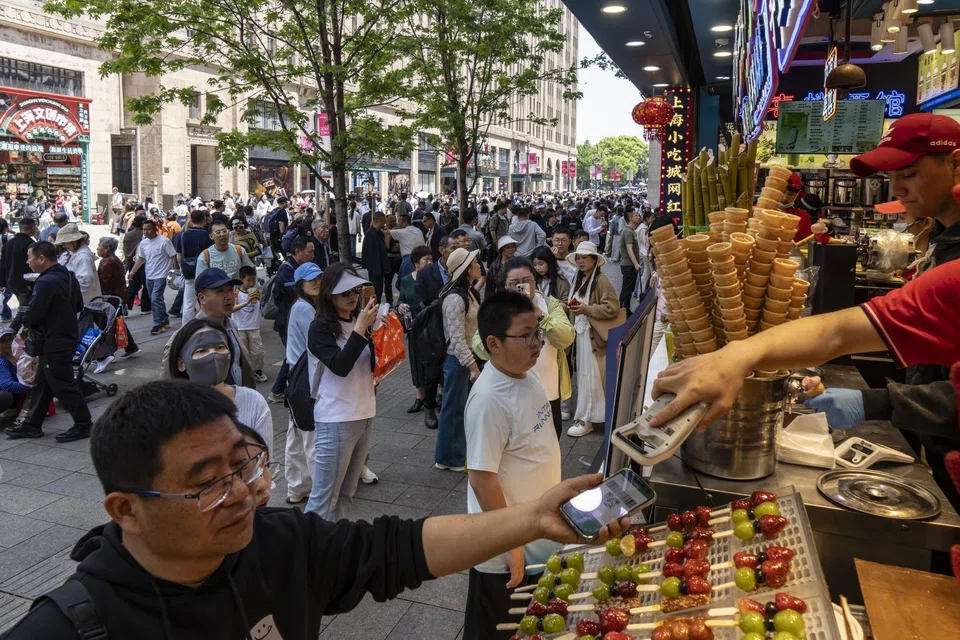
CHINA’S consumer spending may have contracted for the first time since the pandemic, a setback that would extend a slowdown in an economy whose momentum is faltering despite booming trade.
After a surprise acceleration to start the year, the world’s second-biggest economy is cooling rapidly, with investment resuming declines and consumption hobbled by a weak job market and faster inflation. Following near-zero growth in April, retail sales shrank 0.2 per cent last month from a year earlier, according to the median estimate of economists surveyed by Bloomberg.
While industrial production probably picked up slightly, the slump in fixed-asset investment likely deepened further, forecasts compiled by Bloomberg show ahead of the official release on Tuesday (Jun 16).
Absent stronger demand at home, the economy is set to shift down a gear this quarter as it navigates the disruptions caused by the conflict in the Middle East while the government dials back spending.
Although exports are proving largely immune to the upheaval in shipping and energy markets, some analysts estimate that China’s growth slowed to roughly 4 per cent in April, tracking below the government’s official full-year target of 4.5 to 5 per cent.
“Soft Chinese domestic activity data is likely an omen of decelerating growth in the second quarter, even as external demand remains strong,” said Lynn Song, chief economist for Greater China at ING Bank. “While there appears to be limited urgency for now, China still has room for monetary easing this year if it’s needed.”
Higher energy prices stemming from the war in Iran are adding further risk to what’s already a bumpy outlook, especially if companies begin to pass on more of their cost increases to consumers.
But while major central banks around the world are starting to raise interest rates in response to the oil shock, China’s next move is likely a cut, though it’s a step economists now see delayed towards the end of this year or even into 2027.
Here’s what to expect when the National Bureau of Statistics publishes the data at 10 am on Tuesday:
SEE ALSO



Consumption
A decline in retail sales in May would mark their first monthly drop since the country reopened after Covid-19 in late 2022. The drop is in large part a form of payback for a government programme that encouraged households to trade in old consumer goods, prompting them to bring forward their purchases.
Car sales plunged more than 22 per cent in May from a year earlier in the sixth straight month of double-digit declines. The government has scaled back subsidies for electric vehicle purchases this year, while the Iran oil shock hurt sales of petrol-powered cars.
Even though total tourism spending during the early May Labour Day holiday grew from a year ago, average per capita spending was little changed and remained well below 2019 levels.
A gauge of consumer confidence slipped in April to the weakest since mid-2025. Households continued to repay both short-term and longer-term loans in May, driving bank lending to the sector to contract for the second straight month.
“Underlying consumption momentum remains weak,” Australia & New Zealand Banking Group economists, including Raymond Yeung, said. “The continued deleveraging cycle in the household sector is likely to increase reliance on fiscal policy as the main tool for stabilisation.”
Investment
Fixed-asset investment (FAI) is forecast to drop 2.3 per cent for the first five months compared with the same period a year before. That would extend its surprise slump in April following a recovery during the first quarter.
For May alone, FAI is estimated to fall 7 per cent on year following a 8.2 per cent slump the previous month, Goldman Sachs economists led by Andrew Tilton wrote in a Friday note. They blamed heavy rainfall and a heat wave in different parts of the country and the slow pace of government bond issuance for the weakness.
The government lowered public spending in March and April as bond sales decelerated. Authorities likely felt comfortable with the economy’s first-quarter performance, while economists also pointed to a potential lack of eligible projects.
Looking forward, investment could improve as policymakers have more recently moved to accelerate the implementation of a seven trillion yuan (S$1.3 trillion) “Six Networks” programme, which prioritises building infrastructure essential for artificial intelligence expansion and people’s livelihoods.
“The urgency is clear following April’s sharp investment slowdown,” Citigroup economists led by Xiangrong Yu wrote in a note last week. “While early green shoots are emerging, the path forward will likely be a K-shaped recovery led by new economy investment.”
Industrial sector
The 4.3 per cent gain in industrial output expected for May would represent a slight improvement over its performance in the prior month, when it grew at the weakest in almost three years.
Powering the improvement is the spurt of export growth this year, with outbound shipments soaring in May at their fastest pace in three months.
A global investment supercycle in AI drove up prices and demand for hardware made by the world’s manufacturing powerhouse. Chips and computers contributed to about half the growth in both exports and imports, with overseas sales of semiconductors soaring 111 per cent.
But evidence still indicates that momentum remains fragile, especially after China’s industry expanded at a pace closer to 5 per cent and above following the pandemic.
Satellite data analysed by Pantheon Macroeconomics suggested the intensity of light, a measure used to approximate on-the-ground economic activity, was weaker for the whole of China in May than during the same period last year, even as it improved slightly from April.
“Domestic demand remains weak,” Huachuang Securities economists, including Zhang Yu, wrote in a note earlier this month.
“What stands out is the industrial output reading under high oil prices – if it continues to stay soft, it could signal a risk that second-quarter economic growth falls below the target range,” they said, referring to Beijing’s annual expansion goal. BLOOMBERG
Decoding Asia newsletter: your guide to navigating Asia in a new global order. Sign up here to get Decoding Asia newsletter. Delivered to your inbox. Free.
Share with us your feedback on BT's products and services
TRENDING NOW

High Court rules against Julius Baer’s Singapore trust arm in US$50 million family trust dispute
MSCI proposes standalone status for Indonesia; Jakarta stocks plunge 8%

Once staunchly pro-China, Malaysian Chinese businesses are now distancing themselves from Beijing

No chicken feed: How Malayan Flour Mills built an empire from flour to fowl

