


Databricks thinks AI discourse around ROI plays into its favour
The company, whose solutions help firms manage data, says conversations now revolve around making AI work

[SINGAPORE] Shares of several major tech and semiconductor companies in the US and Asia had sharp declines in October, over increasing doubts of whether the revenue of artificial intelligence-related companies can match the massive capital outlay.
It did not help when Broadcom CEO Hock Tan made a comment at a conference in Singapore in early October that companies were “wasting money, spending tokens”, and that enterprises are still in search of AI use cases with worthwhile return on investment (ROI).
Yet some AI companies may not be totally unhappy with the recent discourse over ROI and AI investments.
“Six months or a year ago, the question was how do I get my hands on the latest model, but every conversation people have with me right now is, ‘Hey, I need to figure out context to make this stuff work because my AI is not working well’,” said Arsalan Tavakoli-Shiraji, senior vice-president of field engineering and co-founder of Databricks.
In an interview with The Business Times on Wednesday (Nov 4) at Databricks’ new Singapore office at IOI Central Boulevard Towers, Tavakoli-Shiraji admitted that the current discourse over ROI on AI investments may be benefiting Databricks.
“That has fit well with what has been our identity for more than the last decade,” he said.

Databricks, which was founded in 2013, provides solutions that allow enterprises to organise and govern the data used by AI models with the intended outcome of producing better outputs or more efficient workflows.
The San Francisco-headquartered firm is also a strategic partner with major cloud providers such as Amazon’s AWS and Microsoft’s Azure.
Tavakoli-Shiraji explained that the majority of the work that enterprises do does not require frontier AI models, and that Databricks’ solutions can help companies figure out the best tool for the work required.



Buckets one to five
Arguably, part of what is driving the discourse around ROI on AI investments is that companies may not fully understand how to best leverage AI applications.
Tavakoli-Shiraji said in a recent interview with TechCrunch that he groups companies from a scale of one to five – with a one meaning employees have access to ChatGPT, and a five meaning that the company has adopted new AI capabilities that changed its business processes.
He argued that most companies think that they are in buckets three or four, but they are really only in buckets one and two, meaning that they do not yet understand how to fully utilise the latest AI tools.
This arguably also represents an opportunity for Databricks to provide its solutions to help companies better understand what they need and how they can utilise their AI investments.
Databricks in Singapore
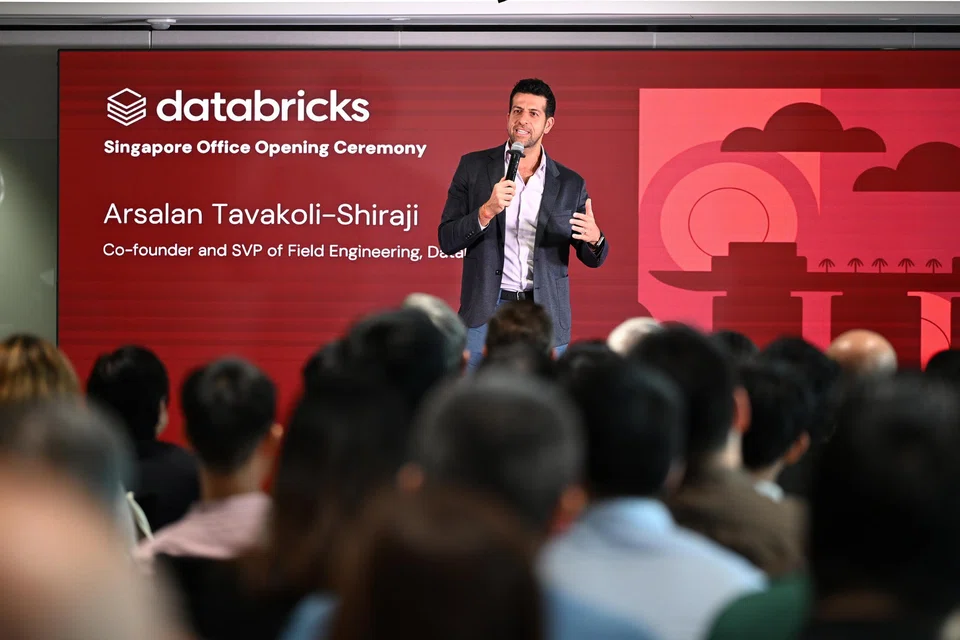
Tavakoli-Shiraji’s conversation with BT took place on the sidelines of the company’s official opening of its Singapore office, which is also Databricks’ Asia-Pacific and Japan headquarters.
The company said in September that it plans to invest more than US$350 million in its Singapore operations over three years and double its workforce to more than 500.
The increased headcount would not be solely for sales roles, and will include more than 200 technical roles such as forward-deployed engineers and technical specialists in areas including R&D.
Tavakoli-Shiraji said that critical parts of the product are now being “driven entirely out of Singapore”, and said the city-state is part of a small group of offices that Databricks puts R&D engineers in, citing Singapore’s strong technical talent pool.
He added that having a Singapore office is a “fascinating” option for Databricks because the country has the combination of a “thriving ecosystem, traditional enterprises and a public sector that’s forward leaning”.
When asked what a thriving ecosystem means, Tavakoli-Shiraji gave the example of digital native companies such as Grab, which has given Databricks feedback on how to improve its product. Grab is a Databricks client, and regionally, other digital native clients such as Xendit and Maya also provide similar feedback to Databricks.
But beyond Singapore’s infrastructure, the city-state serves as a base for Databricks in the Asia-Pacific region.
Its Singapore clients include statutory boards such as GovTech and the Central Provident Fund Board, which administers the country’s social security savings scheme, and enterprises such as Singtel.
Regionally, Databricks works with enterprises ranging from conglomerates like Reliance and Toyota to tech firms like Lenovo.
Tavakoli-Shiraji also said that conversations with Standard Chartered to help the bank build an AI factory, and on running its business in the agentic era, are being driven out of Asia rather than the bank’s London headquarters.
Databricks told BT that its Asia-Pacific and Japan revenue grew 100 per cent year on year for its third quarter, which is the three months ending Oct 31. The company declined to disclose this region’s revenue as a proportion of its total revenue or Q3 revenue. Databricks said in August that it crossed a US$7 billion revenue run-rate and over 80 per cent year-on-year growth during its second quarter, or the three months ending Jul 31. The company also said in August that it closed a US$5 billion strategic funding round at a US$190 billion valuation.
Decoding Asia newsletter: your guide to navigating Asia in a new global order. Sign up here to get Decoding Asia newsletter. Delivered to your inbox. Free.
Copyright SPH Media. All rights reserved.
TRENDING NOW

OCBC Q3 profit rises 3% to S$2.04 billion, slightly above expectations

Stocks to watch: OCBC, IHH Healthcare, FLCT, SingPost, Koh Brothers Eco Engineering

From legacy to launch: Francis Yeoh and Yeoh Pei Xien on family unity and YTL’s next‑gen ventures

Wealthy Indonesians snap up government bonds as yields near 8%: OCBC

