



Singapore can gain from China’s growing markets, must ‘embrace’ AI as the Chinese have: SM Lee
Everyone in the city-state has to learn to adopt artificial intelligence, he adds
 Add BT as a preferred source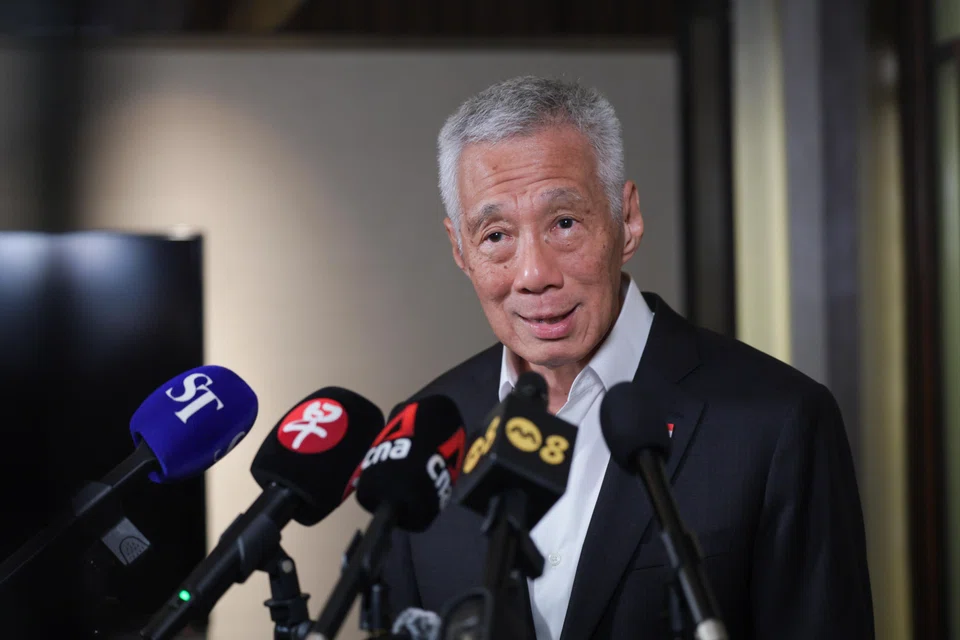
[SHANGHAI] As China’s markets continue to grow, more opportunities have emerged for Singapore and its businesses, said Senior Minister Lee Hsien Loong on Friday (May 22).
“You may be surprised to know that China was the largest source of fixed-asset investment commitments in 2025, overtaking the US for the first time, which is quite a new development for us, but we welcome them,” he told reporters at the end of a five-day trip to China.
There will be opportunities for Singapore to do business, treating China as a market for its exports, he added.
“At the same time, there are opportunities for China and Chinese companies to invest in Singapore – either to manufacture in Singapore or to use Singapore as their regional hub or use Singapore as their international entity and be a separate entity from their domestic business.”
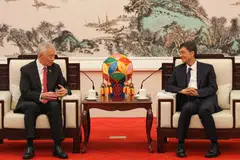
During his meeting with Guangxi Party Secretary Chen Gang on Tuesday, SM Lee said that there is “considerable” potential for win-win economic cooperation in trade, investments and many other areas between Singapore and China, as well as between Asean and China.
SM Lee’s first stop in China was Nanning, the capital of Guangxi, where he visited the Beibu Gulf International Port Group’s (BGIPG) headquarters and the China-Singapore Nanning International Logistics Park.
Navigate Asia in
a new global order
Get the insights delivered to your inbox.
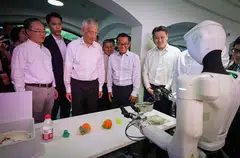
While in Shanghai, he toured the Shanghai Humanoid Robot Innovation Incubator and spoke at the JP Morgan Global China Summit on Thursday.
Avoid the “jobs apocalyse”
With artificial intelligence making waves across the globe, SM Lee said that everyone in Singapore – the government, companies and workers – has to learn to adopt it, just as China has nationwide.
“I think our attitude has to be: We must embrace this, it is coming; we do not know how quickly, but we do know it is coming,” he said.
“If we are lucky, you will not have what people call a ‘jobs apocalypse’ all of a sudden, (where) we are all out of a job and the economy is humming away,” he added.
SM Lee said that such a situation “probably won’t happen”, but noted two areas that must be worked on “very hard” to avoid it while reaping the benefits of AI.
First, the technology must be applied in companies “big and small, and at scale”. Second, individuals must consider how they can use AI for their jobs.
In China, he added, AI is being used in anything from logistics control to tracking.
On May 13, the final recommendations of the Economic Strategy Review were released, including building economic resilience, investing in emerging areas, and for Singapore to become an AI solutions hub.
US-China ties
With SM Lee’s trip to China coming less than a week after US President Donald Trump’s visit to Beijing, he also gave his take on relations between the world’s two biggest economies.
Even if the US-China trade relationship is stabilised, he said, the issues are “longstanding and complex, and not something which can go away easily”.
“On a 20-year view, I think it’s quite clear that… the balance has been tilting, the Chinese have been catching up with the US,” he said.
SM Lee noted that the US views China as “at least a near-peer competitor, sometimes they say a near-peer rival”, with some Americans even saying that Beijing is “a possible future threat”.
“And it’s a very deep perception in the US,” he said.
He added that, in China, there could be “a very deep concern that the Americans maybe want to make sure that they never catch up with the US and hold them back”.
“Americans have heard the Chinese have said that their right to develop is a red line for them, and if they are held back, that’s an absolutely unacceptable situation to be in.”
During Trump and Chinese President Xi Jinping’s two-day summit, they discussed issues such as the Iran conflict, trade and Taiwan.
Both leaders agreed that building a constructive, strategically stable relationship will provide guidance for bilateral relations in the next three years and beyond.
SM Lee pointed out, however, that both countries have a lot to gain from each other, be it on AI safety, climate change or pandemics.
“We hope they can be managed and the rivalry contained to such an extent that firstly, you don’t end up with an open conflict; and secondly, where there is an absolute need for cooperation, it is possible to cooperate,” he said.
Decoding Asia newsletter: your guide to navigating Asia in a new global order. Sign up here to get Decoding Asia newsletter. Delivered to your inbox. Free.
Copyright SPH Media. All rights reserved.
TRENDING NOW
From hawker stall to Enterprise Award winner: How Han Keen Juan scaled the Old Chang Kee empire
Koh Poh Koon resigns from ministerial roles for ‘family reasons’, will stay on as MP
Haidilao co-founder’s family buys second bungalow in Cluny Hill for S$85 million
Ban on land sales, new launches for developers that deliver ‘defect-ridden’ projects

