



Russia’s ‘pivot to Asia’ takes a turn as it prioritises ties with isolated regimes over bigger economies
The country aims to project itself as a serious Asian actor, closely aligned with but distinct from China
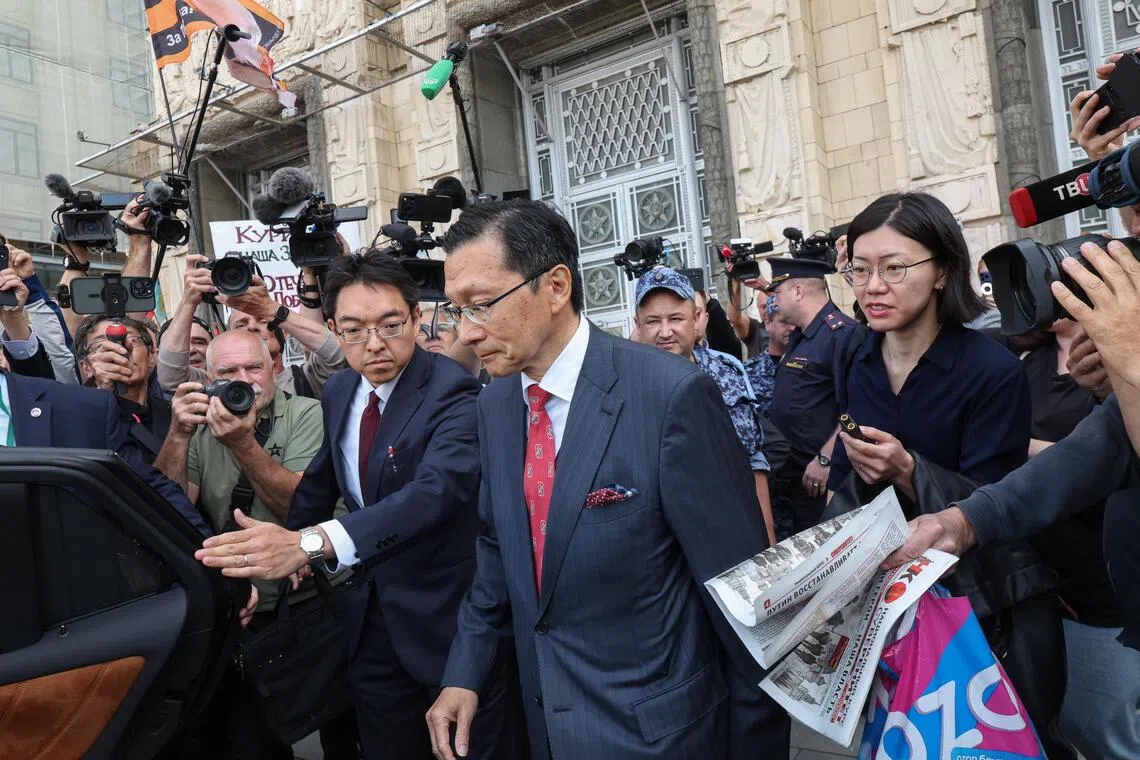
[LONDON] Akira Muto, Japan’s Ambassador to Russia, experienced the sort of petty indignities by now very familiar to most European diplomats in Moscow.
He was summoned on Aug 18 to the Russian Foreign Ministry for a stern dressing-down and then jostled by hostile Russian passers-by and journalists as he struggled to get back to his embassy car.
The episode is hardly an isolated one. For, over the past week, Russia rekindled a decades-old territorial dispute with Japan, exchanged “fraternal” greetings with North Korean leader Kim Jong Un and hosted Myanmar’s former military boss and current president in Moscow.
The shape of Russia’s policy in Asia is becoming clearer. It consists of nurturing a portfolio of clients too isolated to say no, and of distancing one great power – Japan – that Moscow has decided is not worth the courtship.
Russia’s longer-term objective is equally obvious: to project itself as a serious Asian actor, closely aligned with but still distinct from China.
The fate of the southern Kuril Islands that Japan calls its Northern Territories, seized by the Russians in the last fortnight of World War II, has overshadowed relations between Moscow and Tokyo for generations.
In practice, however, the sparsely populated islands from which local Japanese inhabitants have long been expelled have served as just pawns in Russo-Japanese relations.
The shape of Russia’s policy in Asia is becoming clearer. It consists of nurturing a portfolio of clients too isolated to say no, and of distancing one great power – Japan – that Moscow has decided is not worth the courtship.
Russia’s longer-term objective is equally obvious: to project itself as a serious Asian actor, closely aligned with but still distinct from China.

The fate of the southern Kuril Islands that Japan calls its Northern Territories, seized by the Russians in the last fortnight of World War II, has overshadowed relations between Moscow and Tokyo for generations.
In practice, however, the sparsely populated islands from which local Japanese inhabitants have long been expelled have served as just pawns in Russo-Japanese relations.
The shape of Russia’s policy in Asia is becoming clearer. It consists of nurturing a portfolio of clients too isolated to say no, and of distancing one great power – Japan – that Moscow has decided is not worth the courtship.
Russia’s longer-term objective is equally obvious: to project itself as a serious Asian actor, closely aligned with but still distinct from China.
The fate of the southern Kuril Islands that Japan calls its Northern Territories, seized by the Russians in the last fortnight of World War II, has overshadowed relations between Moscow and Tokyo for generations.
In practice, however, the sparsely populated islands from which local Japanese inhabitants have long been expelled have served as just pawns in Russo-Japanese relations.
Predictably, Russian Foreign Minister Sergei Lavrov rebuked Japan’s response on Aug 18 by denouncing what he called Tokyo’s “militaristic line”.
But while the latest Russo-Japanese spat followed an established pattern, Moscow’s other recent Asian forays were unusual. Days after Putin returned from his tour of the disputed Kurils, he and North Korean leader Kim Jong Un exchanged warm messages.
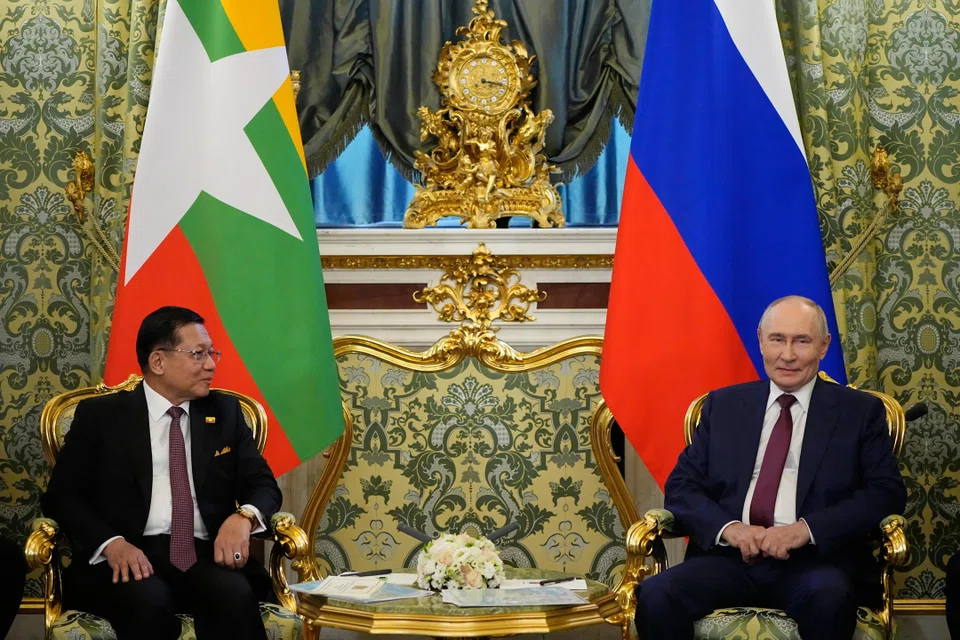
And immediately thereafter, Putin received Myanmar President Min Aung Hlaing at the Grand Kremlin Palace and talked up a massive list of bilateral projects, including a Russian-built deep-sea port at Dawei on the Andaman Sea and oil refineries in Myanmar.
Russian Prime Minister Mikhail Mishustin added the same day that his country was “beginning to implement the agreements on the construction of a small modular reactor nuclear power plant in Myanmar”.
When Russia announced its “Pivot to Asia” strategy in 2012, Putin emphasised the objective of courting Asia’s economic heavyweights. But this approach now seems to have been abandoned in favour of establishing close bonds with smaller and poorer Asian countries under international economic and political sanctions, even if this means bad relations with big trading nations such as Japan or South Korea.
One explanation for this approach is Moscow’s changed strategic perception. The islands seized from Japan act as a protective bastion for Russia’s Pacific ballistic missile submarine force – the Borei-class submarines based at Vilyuchinsk account for roughly a third of Russia’s nuclear capability.
And since 2016, Russia has deployed Bastion and Bal coastal anti-ship missile systems on the islands, and upgraded an airfield on Iturup – a contested island – to take fast jets, all a mere 300km away from Hokkaido.
So, what was once a pawn in a political game with Japan is now a serious Russian military asset. Moscow has concluded it can benefit more from provoking Japan than from placating it.
The North Korean relationship signifies a deeper Russian strategic engagement. North Korea has deployed about 14,000 to 15,000 troops in Russia since October 2024 to help Russia’s invasion of Ukraine. Pyongyang has also shipped an estimated 11 million artillery rounds to Russia.
The relationship benefited North Korea handsomely. Its troops are now battle-hardened and have access to better Russian military technology. Pyongyang is also estimated to have earned up to US$14.4 billion (S$18.4 billion) between August 2023 and the end of 2025 from Russia.
A relationship that once looked temporary is now turning permanent. In April, Russian Defence Minister Andrei Belousov signed a Russian-Korean military cooperation plan covering the period from 2027 to 2031.
And relations with Myanmar are booming. Min Aung Hlaing’s latest visit is his seventh to Russia since the 2021 coup.
Russia’s plans to develop the deep-sea port on the Andaman Sea are also potentially significant. For a Russia whose Pacific access runs through waters dominated by the US Navy and its allies, and whose access to European markets is constrained by sanctions, an Indian Ocean terminal in a client state has obvious appeal – though on current evidence it remains an aspiration, with no confirmation of the signing of an agreement.
But what interests Putin most is the fact that all these moves provide Russia with additional leverage in Moscow’s relations with Beijing.
Currently, Russia is very much the junior partner in this relationship and the gap is widening. Bilateral trade reached US$228 billion in 2025 and has grown by a further 25 per cent in the first half of this year. Yet Russia remains a supplier of raw materials, while China dominates trade in higher-value manufactured goods.
Meanwhile, Russia’s relations with India are drifting apart, while Moscow’s economic engagement with Asean remains negligible, accounting for less than 1 per cent of Asean’s overall trade.
Seen from this perspective, Russia’s outreach to North Korea and Myanmar and Moscow’s carefully contrived showdown with Japan are designed to improve Russia’s posture in Asia and signal to China that the Russians remain important Asian actors.
Still, Russia’s Asia policy remains an exercise in cheap and strategically shallow diplomacy, for it is conducted by a state whose economy is coming under greater strains as the fighting in Ukraine shows no signs of abating.
So, although Beijing is maintaining its dignified silence over all these Russian forays into Asia, it is doubtful that China’s leaders are particularly impressed by Putin’s latest manoeuvring. THE STRAITS TIMES
Decoding Asia newsletter: your guide to navigating Asia in a new global order. Sign up here to get Decoding Asia newsletter. Delivered to your inbox. Free.
Share with us your feedback on BT's products and services
TRENDING NOW

DBS, OCBC, UOB rout lops billions off STI as inflation, rate concerns spook investors

Grab CEO’s wife Chloe Tong on life with Anthony Tan and finding her purpose

OCBC sheds S$8 billion in value as shares close nearly 6% down; analysts cautious on banks

Deal between tycoon friends sparks scrutiny of Philippine power sector

