



Whose problem? The looming US-Europe divorce is Asia’s headache too
As transatlantic ties fray, a Europe scrambling for self-reliance may prove as ‘me-first’ as the US
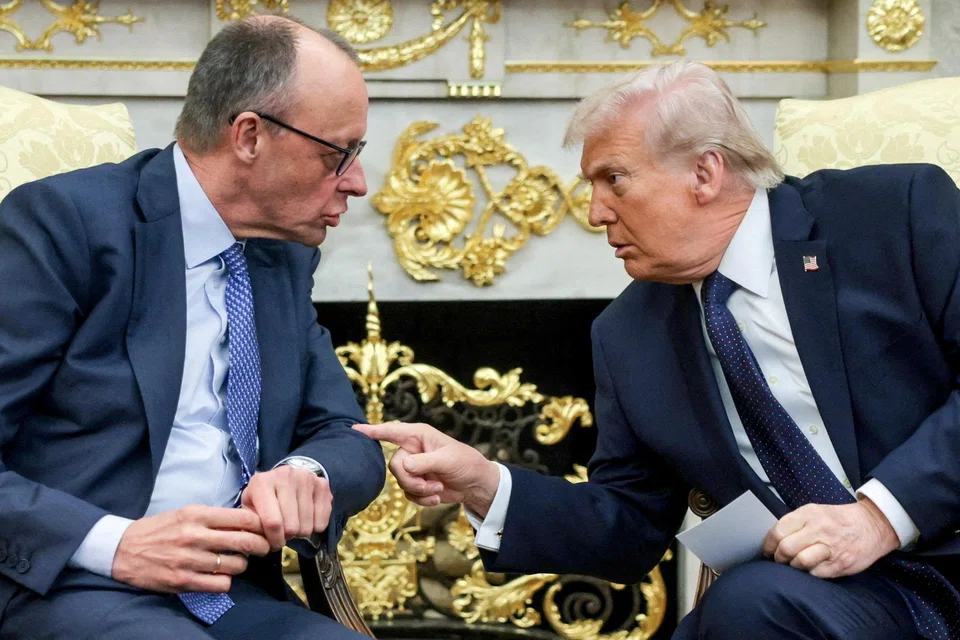
Is the fact that the US and Europe are inching closer to the d-word – divorce – something that might actually hold a silver lining for Asia?
This is among the working assumptions one increasingly hears from optimists assessing the ongoing readjustments to the global order. While these voices readily accept the disruptions caused by America’s wrecking-ball approach to old alliances and institutions, the view is that Europe’s sudden awakening in response could be a strategic boon.
Given the continent’s urgent rearming and frantic efforts to become more self-sufficient, the argument goes, an invigorated Europe could be a more potent, reliable partner for Asia.
To be clear, this shift is indeed happening. European members of Nato and Canada posted record-breaking defence spending in 2025, surging by nearly 20 per cent from the year before.
Add to that Europe conspicuously sitting out the Iran war, alongside the fierce diplomatic row with Washington over Greenland earlier in 2026.
These are all concrete signs that the transatlantic split is not imagined, and that Europe is rapidly bracing itself for a future untethered from the US, even if it is not entirely ready yet.
This is a far cry from the complacent Europe of the past – a continent that once evoked envy in Asia for its executives’ long summer holidays and maxed-out social spending.
That upbeat thinking about capturing the upside of this shift is prevalent in some expert commentaries. A recent report by the Asia Society Policy Institute, for instance, suggested that Asian middle powers are seizing the opportunity to build “geopolitical shock absorbers” – a web of economic, technological and security partnerships meant to ensure that no single disruption anywhere becomes a systemic crisis.
The objective here is not to prematurely pour cold water on these hopes. But if there are Asian governments operating exclusively on such optimistic assumptions, they need a reality check. The right approach is not to cope with the ongoing global shifts by seeing only the silver linings, or – when thinking about Europe – by assuming a transatlantic divorce will not have negative ripple effects here.


Instead, there must be an awareness that this rejigged world order may, in fact, lead to an unhappy outcome. The unravelling of the rules-based system that America underwrote for the last eight decades – and which it increasingly wants no part of – may well eventually plunge us into an every-nation-for-itself reality. It is a sobering thought, but not one that should be disregarded.
As for the Europeans, optimists here see their recent actions and rhetoric as signs of a rejuvenated continent: the ideal new anchor for a multipolar world. But there is a flip side that must be considered. Even if European nations feel similarly pressured by the US, and on paper ought to make common cause with Asia to hedge against an erratic, verging-on-pernicious Washington, they might, for entirely selfish reasons, prove equally unreliable.
A Malaysian warning
It is early days yet in this new era, but one recent real-life example gives form to this abstract fear: Malaysia’s ongoing headache with Nato member Norway over Oslo’s abrupt decision to halt the supply of Naval Strike Missiles for the South-east Asian country’s Littoral Combat Ships (LCS).
The missile supply deal with Norwegian defence manufacturer Kongsberg Defence and Aerospace was inked in 2018, and the weapons and their launcher systems are vital for these ships – the first of five of which is finally undergoing sea trials after a long delay. Without them, major reconfigurations will likely be needed, including ripping out and replacing the launcher ramps and ancillary wiring if a different vendor is used.
The halt, announced just days before scheduled delivery, has been attributed in reports to the Norwegian government’s “stricter controls of certain technologies”, which led to the revocation of the export licence.
Unsurprisingly, there is much consternation in Malaysia, with government critics eager to make hay out of the crisis. Defence Minister Mohamed Khaled Nordin is under intense pressure to provide answers. He has so far said he will seek clarity when meeting his Norwegian counterpart in Singapore soon – presumably on the sidelines of the upcoming Shangri-La Dialogue, scheduled for May 29 to 31.
In an indication of Malaysia’s frustration over the issue, Prime Minister Anwar Ibrahim wrote on social media on May 14 that he had conveyed his “vehement” objection to his Norwegian counterpart, Jonas Gahr Store, adding that signed contracts were solemn instruments and “not confetti to be scattered in so capricious a manner”.
Given the opacity of the reasoning behind Norway’s decision, one has to give serious weight to the thinking among Malaysian commentators that Oslo’s move is rooted in a “me-first” panic. The Naval Strike Missile is heavily used by Nato states – including Poland, Germany and Britain – all of which are currently scrambling to up their capabilities in the face of Russian aggression and American hesitancy.
Simply put: Europe needs the missiles more than Malaysia does.
It cannot otherwise realistically be an issue of sudden security concerns. Malaysia’s foreign policy outlook has not shifted drastically since the deal was signed in 2018. It remains carefully equidistant between Washington and Beijing – and one could even argue it has become more pragmatic and cooperative with the West under Anwar. This makes the cancellation all the more baffling.
If this cancellation is indeed an act of ruthless self-prioritisation, it provides a concrete data point for a grim new reality: when Europe’s own interests are threatened, convenient force majeure clauses will be invoked, orders may be cancelled, and Asian partners will be left in geopolitical limbo. It is an uncomfortable conclusion, but makes it entirely fair for Asia’s military establishments to ask: under pressure, how exactly does European reliability differ from American erraticism?
To be fair, one should not press this point too hard, or paint the entire European defence sector with the same brush. For decades, many Asian militaries have counted on European manufacturers – from France’s Naval Group and Dassault Aviation, to Britain’s BAE Systems and Germany’s ThyssenKrupp – as serious and reliable partners.
The new playbook
But if unreliability driven by self-interest is becoming a feature of the new order, what is the playbook for Asian nations forced to navigate between unpredictable partners?
Complete self-reliance in advanced arms procurement remains unfeasible for most middle powers. The obvious answer, then, has to be continued, aggressive diversification.
Asian capitals must not fall victim to the Tina fallacy – the belief that There Is No Alternative to their traditional suppliers. Such is the nature of a fracturing world order that procurement scenarios once deemed far-fetched will now have to be on the table.
In Malaysia’s case, if no diplomatic headway is made with Oslo – and a sudden reversal seems highly unlikely – decision-makers will have little choice but to pivot to alternatives, such as Turkish-made replacements for the halted missiles. Navigating a new procurement process will inevitably mean more painful delays for the already beleaguered LCS programme, but there may be no other option.
Many Asian countries are also cognisant of other highly capable alternatives closer to home. South Korea, for instance, is today a global arms-exporting heavyweight, offering advanced hardware, rapid delivery timelines and an approach one can say is unlikely to see its legislature suddenly deem a customer country a security risk.
Of course, this strategy comes with trade-offs. In the defence realm, buying equipment from a patchwork of different countries creates massive interoperability problems. It is inherently expensive, burdening a nation’s military with multiple, non-integrated streams for training, logistics and maintenance. Diversification is, by definition, a high-maintenance strategy.
But this may well be the unavoidable price of security in the new world order.
At the Shangri-La Dialogue, Malaysia’s Khaled will probably have a tough conversation with his Norwegian counterpart. But others, even those with good ties to their respective suppliers, should not be too sanguine. They should be having tough conversations too.
The silver linings of the post-American world that the glass-half-fullers say are there may well exist. But Asia would be foolish to admire them without also preparing for the very clear storm clouds gathering around them. THE STRAITS TIMES
Decoding Asia newsletter: your guide to navigating Asia in a new global order. Sign up here to get Decoding Asia newsletter. Delivered to your inbox. Free.
Share with us your feedback on BT's products and services
TRENDING NOW

DBS, OCBC, UOB rout lops billions off STI as inflation, rate concerns spook investors

Grab CEO’s wife Chloe Tong on life with Anthony Tan and finding her purpose

OCBC sheds S$8 billion in value as shares close nearly 6% down; analysts cautious on banks

Deal between tycoon friends sparks scrutiny of Philippine power sector

