LNG, stronger regional power links key to Asean’s energy resilience: Shell
Singapore’s long-term planning and trading ecosystem support energy resilience, says senior Shell executive Andrew Smith

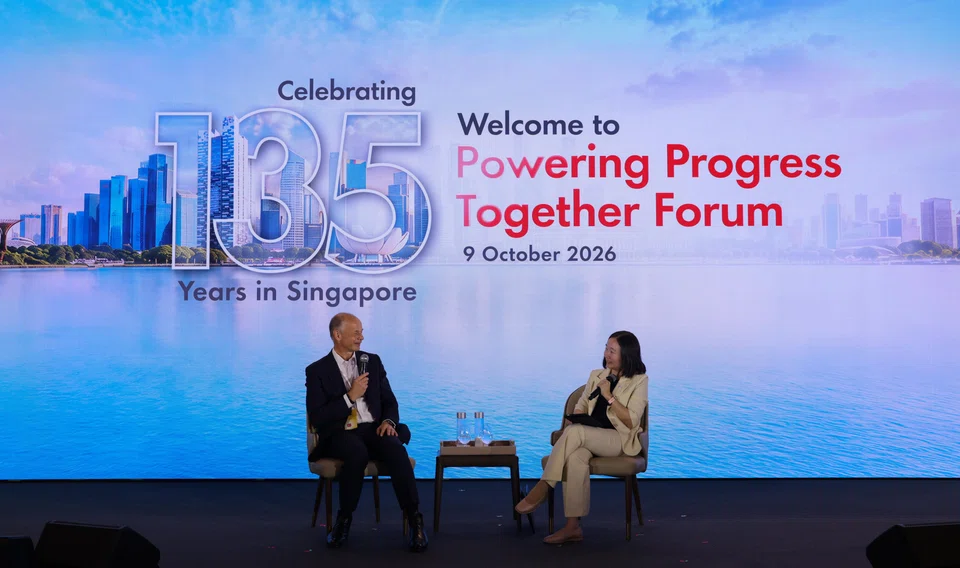
SOUTH-EAST Asia will need diverse energy supplies and stronger cross-border power links to build resilience as electricity demand grows and geopolitical tensions put pressure on the global energy system, said a senior Shell executive.
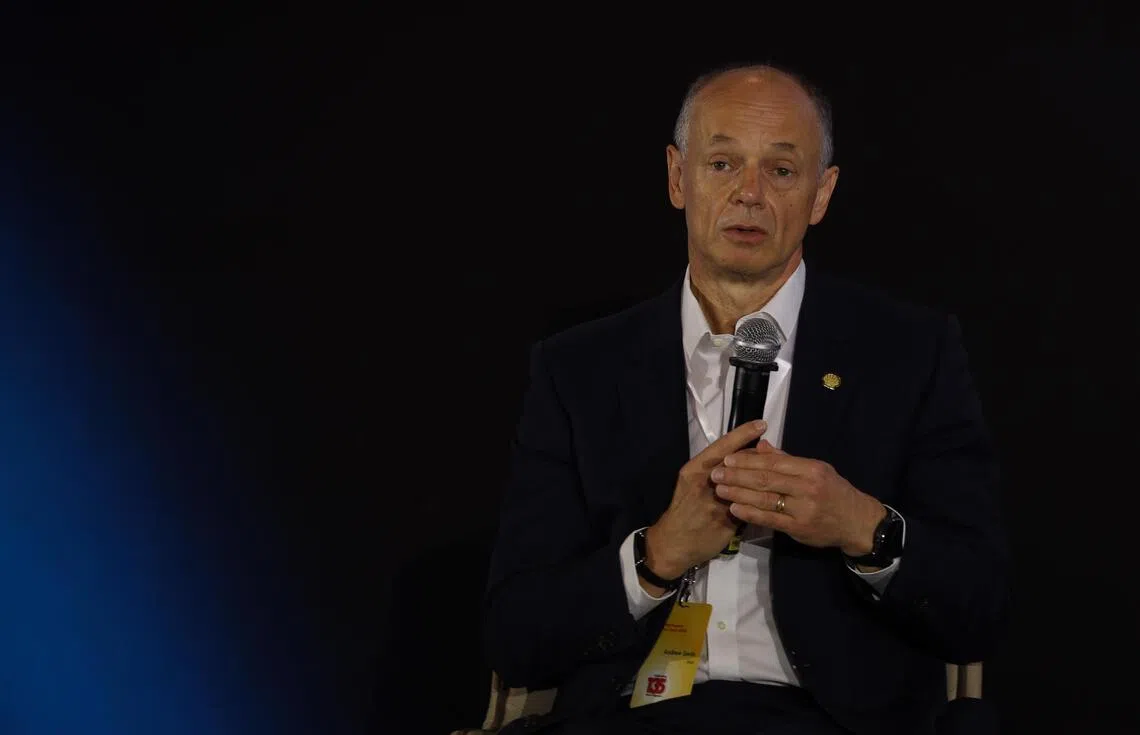
Andrew Smith, president of trading and supply at Shell, said governments have increasingly had to balance three considerations: keeping energy affordable, making supplies more sustainable and ensuring there is enough energy when it is needed.
“Many countries are becoming much more concerned around energy security – and, of course, security comes at a cost,” he said. “But the lack of availability of energy comes with an extreme cost as well.”
Smith was speaking at a fireside chat at Shell’s Powering Progress Together Forum at the Marina Bay Sands Expo and Convention Centre on Friday (Oct 9). The event was part of commemorations for Shell’s 135th anniversary.
The session was moderated by Chen Huifen, editor of The Business Times, with the discussion ranging from rising energy costs and Singapore’s supply resilience to liquefied natural gas (LNG), decarbonisation and the Asean Power Grid.
Energy costs climb
Those issues have become more pressing for businesses as energy bills rise.
'%3e%3cpath%20d='M12.1475%2025.5262C13.7713%2025.4295%2014.94%2023.913%2014.94%2021.8832C14.94%2019.5359%2013.474%2018.093%2011.5917%2018.093C11.3745%2018.093%2010.9582%2018.093%2010.8393%2018.1413V25.2086L11.8891%2025.5745C11.8891%2025.5745%2012.207%2025.5262%2012.1475%2025.5262ZM11.4934%2017.6281C13.2567%2017.6281%2014.3843%2016.4292%2014.3843%2014.4501C14.3843%2012.372%2013.275%2011.2973%2011.4339%2011.2973H10.8393V17.6305H11.4934V17.6281ZM6.66078%2025.6482L7.39265%2025.5492C8.02617%2025.4502%208.26403%2025.3053%208.26403%2025.1097V11.6149C8.26403%2011.4193%208.1451%2011.3709%207.23484%2011.249L6.68137%2011.173L6.6219%2010.7588H11.9508C15.7153%2010.7588%2017.0624%2012.0797%2017.0624%2014.1578C17.0624%2015.9666%2015.7748%2017.1909%2013.4969%2017.6305V17.7041C16.111%2017.948%2017.6571%2019.5382%2017.6571%2021.7636C17.6571%2024.3318%2015.8937%2026.0417%2012.1109%2026.0417H6.60132L6.66078%2025.6482Z'%20fill='%232B2B2B'/%3e%3cpath%20d='M20.6287%2025.6505L21.5596%2025.5515C22.1725%2025.4779%2022.4104%2025.3076%2022.4104%2025.112V11.249H21.9346C20.073%2011.3479%2018.982%2013.0095%2018.408%2014.6227L18.1907%2015.5018H17.6555L18.1701%2010.7588H29.3837L29.6421%2015.4787H29.1664L28.9491%2014.6227C28.3728%2012.8645%2027.3047%2011.2743%2025.5002%2011.249H24.9856V25.1856C24.9856%2025.3812%2025.1251%2025.4548%2025.9965%2025.5515L26.7695%2025.6505L26.829%2026.0417H20.5693L20.6287%2025.6505Z'%20fill='%232B2B2B'/%3e%3c/g%3e%3cdefs%3e%3cclipPath%20id='clip0_5242_21648'%3e%3crect%20width='24'%20height='16.8'%20fill='white'%20transform='translate(6%2010)'/%3e%3c/clipPath%3e%3c/defs%3e%3c/svg%3e)
A BT survey of C-suite executives, conducted for The Business Times Insights: Powering Asean’s Future 2026, found that 79 per cent of Asean businesses had faced higher energy costs since the start of 2026, with the most common increase being between 10 and 29 per cent.
Some 44 per cent said higher energy costs had a moderate to significant negative impact on profitability.
Asked by Chen what businesses could do beyond cutting costs, Smith pointed first to energy efficiency, which he said remained important for profitability.
But he said companies should also consider how decisions made today would hold up over the longer term.
“The energy system is one where you make decisions that you live with the consequences (of) for many years,” he said, noting that a furnace installed in a factory could remain in use for 20, 30 or 40 years.
Energy prices would rise and fall over that period, Smith added, so investment decisions needed to be robust against different possible futures.
For Singapore, part of that resilience comes from its longstanding role as an energy trading hub.
When Chen asked how geopolitical volatility was reshaping energy flows through Singapore, Smith pointed to the concentration of energy and commodities traders here, as well as the country’s energy infrastructure.
The trading system offered a “natural resilience”, he said, as many energy flows were managed by companies based in Singapore.
Shell’s own presence reflects Singapore’s role as an energy hub. The company has operated here since 1891, and the Republic is now one of its three global LNG trading hubs, with half of its global shipping fleet managed from Singapore. Such infrastructure is particularly important given Singapore’s lack of domestic energy resources and reliance on imports.
Imported natural gas accounts for about 95 per cent of Singapore’s electricity generation, leaving power costs exposed to movements in international gas markets.
Smith said sourcing different forms of energy, including oil, gas, LNG and imported electricity, from different parts of the world could give Singapore greater resilience.
At the same time, he noted that being part of the global economy meant the country would remain exposed to swings in commodity prices.
LNG demand set to grow
For Singapore, LNG provides an alternative to relying solely on natural gas delivered by pipeline.
LNG is natural gas that has been cooled into liquid form, allowing it to be transported by ship over long distances. This gives importing countries access to a wider range of suppliers.
Shell expects global LNG demand to increase by about 65 per cent by 2050 as demand for electricity grows over the coming decades.
“We see that there will be a very significant expansion of the demand for power over the next 20, 30 years, and that LNG will play a major role in meeting that demand,” Smith said.
He argued that LNG’s ability to move gas between markets gives countries more flexibility in responding to changes in supply and demand.
Chen then pointed to BT’s survey findings on energy resilience, noting that 85 per cent of businesses across the region considered themselves either very well or moderately prepared for disruptions such as outages or supply shortages.
Preparedness was highest in Thailand at 94 per cent and Indonesia at 90 per cent. In Singapore, the figure was 81 per cent, while Malaysia came in at 75 per cent.
Building a regional grid
But resilience does not have to come solely from importing more fuel. Another option is greater electricity trading between Asean economies, allowing power generated in one market to flow across borders to another.
The Asean Power Grid is a longstanding effort to connect the electricity systems of member states and increase cross-border power trading.
In practice, deeper interconnection could allow countries with abundant sources of power, including renewable energy, to export electricity to markets where demand is higher.
Chen asked Smith what it would take, both commercially and politically, for such trading to take place at a much larger scale.
Smith said greater electrification would make an expansion of power grids increasingly important.
“Whichever way you think decarbonisation will go, increased electrification of the energy system is a very important part of this,” he said.
Growth of the power grid was therefore an “absolute necessity”, in his view, although maintaining reliability would become important as larger amounts of renewable power were added to electricity systems.
A regional grid would also require governments to work closely together.
Smith noted that there were political questions to resolve, including the greater mutual dependence that comes when countries rely on electricity generated across their borders. But he was optimistic that these hurdles could be overcome.
“I don’t see this as an unachievable challenge,” he said. “It will take participation and commitment from governments and companies like ourselves to make this happen.”
Private sector participation could extend to financing such projects, Smith added, particularly as governments face competing demands on their balance sheets. Companies could also bring experience from energy projects elsewhere in the world.
On their part, businesses are already watching the development of the regional grid closely.
BT’s survey found that 87 per cent of respondents were actively monitoring the Asean Power Grid, including 49 per cent who were following developments very closely.
Overall attention was particularly high in Indonesia and Thailand, at 92 per cent each, followed by Vietnam at 90 per cent. Singapore stood at 86 per cent.
Balancing the energy transition
Even as businesses focus on securing reliable supplies, higher costs are also complicating efforts to move towards cleaner forms of energy.
BT’s survey found that 53 per cent of businesses had delayed or deprioritised their decarbonisation plans, compared with 26 per cent that had accelerated them.
Singapore itself has committed to reaching net-zero emissions by 2050.
With different sectors likely to require different fuels and technologies – some of which are still at relatively early stages of commercial development – the Republic is exploring a range of options as it seeks to cut emissions without compromising the affordability and reliability of its energy supply.
Chen asked what technologies or commercial approaches could help businesses continue making progress.
Smith said the options differed depending on how quickly companies wanted to act. Some could be adopted in the shorter term, while others required investments that could take decades to deliver their full benefits.
He cited biofuels and sustainable aviation fuel, as well as carbon capture and storage and renewable sources such as solar and wind power.
Such long investment horizons also shaped Smith’s answer when Chen closed the conversation by asking what Singapore most needed to get right on energy over the next five years.
His answer was long-term planning, supported by a stable regulatory environment.
“Energy investments are long-term investments,” he said. “And you live with the consequences for many years.”

Decoding Asia newsletter: your guide to navigating Asia in a new global order. Sign up here to get Decoding Asia newsletter. Delivered to your inbox. Free.
Copyright SPH Media. All rights reserved.