

Singapore ‘always chooses Singapore’s side’ amid US-China rivalry: Chan Chun Sing
He says staying relevant to both powers requires trust and credibility, as he also calls for deeper Asean economic integration

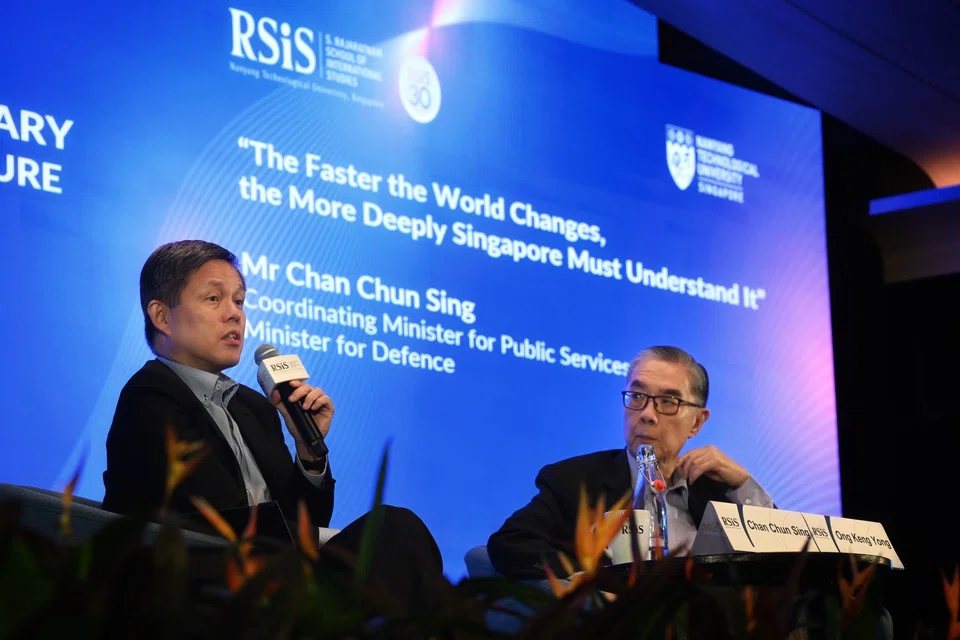
[SINGAPORE] Singapore does not avoid choosing sides amid intensifying competition between the US and China – it chooses based on its own national interest, Defence Minister Chan Chun Sing said on Tuesday (Sep 22).
“We choose sides – we always choose Singapore’s side,” he said during a question-and-answer session at the S Rajaratnam School of International Studies’ (RSIS) 30th Anniversary Distinguished Lecture.
Chan, who is also coordinating minister for public services, noted that he was “not a fan of binary thinking”, arguing that countries increasingly make different choices across different domains rather than aligning wholesale with one power.
Singapore’s aim remains to be an open and trusted platform where countries can work together, he noted. “You can be competitors, you can even be rivals, but you need not be enemies.”
In his earlier prepared remarks, Chan said that Singapore could not take its relevance to either Washington or Beijing for granted. “Singapore’s ability to remain relevant to both is never guaranteed; it has to be earned continuously.”
He pointed to the RSIS Trilateral Exchange, which brings together participants from Singapore, the US and China, as an example of creating a space where both sides can speak candidly.
The value Singapore brings to such discussions depends on the quality of its understanding and credibility of its analysis, he added.
Asean must compete as a region
Asked by moderator Ong Keng Yong, ambassador-at-large and RSIS’ executive deputy chairman, about Singapore’s approach when it chairs Asean next year, Chan said that its first priority should be to avoid being dragged into trouble as global tensions rise.
“First order of business: Stay out of trouble,” he noted. “If there are really troubles on the horizon, manage them; don’t let (them) boil over.”
But Asean must also look beyond managing crises and become more economically integrated, he added.
“The real competition is not among the Asean countries,” Chan explained. “The real competition is how Asean can present itself as a viable and attractive proposition to the rest of the world.”
He called for greater integration of the region’s data, financial and energy systems, as well as simpler rules for businesses investing across Asean.
The grouping should “set aside some of the politics and really let the economics drive the integration”, he said, arguing that stronger economic interdependence could also reduce the risk of conflict by giving countries a greater stake in one another’s success.
Chan also stressed in his lecture that Singapore needs a deeper understanding of its closest neighbours, saying its relationships with Malaysia and Indonesia cannot be “managed on autopilot”.
Changes within both countries require Singapore to understand their history, political culture, demographics, economic structures and institutions, so that policymakers are not caught “flat-footed”, he pointed out.
Quiet diplomacy
Responding to a question on whether Singapore could play a role in the Middle East, Chan said that the Republic remained willing to facilitate dialogue where opposing parties genuinely wanted to find common ground.
He disclosed that Singapore had made such efforts privately.
“Even in recent times, have we tried behind the scenes to encourage people to come together to transcend their current issues? Yes, we have. I have personally done that,” he said, without identifying the parties involved.
Where both sides wanted broadly similar outcomes, Singapore could help bring them together. Chan said that he generally preferred such efforts to remain away from public attention, adding that he did not find “megaphone diplomacy” particularly helpful.
He also warned against complacency and confirmation bias in defence planning.
Chan, a former army chief who took over as defence minister in May 2025, said that he had introduced a planning discipline at the Ministry of Defence: The probabilities assigned to anticipated scenarios should never add up to one, leaving room for possibilities that planners had not considered.
Tuesday’s lecture marked the 30th anniversary of RSIS, which began as the Institute of Defence and Strategic Studies (IDSS) in 1996.
Chan himself was involved in its early days. He recalled being seconded part-time to the fledgling IDSS, joking that it began with “3.5 staff” – with him accounting for the half.
He helped set up its first office at Nanyang Technological University, down to ordering its first furniture and ensuring that its power points worked.
More importantly, he added, the institute was founded on the belief that Singapore could not afford to be surprised and needed “our own eyes, our own analysis, and most importantly, our own voice”.
Decoding Asia newsletter: your guide to navigating Asia in a new global order. Sign up here to get Decoding Asia newsletter. Delivered to your inbox. Free.
Copyright SPH Media. All rights reserved.
TRENDING NOW

Malaysian king buys stake in Singapore-listed mining firm expanding into rare earths

Family offices ‘kept captive’ by relationship managers turn to independent advisers, direct deals

Once staunchly pro-China, Malaysian Chinese businesses are now distancing themselves from Beijing

Could stablecoins be the future of money?

