

Talk of diesel export ban deepens US crude futures’ discount to global benchmark
Rising freight rates and tight vessel availability have dimmed demand for American oil
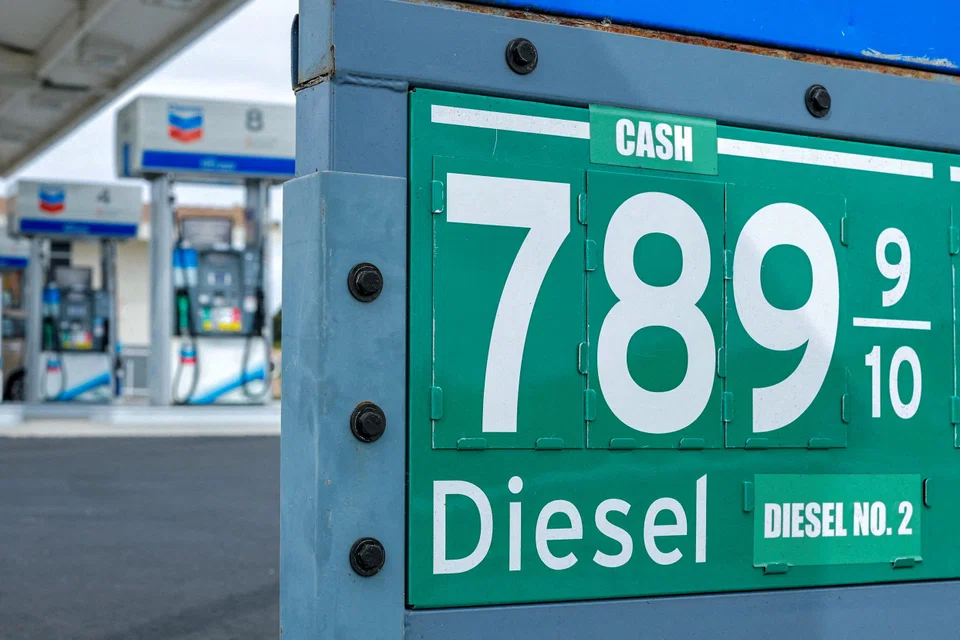
[HOUSTON] Washington’s talk of a possible ban on diesel exports is widening the gap between US crude oil futures and the global Brent benchmark, a signal that markets expect US refiners to process less crude oil if their diesel output gets stuck at home.
While that may bring some immediate relief to high domestic diesel prices, which this week hit a record US$6.528 a gallon and stirred a political uproar, the bigger discount for domestic crude futures could be a double-edged omen: an indicator of higher petrol prices to come, while in the longer term, diesel prices could also begin rising again.
As investors price in a scenario where diesel gets stranded in the US, West Texas Intermediate (WTI) crude futures traded as much as US$12.02 a barrel under Brent futures on Thursday (Sep 24), their largest discount since May 6, LSEG data showed.
Analysts say US refiners could cut their crude runs by as much as 12 per cent if diesel exports are banned, with key storage hubs likely to fill up within a month.
The US is the world’s largest diesel exporter, with net exports of about 1.2 million barrels per day (bpd), versus production of 5.1 million bpd, according to Morgan Stanley.
These exports have partially plugged the gap from lost Middle East barrels while the Strait of Hormuz remains largely closed. Diesel supplies have also dwindled from Russia, which has repeatedly imposed export bans of its own to tackle shortages that followed Ukrainian drone attacks on its oil refineries.
Wood Mackenzie analysts, in a note on Thursday, said that a diesel export ban would redirect a 700,000 bpd oversupply of diesel and gasoil into storage, effectively filling Gulf Coast inventories to maximum capacity in just over a month.
That would force US refiners to cut crude runs by more than two million bpd, Wood Mackenzie estimated, to prevent inventories from exceeding capacity – a reduction of 12 per cent of US refinery crude runs at current rates.
The prospects for a US diesel export ban remain uncertain.



The White House on Wednesday denied media reports that it was preparing for a 90-day diesel export ban, and US Energy Secretary Chris Wright said a ban would not bring surging prices under control. On Tuesday, however, US President Donald Trump said he backed a ban.
In the meantime, Wright has contacted executives at several major American refiners in recent days to gauge support for voluntary restraint on diesel exports, as the Trump administration searches for an alternative to a short-term ban, according to three people familiar with the discussions.
Record prices stir calls for ban
Driving the demand for a US export ban is a surge in diesel prices, which have hit records in both the US and Europe. On Thursday, US prices remained elevated at US$6.514 a gallon, according to AAA, as the US war with Iran disrupts global supplies.
That could spell trouble for Trump’s Republican Party in the November midterm elections, by fuelling inflation and putting a particularly heavy burden on farmers, one of the party’s key constituencies.
The Iran war is complicating the conundrum in the US oil sector in another way: by boosting shipping costs.
A rise in the discount for US crude relative to European crude, known as the WTI-Brent spread, typically boosts demand for US oil and increases exports, as traders can make a profit through arbitrage by selling it abroad. But that depends on shipping costs.
Rising freight rates and tight vessel availability have dimmed demand for US exports and contributed to the widening WTI-Brent spread, said Georgios Sakellariou, freight analyst at Signal Maritime.
While the WTI-Brent spread has been trending wider in the third quarter, US crude exports have not risen significantly, data from ship tracker Kpler shows.
Shipping crude from the US Gulf Coast to Asian markets on a very large crude carrier currently costs around US$50 million in freight, according to Signal Maritime, compared with US$16 million before the Iran war broke out and drove up war risk premiums.
The discount that a barrel of US crude would need versus a European barrel to offset shipping costs was previously around minus US$4 a barrel, said Bob Yawger, director of energy futures at Mizuho.
He added that it is now likely double that, at minus US$8, due to surging freight rates.
Shohruh Zukhritdinov, CEO at oil trading firm NitrolOil, said that international crude is “carrying a higher scarcity and logistics premium, while US barrels are struggling to clear abroad at current transportation costs”.
The WTI-Brent spread has traded exclusively at a US$4 discount or wider since Jul 7, according to LSEG. Yet, US crude exports have remained relatively flat month on month, rising only 45,000 bpd from July to August, at 3.72 million bpd, according to Kpler.
On a three-month average basis, US crude exports for September are currently on track to fall for the third consecutive month to their lowest since before the Iran war broke out in February, Kpler showed.
“A wide paper spread is an invitation to test the arbitrage, not proof that the arbitrage is open,” said Zukhritdinov. REUTERS
Decoding Asia newsletter: your guide to navigating Asia in a new global order. Sign up here to get Decoding Asia newsletter. Delivered to your inbox. Free.
Share with us your feedback on BT's products and services
TRENDING NOW

Once staunchly pro-China, Malaysian Chinese businesses are now distancing themselves from Beijing

Looking beyond looming CEO succession, should UOB potentially pursue a transformative merger?

Could stablecoins be the future of money?

Grab CEO’s wife Chloe Tong on life with Anthony Tan and finding her purpose

