



Vietnam’s data-centre investment rush faces reality check on power and site constraints
Tariff disputes, looming electricity shortfalls and tighter site economics are narrowing the investable pipeline
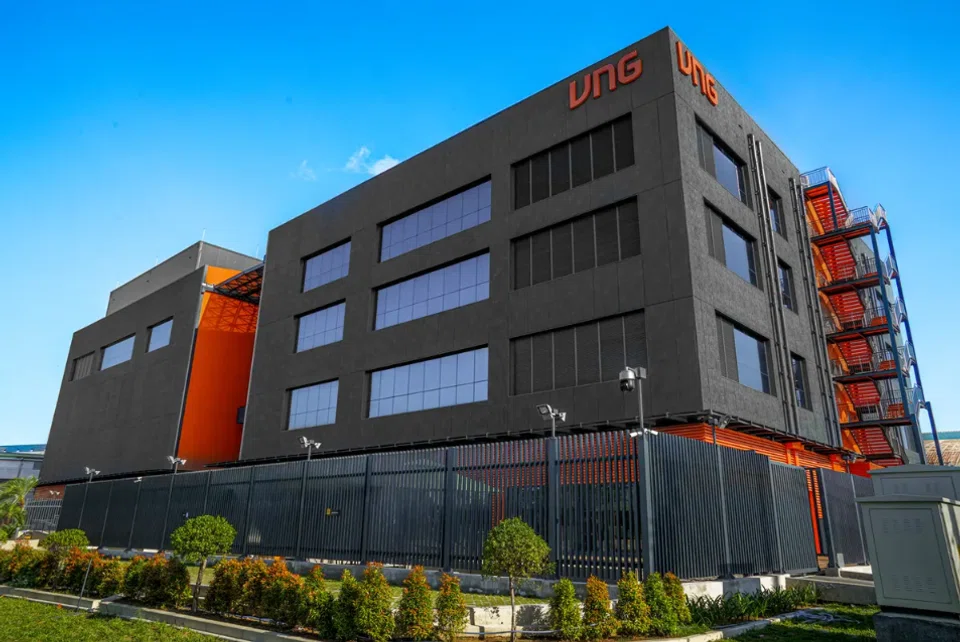
VIETNAM is drawing a growing pipeline of data-centre investment as global operators seek to expand beyond Singapore and Malaysia, but a dispute over electricity tariffs and the collapse of a planned 60-megawatt (MW) facility in Ho Chi Minh City show the hurdles of getting those projects built and operating efficiently.
Viettel and CMC, two of the country’s largest technology groups, are in an ongoing dispute with the Ho Chi Minh City unit of state utility Vietnam Electricity over electricity tariffs applied to their data centres. The case has raised questions over how pricing rules are interpreted and applied.
Earlier in February, the two companies joined major operators VNPT, FPT and VNG in warning that a shift from production to higher commercial tariffs had pushed up power costs – typically the largest component of operating expenses – by more than 50 per cent at some facilities.
About six months later, Singapore-based STTGDC, formerly ST Telemedia Global Data Centres and recently acquired by a KKR–Singtel consortium, said it would step away from a planned 60 MW data-centre project in Ho Chi Minh City and sell its 65 per cent stake to joint venture partner VNG.
Unveiled in 2024, the data-centre project was planned for a 2.5 hectare (ha) land plot 1.5 km away from the existing 9.6 MW data centre co-managed by the two firms. However, STTGDC concluded that the site no longer met its investment and commercial requirements.
A key consideration was the remaining land-use term, which expires in 2041 and was deemed unsuitable for the long-term operation of a hyperscale data centre.
Lionel Yeo, CEO for South-east Asia at STTGDC, acknowledged Vietnam’s strong long-term fundamentals supported by the continued growth of its digital economy, cloud adoption and demand for artificial intelligence infrastructure, but he believes it does not make every site investable.
“A viable development also requires sufficient scale and land tenure, strong connectivity, and a clear path to securing power at the capacity, cost and within the time frame required,” he told The Business Times.
Yeo stressed that predictability was critical for data centres, which are long-life assets requiring multi-decade investment.
SEE ALSO





“The economics must hold over the full life of the development, so long-term visibility over both the availability and cost of power is important,” he added. “We will remain selective about where and how we commit capital (for additional projects).”
Power risks mount
These developments have highlighted the risks facing an industry already contending with broader grid and power supply constraints.
In a Sep 10 report seen by BT, Vietnam’s industry and trade ministry warned that the country faces “very serious challenges” from an imbalance between energy supply and demand, with net energy imports already accounting for more than 40 per cent of total primary energy supply.
Investment in power generation and grid projects remains below the levels required under Vietnam’s national power plan through 2030, known as PDP8, with about 45 per cent of generation projects yet to receive investment approval.
The ministry estimated that Vietnam could face a nationwide capacity shortfall of about 4,300 MW in 2027, which could more than treble to about 14,000 MW by 2030. (* See amendment note).
The regulator singled out emerging sources of electricity load demand, including data and AI centres, electric vehicle charging infrastructure, and cooling and heating systems.
It then recommended reviewing the planning of these facilities and “minimising” their placement in major load centres such as Hanoi, Ho Chi Minh City, Bac Ninh and Dong Nai.
“Where projects are located (there), only those capable of securing at least 50 per cent of their own electricity consumption should be included in the planning,” the ministry proposed in the report.
Big pipeline, harder execution
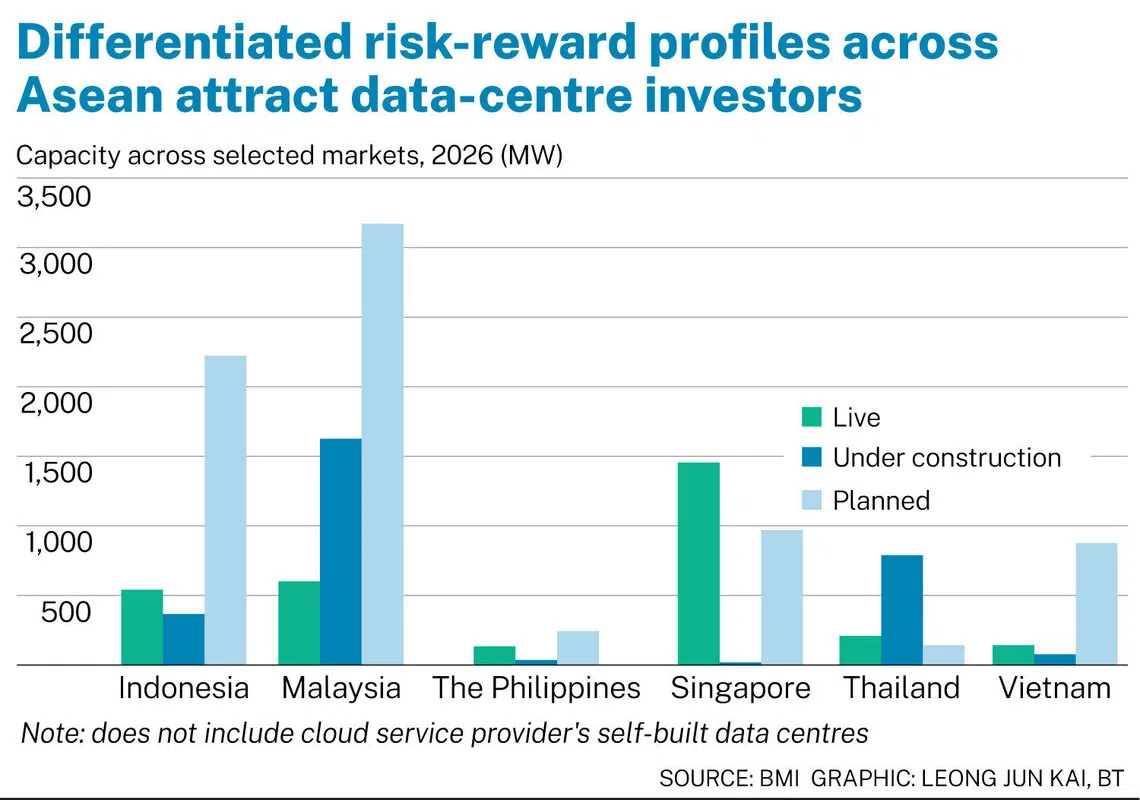
BMI, a Fitch Solutions research firm, estimated in July that Vietnam had about 148 MW of live data-centre capacity, concentrated in Hanoi and Ho Chi Minh City, with another 79 MW under construction and 874 MW planned.
Domestic operators Viettel, VNPT and FPT remain prominent, while international groups including Google, Alibaba, Amazon Web Services, G42, STTGDC and Sembcorp are among those exploring or developing capacity.
“However, execution will remain highly selective, with realised capacity likely to lag the headline pipeline,” BMI analysts wrote. “Operators face significant headwinds from rising commercial electricity tariffs and grid-capacity constraints.”
BMI said even the pace and economics of projects by state-owned enterprise Viettel, which dominates both operating capacity and the development pipeline in Vietnam, were becoming increasingly exposed to “power-side risks”, rather than the semiconductor procurement constraints that had previously been a concern.
A major Singapore player, Sembcorp Development, is also pursuing a proposed hyperscale and AI-ready data-centre campus in Ho Chi Minh City through a joint venture with BB Holdings.
The 4.5-ha project in Saigon Hi-Tech Park received investment approval in March and is planned for up to 90 MW of computing capacity, to be developed in phases.
Sembcorp did not respond to BT’s request for comment on the power issues facing data-centre developers in Vietnam.
Still an emerging hub
BMI still described Vietnam as a “credible secondary South-east Asian data-centre hub” for the 2026-to-2030 period, supported by diversification away from more constrained regional markets such as Singapore and Malaysia, as well as robust cloud market growth, domestic data storage requirements and new subsea cable links.
A Cushman & Wakefield report in August indicated that Vietnam was the most underserved data-centre market in the Asia-Pacific, with about 1.4 million people for every 1 MW of operational capacity, while offering the region’s second-highest yield on cost after Singapore.
In its latest measures, Vietnam has also moved to facilitate direct power-purchase agreements between renewable-energy generators and large electricity users, encourage self-consumption solar paired with battery energy storage systems, and accelerate investment in generation and transmission infrastructure.
Speaking at an energy industry conference on Sep 22 in Ho Chi Minh City, Oscar Loza, country manager at renewable energy developer Constant Energy, said Vietnam remained attractive partly because other South-east Asian data-centre markets had become increasingly crowded.
“There’s definitely a problem in terms of infrastructure and lack of power (in Vietnam),” he said.
“But data-centre investors have a very long-term view and long investment horizons,” Loza added. “If somebody wants to start investing in data centres, they should probably look at Vietnam for the future.” THE BUSINESS TIMES
* Amendment note: An earlier version of this story incorrectly stated that Vietnam could face a nationwide capacity shortfall of about 14,000 gigawatts by 2030.
Decoding Asia newsletter: your guide to navigating Asia in a new global order. Sign up here to get Decoding Asia newsletter. Delivered to your inbox. Free.
Share with us your feedback on BT's products and services
TRENDING NOW

Once staunchly pro-China, Malaysian Chinese businesses are now distancing themselves from Beijing

Looking beyond looming CEO succession, should UOB potentially pursue a transformative merger?

Could stablecoins be the future of money?

Grab CEO’s wife Chloe Tong on life with Anthony Tan and finding her purpose

