

Wall Street ends sharply lower as Anthropic’s debut fails to revive AI fervour
All three major US stock indexes are down at least 2%
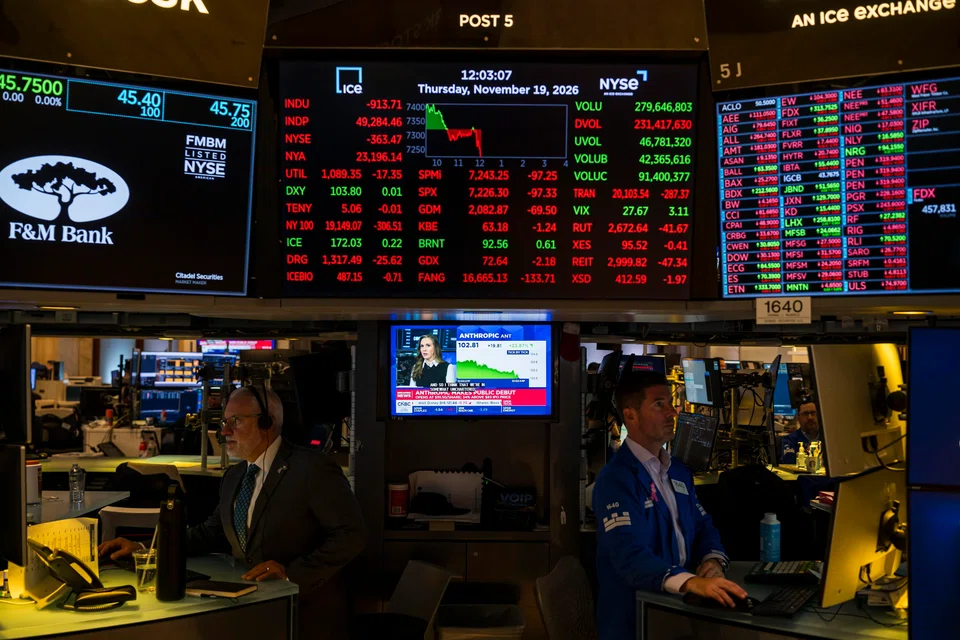
[NEW YORK] US stocks slumped on Thursday (Nov 20), after Anthropic’s super-sized initial public offering failed to revitalise faded enthusiasm over artificial intelligence, as an early spike in its share price ebbed.
Anthropic shares opened at US$111.50 a share and quickly rose as high as US$115 a share, or 38.6 per cent above the offer price, but pared those gains to 17.1 per cent by the end of the session.
All three major US stock indexes dropped at least 2 per cent, with the benchmark S&P 500 logging its sixth straight session of losses.
The S&P 500 was on course to post its steepest weekly decline since April 2025.
Anthropic’s debut, the largest IPO on record, was priced late Wednesday at US$83 a share and was widely viewed as the next high bar to clear for the AI trade. The stock opened shortly before noon. After the company’s market valuation briefly surpassed US$2 trillion, its momentum began to lose steam.
“The Anthropic IPO is attracting gobs of attention,” said Jed Ellerbroek, portfolio manager at Argent Capital in St Louis, Missouri.

“That money is coming from somewhere; investors are making changes in their portfolio to incorporate Anthropic, so I wouldn’t extrapolate a whole lot of meaning from today’s trading behaviour, whether it’s up or down.”
Even so, Ellerbroek’s enthusiasm for the AI trade has waned.
“My beliefs about the growth in data centre capex spending have come down a little bit over the last month or two,” he added. “Nvidia’s crisis situation is a big deal. The midterm elections have had an impact.”



“Data centres are going to be more expensive to build and they’re going to be built more slowly.”
Advanced Micro Devices shares tumbled 7.7 per cent after investigative outlet Hunterbrook said its affiliated fund, Hunterbrook Capital, had taken a short position in the company.
Most tech stocks lost ground, with Micron and Broadcom both dropping 2.1 per cent.
Nvidia declined 3.3 per cent, its sixth straight losing session, after the chipmaker’s upbeat revenue forecast did little to lift sentiment.
The Philadelphia Semiconductor Index closed 2.4 per cent lower on the day.
Neocloud firms CoreWeave dropped 6.1 per cent and Nebius slid 9.4 per cent.
The broader technology sector ended down 1.9 per cent.
In other stocks, Palo Alto Networks shares jumped 6.4 per cent after the cybersecurity firm raised its 2027 revenue guidance.
Walmart slipped 1 per cent following the retail giant’s disappointing annual sales forecast.
The Dow Jones Industrial Average fell 1,101.11 points, or 2.19 per cent, to 49,097.06, the S&P 500 lost 147.80 points, or 2.02 per cent, to 7,175.83 and the Nasdaq Composite lost 550.68 points, or 2.25 per cent, to 23,879.20.
Focus turns to Fed
Following Wednesday’s release of minutes from the US Federal Reserve’s October policy meeting, investors are recalibrating their expectations pertaining to upcoming rate decisions.
The minutes revealed a desire to rein in inflation even prior to the recent release of consumer and producer price indexes, which showed price pressures heating up.
Financial markets are currently pricing in a 96.4 per cent likelihood of a 25-basis-point rate hike at the central bank’s December meeting, with a small chance of a super-sized 50-basis-point increase, according to CME’s FedWatch tool.
Next week, the Commerce Department is expected to release its personal consumption expenditures (PCE) report, which includes the Fed’s preferred inflation gauge, the PCE price index. Analysts expect the report to show year-on-year core inflation of 3.2 per cent, well above the central bank’s 2 per cent annual target.
Declining issues outnumbered advancers by a 4.37-to-one ratio on the New York Stock Exchange (NYSE). There were 21 new highs and 796 new lows on the NYSE.
On the Nasdaq, 1,057 stocks rose and 3,756 fell as declining issues outnumbered advancers by a 3.55-to-one ratio.
The S&P 500 posted one new 52-week high and 18 new lows while the Nasdaq Composite recorded 34 new highs and 529 new lows.
Volume on US exchanges was 20.83 billion shares, compared with the 19 billion average for the full session over the last 20 trading days. REUTERS
Decoding Asia newsletter: your guide to navigating Asia in a new global order. Sign up here to get Decoding Asia newsletter. Delivered to your inbox. Free.
Share with us your feedback on BT's products and services
TRENDING NOW

Demand, tech capabilities position Apac and AI as Skyscanner’s next growth frontiers: CEO Bryan Batista

Motoring tycoon Peter Kwee is back in court: Here are his previous legal battles

South-east Asia has lost Nvidia’s best salesman

Could Jensen Huang work for Elon Musk? It would be ‘a titanic ego death match’, says biographer

