

BYD’s new theme park could be subsidising keen drivers to prove a point
The Zhengzhou All-Terrain Race Track needs to prove that BYD’s cars aren’t merely cheap and efficient
[ZHENGZHOU] The only safe place to see what 965 horsepower feels like is on the track, especially if you’re in China where, for all you know, President Xi Jinping has a live camera feed of every street.
Which is how I found myself at BYD’s sprawling Zhengzhou All-Terrain Race Track, bombing down a 550-metre straight in a Denza Z9GT, an electric wagon whose three motors can fling it to 100 kmh in a Porsche-baiting 3.4 seconds.
I had expected to hit the track in the outrageously powerful, 1,305 hp Yangwang U9, but an earlier batch of visitors managed to crash two of the 1.8 million yuan supercars, putting them out of commission. Them’s the breaks, I suppose.
Still, the Z9GT proved powerful enough to make a point: when you build cars this fast, you need somewhere people can actually use them without ending up in a state surveillance file.
That’s the thinking behind BYD’s Zhengzhou facility, which reportedly cost five billion yuan to construct. That amount buys enough real estate for a 150,000 square metre complex that includes a scarily steep, Guinness World Record-breaking, 10-storey high sand dune, as well as a swimming pool for the Yangwang U8 to demonstrate its party trick of floating like a 3.5-tonne bath toy.
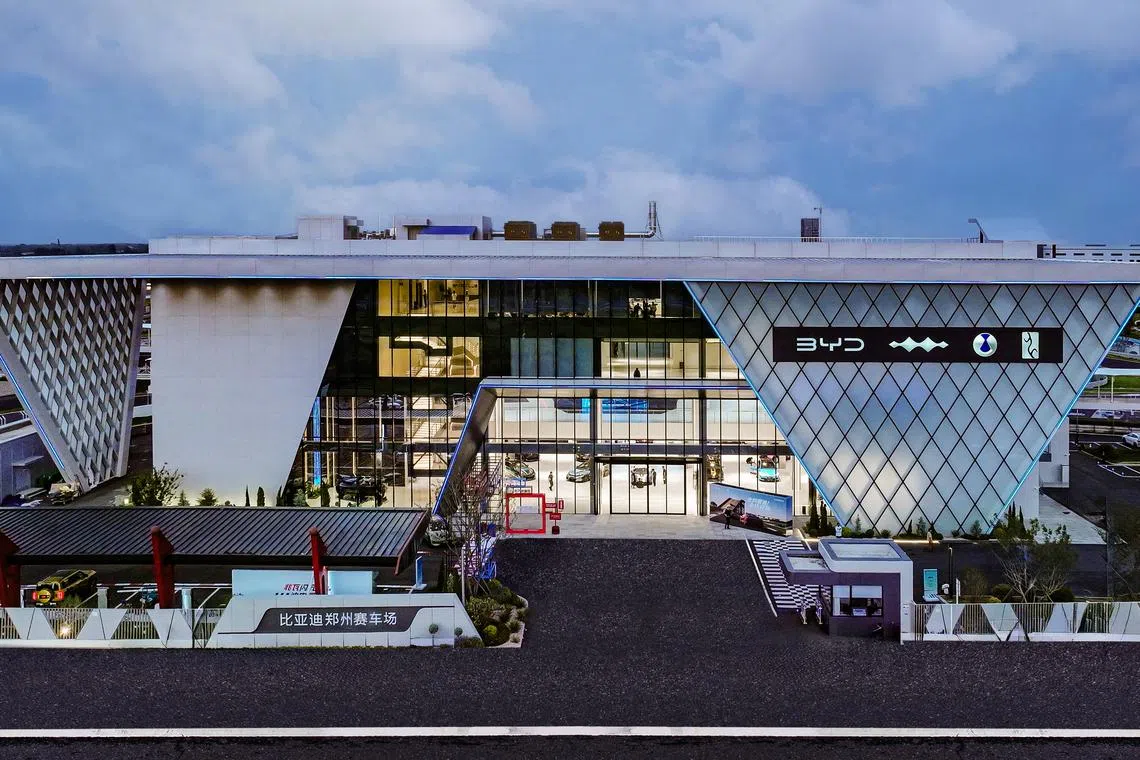
There’s a 1.8-kilometre main circuit for high speed and handling tests, a low-friction drift track built from 30,000 basalt bricks and 27 off-road stations ranging from beginner-friendly to hardcore. It is, in other words, a theme park for driving enthusiasts, except with New Energy Vehicles (NEVs), meaning plug-in hybrids and pure electric cars.
BYD’s first track sits at its Shenzhen headquarters in southern China, but the Zhengzhou facility, which opened in August 2025, lies squarely in China’s Central Plains, marking a deliberate expansion into the north.
BYD Singapore flew journalists and influencers to Zhengzhou to tour the circuit, but also to put the latest cars from BYD and its upscale label Denza through their paces. “Sales talk is not very useful. You really need to experience the vehicles,” James Ng, managing director of BYD Singapore and the Philippines, said. “The test track that we’ve designed is extreme, so that people can believe what they see in the news about BYD’s technology.”
Not everything there is hands-on. Our day began with watching local hotshoes put on a tandem drifting display that bordered on automotive ballet on simulated ice. The towering sand dune is a passenger ride experience, too; the consequences of a Yangwang driven by a business writer (or if we’re lucky, an influencer) cartwheeling down a 10-storey slope don’t bear thinking about.
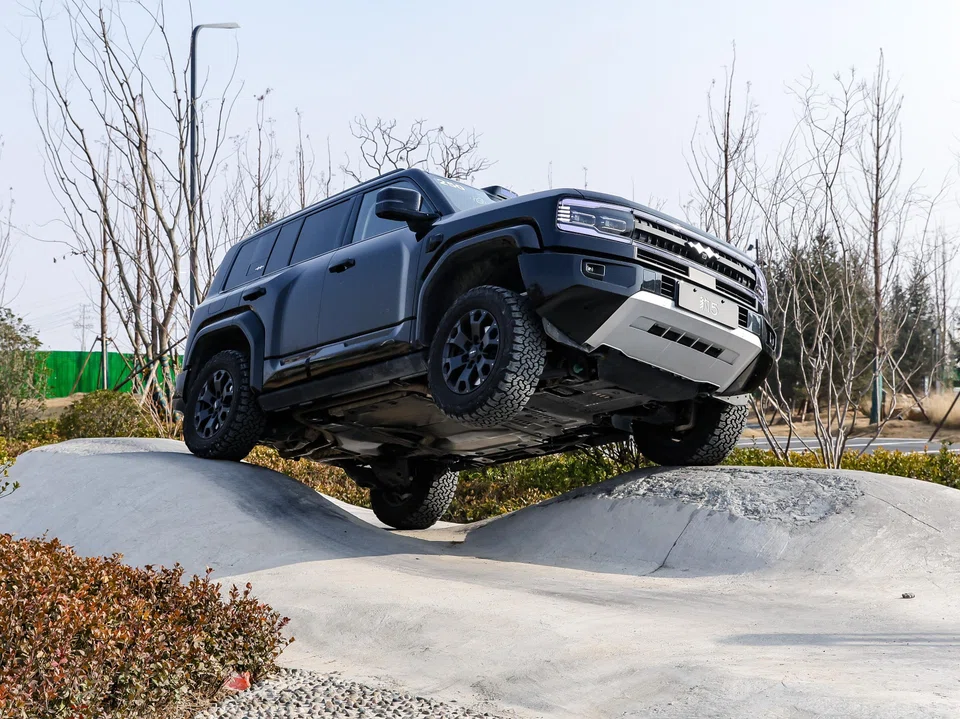
I did get to put a Denza B8, which is BYD’s answer to a Land Rover Discovery, through its paces on the off-road section. That was less about driving skill than trusting the car’s tech as it crawled over obstacles that sometimes put two wheels in the air, with stomach-churning tilt and climbing angles that made me grateful for whatever electronic wizardry was keeping the car’s shiny side up.
Getting customers to audition a variety of cars while high on adrenaline isn’t a new concept. A certain sports car specialist from Stuttgart has been at it for years, operating its “Porsche Experience Centres” around the world, with its 11th location breaking ground in Changi last year for a 2027 opening.
But in China, it’s affordable. At Zhengzhou, prices start at 599 yuan (S$109.60) for passenger rides. Taking the wheel yourself costs 1,599 yuan and up, but that does include a stint in the Yangwang U9, which retails for 1.8 million yuan. Just try to pick a date that doesn’t coincide with a crashaholics convention.
At those prices, BYD is almost certainly subsidising attendees. Even if fully booked every day of the year, it would take decades to recoup the construction cost – and that’s before maintenance, staffing, energy or the cost of replacing wrecked supercars.
BYD Singapore brought around 30 lucky draw winners and fleet buyers to the track in January. Ng says he is mulling over whether to make the experience available to more Singapore customers. “We want to try it out and see if we get a good response. If so, we’ll be catering for more,” he said.
BYD itself is already thinking beyond Zhengzhou, with plans for a third track in Shaoxing next year, followed by an 800-hectare mountain off-road base in China’s east. The company, which sold 4.6 million cars in 2025, is working with the Federation of Automobile and Motorcycle Sports of China to get one million people to experience circuit driving, and eventually nurture 100 professional racers.
“BYD Circuits will accelerate the professionalisation of China’s NEV racing events and reshape China’s automotive culture,” Zhan Guojun, CAMF’s president, said in 2025. The subtext is clear: the expensive race is on to prove that Chinese cars aren’t merely cheap, but thrilling, too.
Decoding Asia newsletter: your guide to navigating Asia in a new global order. Sign up here to get Decoding Asia newsletter. Delivered to your inbox. Free.
Share with us your feedback on BT's products and services
TRENDING NOW

Once staunchly pro-China, Malaysian Chinese businesses are now distancing themselves from Beijing

Stocks to watch: HPL, Aims Apac Reit, Zico, Advanced Systems Automation, ComfortDelGro
‘How many will survive?’: Bubble fears arise as China’s humanoid robotics face reality check
Smaller board lots can’t fix a market run by three banks

