

Quantedge Foundation commits S$50 million to advance social mobility in Singapore
It will launch QOLab, a space for early stage non-profits, and expand its ‘philanthropreneur’ programme
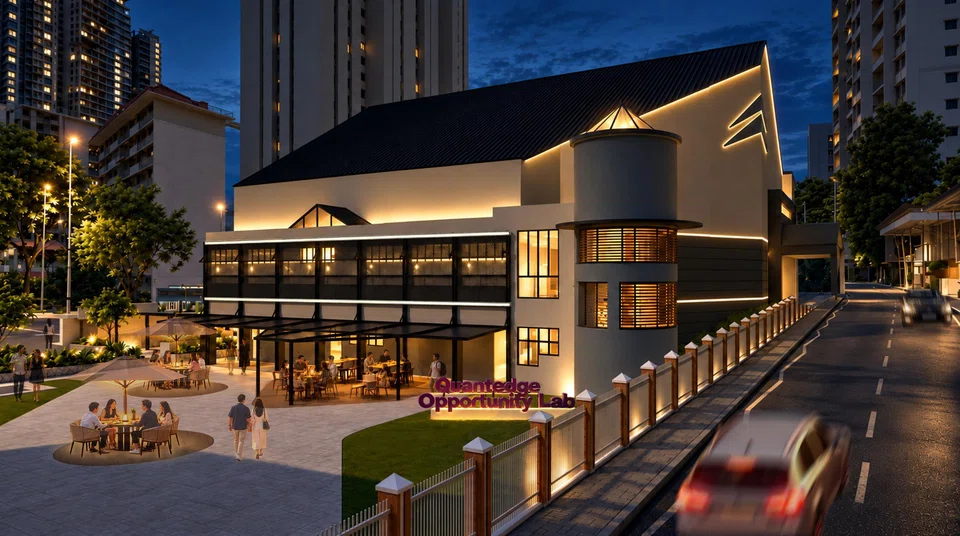
[SINGAPORE] A new facility to help early stage non-profits scale is among the initiatives under a S$50 million commitment by Quantedge Foundation Singapore (QFS) to advance social mobility in the Republic.
Announced on Wednesday (Oct 28), the commitment comes as the charity marks its 10th anniversary.
The funds will go towards three initiatives: the launch of Quantedge Opportunity Lab (QOLab), expansion of QFS’ Philanthropreneur-in-Residence (PIR) programme and a social mobility study.
Xie Yao Quan, CEO of QFS, said: “Our approach to philanthropy will be to bring together systems of practice, policy and evidence, and build an ecosystem of partners to create more opportunities for Singaporeans.”
Shared space to scale impact
QOLab will be a dedicated space to help early stage non-profits focused on social mobility to innovate and scale their impact.
The facility will be located in a three-storey building at 300 Jalan Bukit Ho Swee, a former community centre. Scheduled to open in 2028, it will provide up to 250 residents with co-working and collaboration spaces.
“With QOLab, we want to give promising organisations the space to innovate, grow and scale, while helping them connect with the expertise, resources and partnerships they need to move beyond the pilot stage and achieve greater impact,” Xie said.
In an interview with The Business Times, he said the space will be “highly subsidised, way below market rate” for residents. QOLab will complement Temasek Shophouse and The Foundry, two existing spaces dedicated to social impact.
“The idea is that the foundation will… provide low-cost space to these organisations, so that their resources can be better channelled to their work and reduce their overheads.”
An “involved and holistic” approach
The PIR programme, launched in 2023, provides end-to-end support in capability building for individuals who want to improve social mobility in Singapore.
The multi-year residency is built on partnerships, with QFS working alongside each PIR to co-create, test and scale new approaches to help vulnerable communities.
To expand the programme, QFS will appoint up to two new PIRs annually and make up to S$2 million available over five years to each organisation founded by a PIR.
“It was an experiment to move from traditional grant-making to this model… that is a lot more involved and holistic to support changemakers in creating impact,” Xie said.
So far, QFS has supported six PIRs, two of whom have graduated.
Among the current PIRs is non-profit The Astronaut Collective (TAC), which helps youths transition from school to work through mentoring.
In 2025, TAC launched JumpStart in collaboration with QFS and the Institute of Technical Education (ITE). It is the first mentoring initiative for ITE’s Work-Study Diploma and helps students secure placements by pairing them with a mentor and teaching career readiness skills.
TAC co-founders Marvin Kang and Wong Yi Fong said that TAC and QFS “were aligned in how we thought mentoring would be a scalable lever to support the students to secure and sustain their Work-Study Diploma, as a meaningful career development and social mobility vehicle”.
They added that QFS helped with stakeholder engagement, capacity building and developing networks. “As a very small charity, that sort of influence and support, together with the funding, was instrumental in building trust and credibility in our work.”
Meanwhile, graduated PIR, Happee Hearts Movement’s IDHealth initiative, is Singapore’s first dedicated clinic for people with intellectual disabilities (PWIDs). It worked with QFS to better understand the intersection between intellectual disability and social mobility.
Dr Chen Shiling, founder and executive director of the charity, noted that IDHealth’s priority was demonstrating its impact to government agencies to obtain long-term funding.
“QFS therefore focused… on brainstorming with me, making connections, giving suggestions and eventually helping me concretely with funding to kickstart our research on cost effectiveness of providing healthcare to PWIDs via specialised clinics,” she said.
Digging deep with research
QFS will also launch the Social Networks and Mobility Study to collect data from more than 3,000 households in Singapore’s bottom 40 per cent income group over six years, looking at how social networks influence social mobility.
Since its establishment, QFS – which was founded by the principals of hedge fund company Quantedge Capital – has deployed close to S$40 million towards social mobility efforts.
It takes a “life-course view” to social mobility, said Xie, who is also Member of Parliament for Jurong Central Single-Member Constituency.
“The problem that we see is that there’s a systemic opportunity gap in our society,” he said. “The mission of social mobility is to close the opportunities gap between those… who have more opportunities and those who have less on account of their background and resources available to them.”
Xie added that the gap starts at birth and “compounds through life”.
QFS acts across multiple domains, from financial to technical to social domains, to bridge these gaps. It aims to make a “major push” into practice research and gathering more evidence, which can inform policy and the foundation’s interventions.
Decoding Asia newsletter: your guide to navigating Asia in a new global order. Sign up here to get Decoding Asia newsletter. Delivered to your inbox. Free.
Copyright SPH Media. All rights reserved.
TRENDING NOW

If Europe goes to war, the fallout will be felt in East Asia

Indonesia stocks suffer worst plunge in nearly 30 years as MSCI proposes standalone status
Keppel seeks US$1 billion for Vietnam investments as it joins country’s international financial centre

Philippines’ FDI slowdown exposes uneven investment prospects across S-E Asia

