

How Singapore parents are using AI to give their kids an edge
Mums and dads are creating worksheets and games with artificial intelligence – and potentially reshaping the tuition industry

[SINGAPORE] When Maggie Chan saw her young daughter’s maths worksheet covered in red marks, she did not look for a new assessment book or a tutor.
Instead, she photographed the mistakes, uploaded them to ChatGPT, and asked it to do something other than provide the answers.
“I asked ChatGPT to create a series of interactive, engaging games for my daughter to play and learn at the same time,” says Chan.
At first, what it produced was a series of “basic quizzes”, she recalls. But Chan kept refining her instructions: “Put in more visuals. Make it more fun.”
Soon, her eight-year-old daughter was playing a colourful, candy-themed game designed to help her learn fractions, one of the subjects she struggled with most.
Chan was hooked. An entrepreneur with her own shoe brand, Jaedals, she wanted her elder daughter to benefit from artificial intelligence, too.
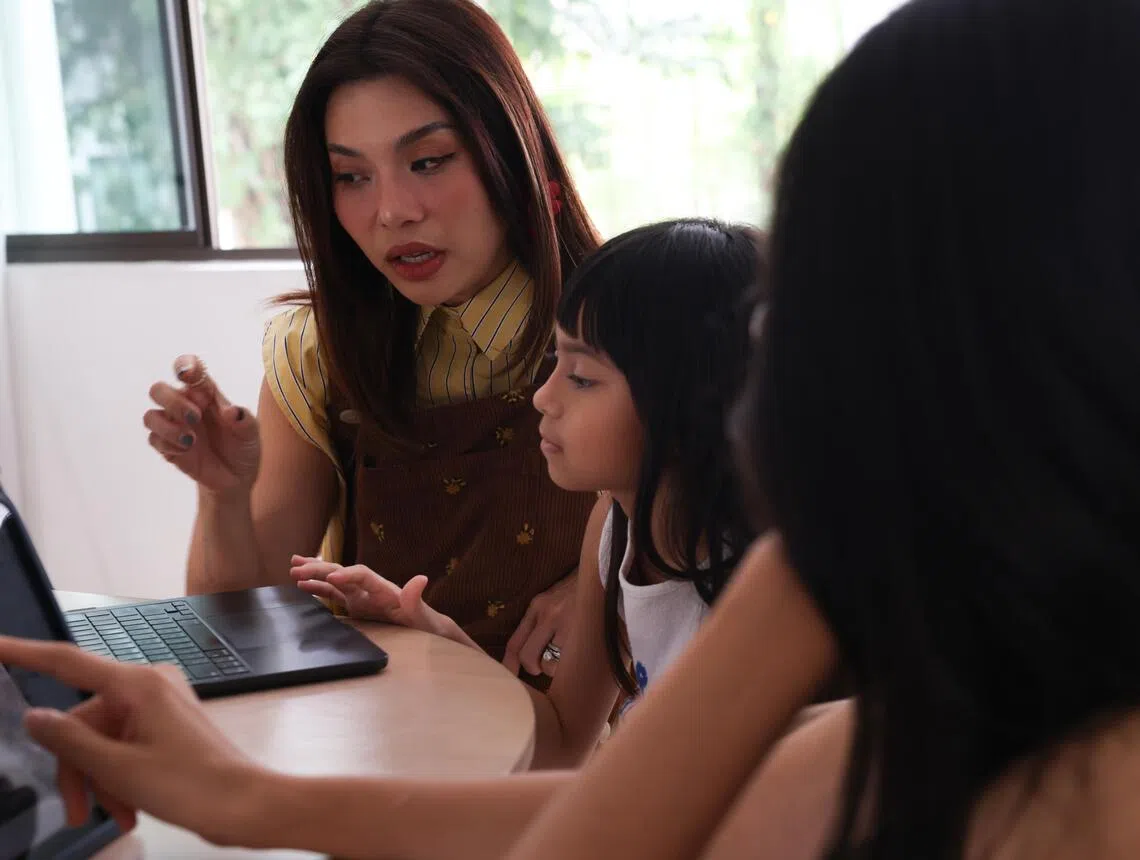
So she tasked the 13-year-old to use AI to create a business plan to sell squishies, the soft sensory toys the teenager collects.
Her daughter had to research where to source and manufacture them, work out costs and retail prices, and figure out how and where to sell them.
“In her case, I didn’t just want AI to teach school subjects – I’m preparing her for things that school doesn’t teach her,” she says.

“After all, AI is going to become more powerful, so we need to educate our children on how to use it wisely instead of being scared of it.”
AI for the youngest learner
Chan is hardly alone. For many Singapore parents, tools such as ChatGPT, Claude and Gemini are becoming everything from an extra tutor and storytelling companion to a research assistant and coding instructor.
Microsoft’s latest AI Diffusion Index ranks Singapore second in the world for AI adoption, behind only the United Arab Emirates. They were followed by Norway, Ireland and France.
It estimates that 63.4 per cent of Singapore’s working-age population was using AI in the first quarter of 2026, compared with 31.3 per cent in the United States and 17.8 per cent globally.
Meanwhile, the education ministry announced in March plans to integrate AI literacy into the school curriculum.
A recent study by researchers from the Agency for Science, Technology and Research and the National University of Singapore found that more than half of Singapore children had used AI by age eight.
In fact, some are encountering it much earlier.
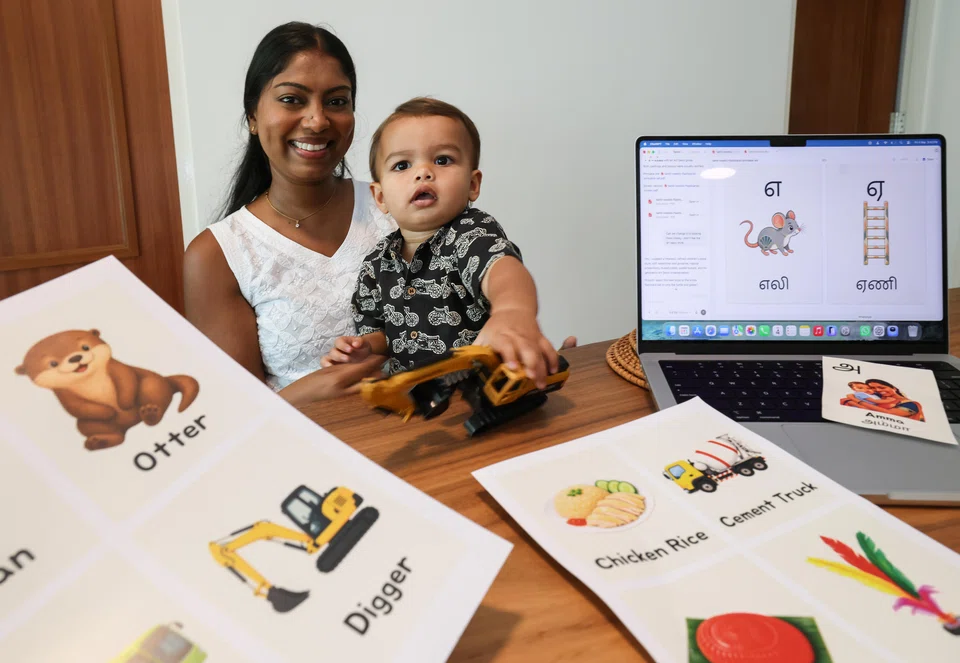
Vela, for instance, is only 18 months old. But he’s already learning new words from picture cards generated by ChatGPT.
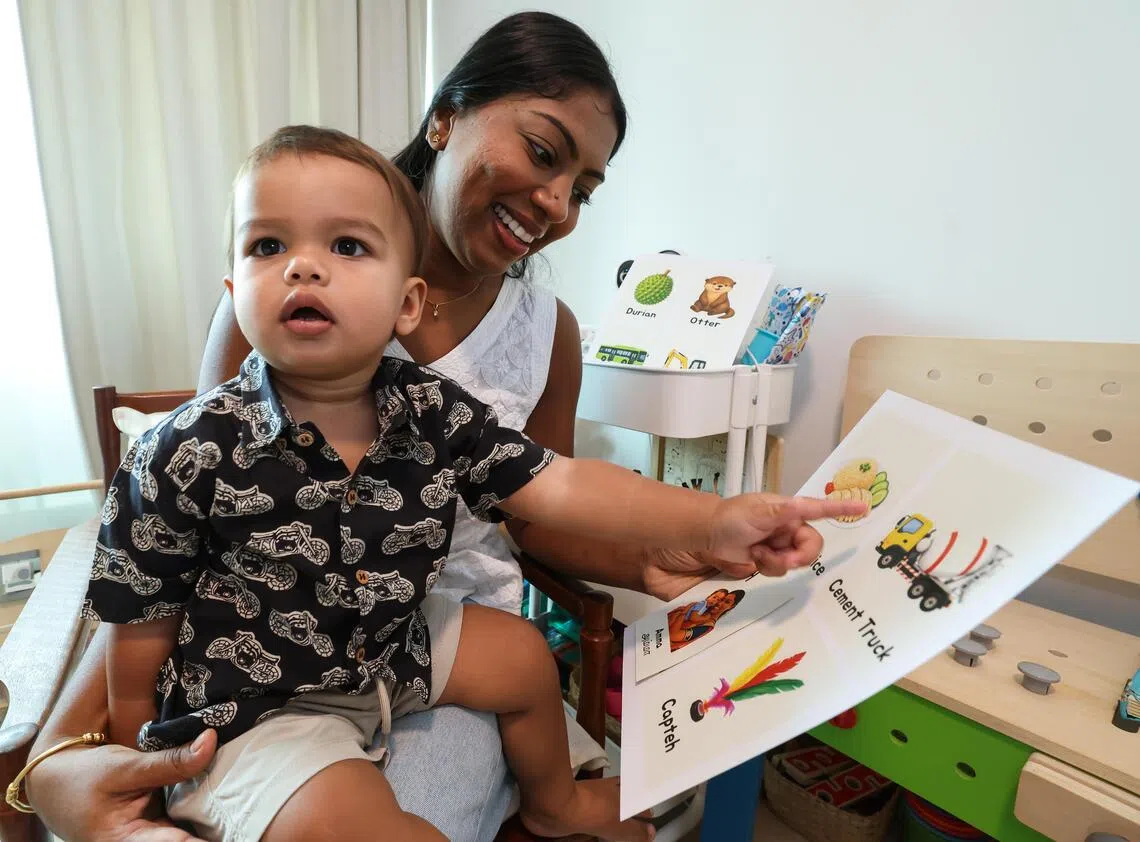
His mother, Durgasena Thanabalan, began making them because mass-market flashcards often felt too Western.
“They feature yellow school buses, pancakes and strawberries,” she says. “But my son sees things like dosa, durians, nasi goreng and chicken rice. I wanted flashcards that reflect his world.”
Thanabalan has also added Tamil words, hoping to familiarise Vela with the script while relearning it herself.
“I speak Tamil every day,” she says. “But I can’t read the script so well anymore, years after leaving school.”
AI has helped her create bilingual learning materials tailored to both her son’s world and their language – which are difficult to find off the shelf.
“Digital dads” make their own tools
Thanabalan knew very little about AI until a friend introduced it to her recently.
But what happens when parents who already work in technology begin applying it at home?
Ethan Ow offers a glimpse of how far that can go.
Ow co-founded Wenti Labs, an AI startup serving the construction industry. At home, the father of two has been using the same technology to create learning tools for his seven-year-old son and five-year-old daughter.
When his children needed something to occupy them one day, he used ChatGPT to build a simple maths programme.
“Instead of asking ChatGPT to generate maths questions, I used (it) to build a programme that can keep generating new questions,” says Ow. “I can make those questions easier or harder depending on how my children are doing.”
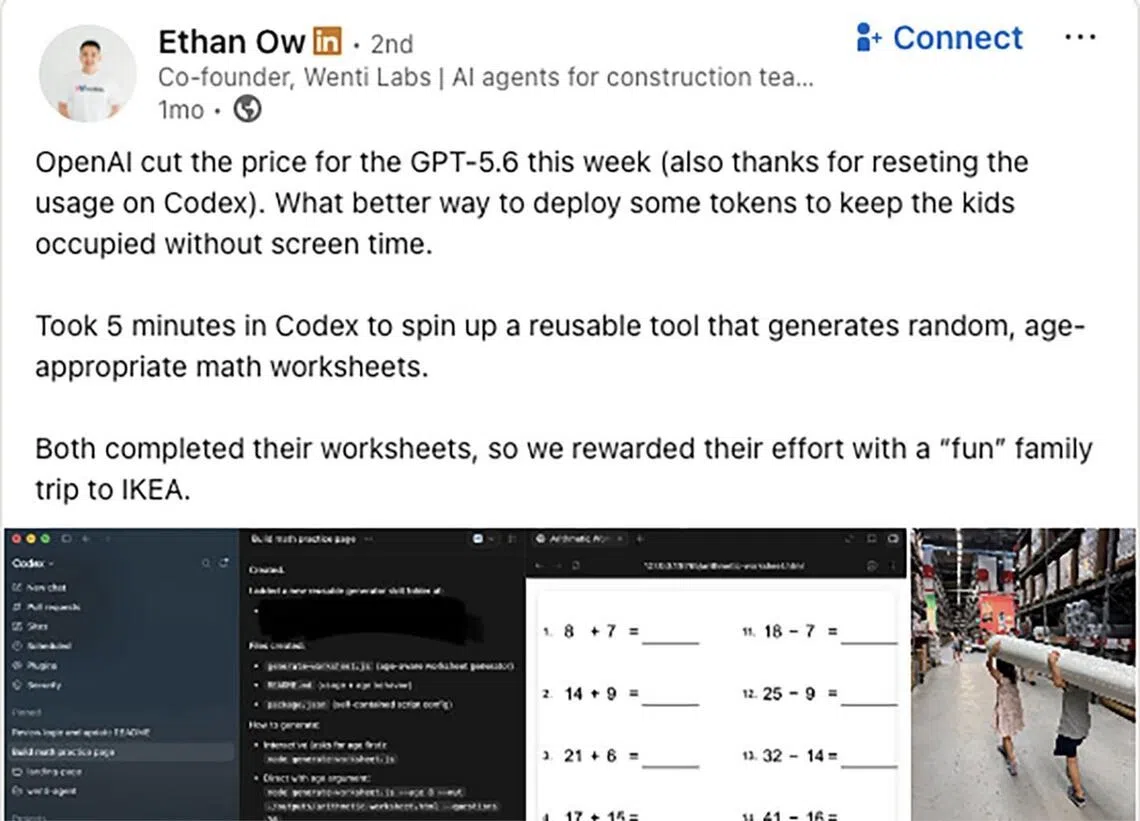
In effect, Ow had made a personalised educational software for his children almost for free.
On another occasion, his children spotted a puzzle game online and wanted to download it. Ow had a different idea: “I toyed around with ChatGPT, and within 30 to 40 minutes, I had an advertisement-free version they could safely play with.”
He also uses ChatGPT to generate progressively harder challenges for his son’s programmable Makeblock robot. Rather than using AI to provide answers, he gets it to set problems: make the robot move straight, navigate an obstacle, and so on.
“The experimentation becomes so much faster,” he says. “You can think of something and make it come to life.”
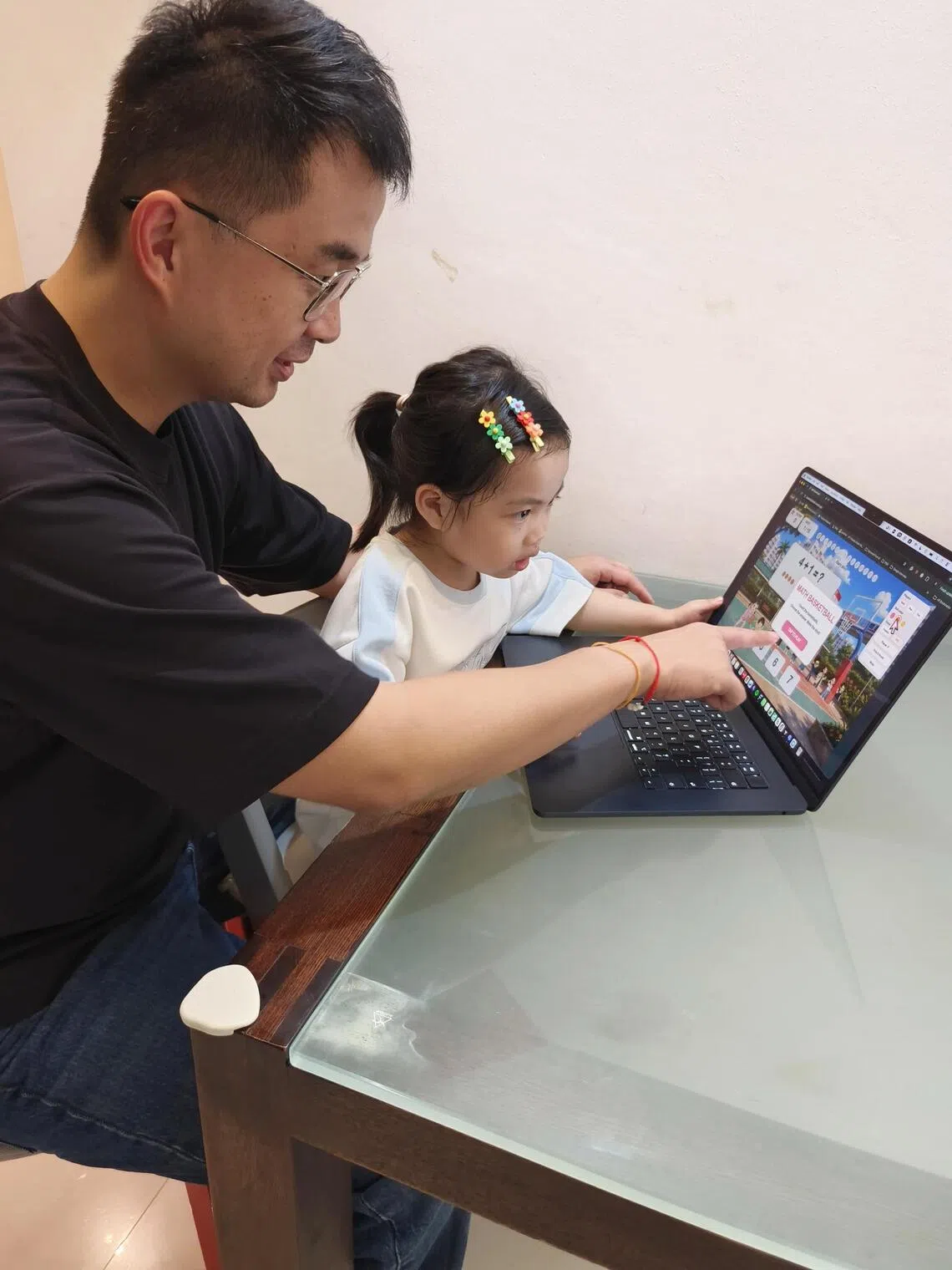
Another “digital dad”, Brandon Lim, takes a similarly hands-on approach. After learning AI-assisted coding earlier this year, he told his four-year-old daughter: “I can build you a game. What do you want?”
Her request was very specific: she wanted a game featuring herself and her cousin riding a bicycle to a Housing & Development Board block. His wife suggested making it educational.
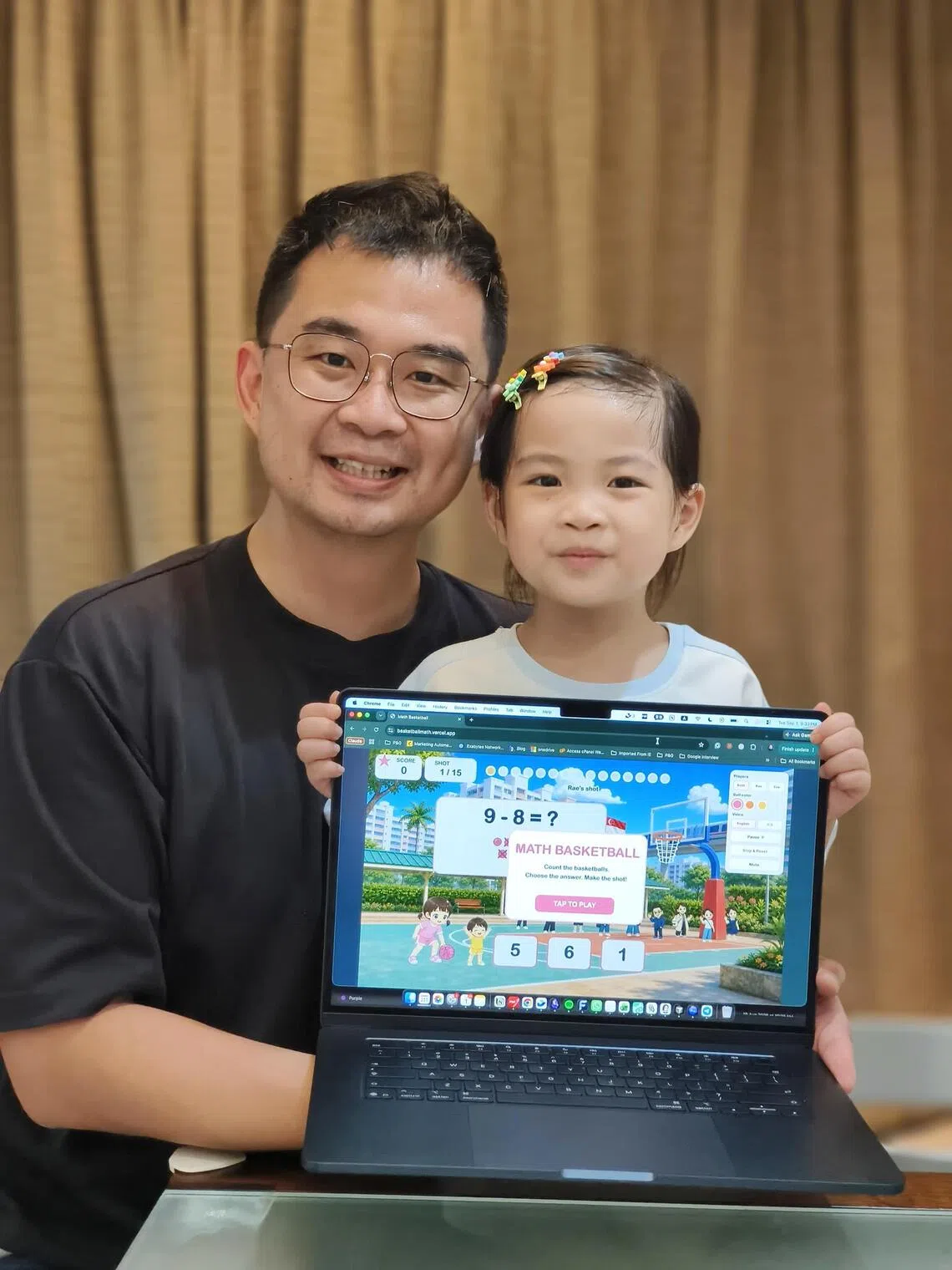
Lim began weaving in what his daughter was learning in school – numbers, phonics, the alphabet and healthy eating – while keeping the characters and settings familiar to her.
“It’s her and her cousin doing things that she wants to do, while learning the things that I want to reinforce.”
Still, the tech-industry professional is wary of excessive screen time. “Every time she gets screen time, I try to make sure it’s either an educational moment or a bonding moment,” he says. “I call it ‘screen time for good’.”
Another tutor in the room
Most parents interviewed by The Business Times said ChatGPT was their main AI tool because it was the platform they knew best. Similarweb estimated 5.6 billion visits to ChatGPT in May 2026, versus 2.9 billion for Gemini and 953 million for Claude.
But some parents are experimenting with alternatives.
Home designer Bryan Soh, for instance, uses Claude to organise presentation notes, suggest material and colour combinations, and structure preliminary cost information quickly.
“I prefer Claude because of how well it works with PowerPoint,” he says.
At home, however, he also turns to it to support his two sons’ schoolwork.
For his younger son, 10, Soh uses Claude to work through difficult maths questions first, so he understands the method before explaining it.
For his elder son, 13, he uploads photographs of compositions and asks Claude to comment on their structure, clarity and arguments.
Both boys go for tuition, but Soh says that does not remove the need for him to stay involved. He says: “I still want to understand what they are learning, so that when they need help, I can help them too.”
That coexistence – paid tuition alongside AI tools – raises a bigger question for Singapore’s education economy.
The S$1.8 billion question
In Singapore, families spend heavily on education outside school.
According to the Department of Statistics, households spent an estimated S$1.8 billion on private tuition in 2023, up from S$1.4 billion in 2018 and S$1.1 billion in 2013.
Among married-couple households whose youngest child was aged seven to 15, average monthly spending on education reached S$1,058 in 2023. Private tuition alone accounted for S$548.
AI is unlikely to make that tuition industry disappear. Chan’s children, for instance, still receive tuition for selected subjects. Her younger daughter takes Mandarin tuition because the family barely speaks the language at home.
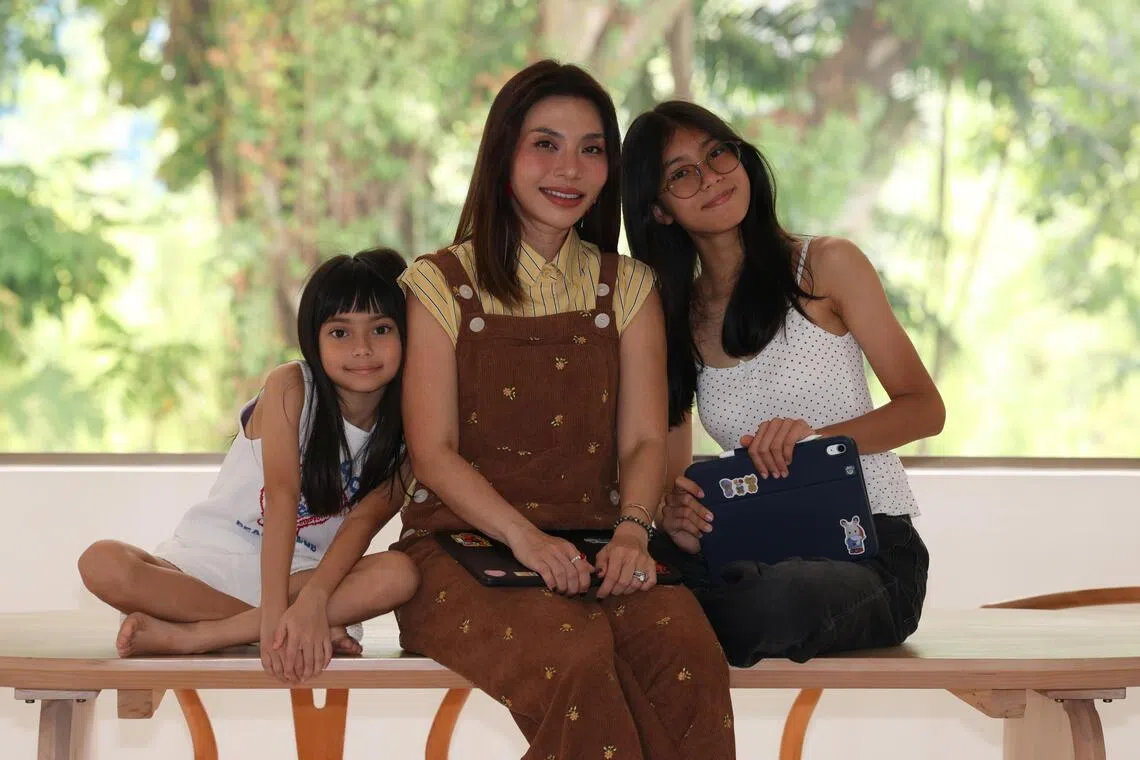
Maths tuition, meanwhile, is non-negotiable. “Sometimes I look at a PSLE question and I can’t even answer it,” Chan admits, referring to the Primary School Leaving Examination.
But AI is increasingly giving parents access to some of what they once had to pay for: worksheets, explanations, feedback and learning materials tailored to an individual child.
Businesses whose value lies in supplying educational content may come under pressure. The implications could extend beyond tuition centres to assessment-book publishers, enrichment providers and education-software producers.
At the same time, none of the parents interviewed can say definitively that AI has improved their children’s grades. What they can say is that it has made it far easier to take part in their children’s learning – without having to become teachers themselves.
Knowing when to switch off AI
For all its possibilities, AI also raises some persistent questions. How much screen time is too much? What is constant digital stimulation doing to children in their formative years?
How should children think about the ideas AI generates – considering that it draws on vast amounts of existing material, including copyrighted works?
Lim says he restricts AI-related activities to only 10 to 15 per cent of the time he spends with his daughter. She still reads books, plays with Lego and has what the family calls a “calm corner”, where she can sit alone and simply daydream.
Soh thinks the more powerful AI becomes, the more important it may be to teach children when not to use it. “I have frequent chats with my boys about when to stop using it and when to work something out themselves, with no help from digital devices.”
That seems to be the paradox facing the first generation of parents raising children alongside generative AI.
The technology can now produce flashcards, explain maths problems, review compositions and build games.
But it still can’t decide when a child needs help, when they need to struggle a little longer, when they should be left alone to daydream, or how they can juggle ambiguity and uncertainty.
That judgment still belongs to parents and teachers.
As Soh puts it: “AI can create educational content very quickly and cheaply. But the motivation and discipline to learn, the judgment about when to use it and when not to use it – that is still very much part of parenting.”
Decoding Asia newsletter: your guide to navigating Asia in a new global order. Sign up here to get Decoding Asia newsletter. Delivered to your inbox. Free.
Copyright SPH Media. All rights reserved.






