

Subaru e-Outback review: Japan’s best EV uses one key Chinese component
The E-Outback is Subaru’s boxy, button-covered flagship, and the most convincing evidence yet that Japan is back in the electric fight
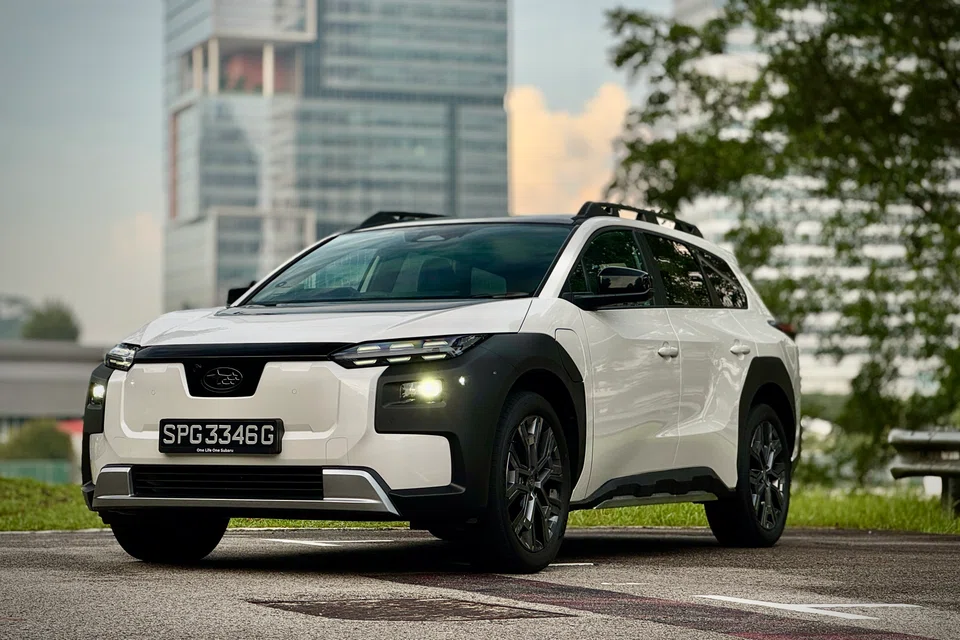
[SINGAPORE] Like an avenger from Japan, the Subaru E-Outback has landed here to defy the electric vehicle norm that the Chinese have converged on. In the futuristic world of Sino EVs, straight lines are banned, and every car leaves the factory looking so sleek that the very air can’t bear to stand in its way.
The E-Outback, effectively Subaru’s flagship in Singapore, is not that kind of EV. It’s boxy, chunky, and from certain angles, looks less like a vision of the future than the distant cousin of a fridge. It is also littered with old-fashioned physical buttons and knobs. And it is, above all, brilliant.
The price tag is S$215,800, which I’d call competitive, given its size and the fact that it packs 381 horsepower and 536 Newton-metres of torque from two electric motors. That’s enough to blast it to 100kmh in 4.5 seconds, which is as quick as the first Ferrari I ever had the pleasure to drive in Europe, the 360 Spider. That car blew my mind then, and it blows my mind now that a family Subaru is just as speedy.
Of course, a 4.8-metre long sport utility vehicle (SUV) is slightly less glamorous, but the Subaru can do things no open-top Ferrari can: cart families around, plus all the gear that makes their lives interesting.
At this point, it’s worth pointing out that despite its name, the E-Outback isn’t a version of the Outback (a petrol crossover not sold here) with its combustion guts ripped out and electric components transplanted in their place.
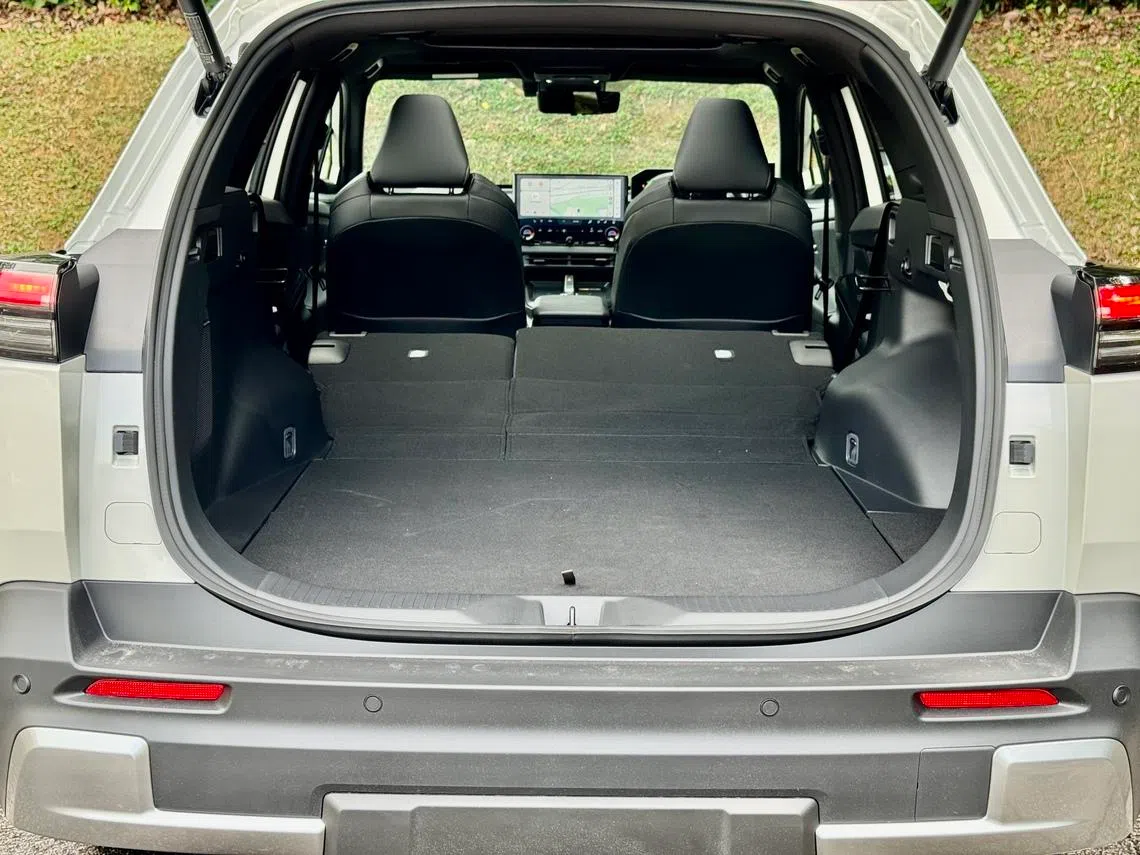
Instead, it’s effectively an extended version of the Solterra, the EV that Subaru co-developed with Toyota. It’s nearly 16 cm longer, with the bulk of the added length in the caboose area. The boxy shape back there might not help the E-Outback slip through the wind, but it does make the boot vast, at 619 litres with the rear seats in place. The cargo space is also thoughtfully designed; it has hooks and loops for securing things, a place to stow the luggage cover, and levers that let you fold the rear seats flat from the boot itself.
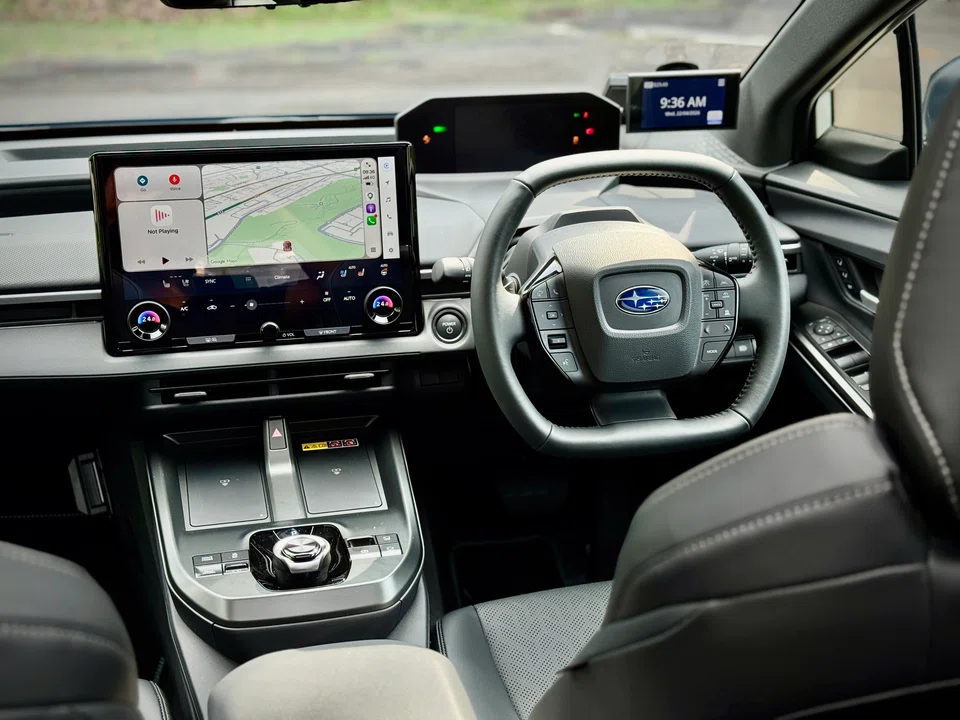
While the boot and roof rails hint at a life of weekend adventure, the interior plays things decidedly straight. The 14-inch centre touchscreen is sharp and easy to navigate, but the real pleasure is everything around it: real switches, real knobs and an air-conditioning system you can aim and adjust without navigating a submenu.
In fact, the interior is likely to expose a fault line in car buyers, who will either think it’s terribly user-friendly (because it is) or horribly outdated (because EVs have convinced people that touchscreen controls are slick).
But perhaps the E-Outback’s true appeal is that it drives like a car created by car people. Yes, it’s silent and the dual-motor punch is fearsome, but it’s old school in how the steering has heft and lets you know what the front tyres are up to, and how the brakes feel natural and progressive. The suspension is firm enough to keep the body on an even keel, but soft enough to keep you from the chiropractor’s bed.
Insiders say Subaru had more say in the E-Outback’s tuning than in the Solterra, which had more Toyota input. The two have different suspension parts, such as dampers and bushes, accordingly.
The E-Outback does have one Chinese component, though: its 71 kilowatt-hour battery pack uses cells from CATL, the giant that supplies 40 per cent of the world’s EVs. It’s good for a claimed 441 km and 150 kW fast charging takes it from 10 to 80 per cent in 30 minutes, which are decent numbers.
Less decent is the road tax, levied on motor output, which is an eye-watering S$4,712 a year. Inexplicably, the Subaru doesn’t have a glovebox, and what’s more, it lacks a companion smartphone app to let you operate certain things remotely, such as the air-con.
Still, I daresay the E-Outback is the best EV from Japan I’ve driven. It reminded me that, impressive as they are, many Chinese EVs are a soporific experience, with vague steering, mushy brakes and wallowy suspension. Its controls and switches are a cinch to use, too.
Ultimately, the E-Outback is a variation of Subaru’s maiden pure EV attempt, so it’s competitive rather than a Chinese EV-killer. Future models could change that, of course. A good vengeance takes time to brew.
Subaru E-Outback
Motor power/torque 381 hp/536 Nm Battery type/capacity Lithium-ion nickel manganese cobalt/71 kWh Charging time/type 3.5 hrs (22 kW AC, estimated)/30 mins 10-80 per cent (150 kW DC) Range 441 km 0 to 100 kmh 4.5 seconds Top speed 180 kmh Efficiency 17.6 kWh/100 km Agent Motor Image Enterprises Price S$215,800 with COE Available Now
Decoding Asia newsletter: your guide to navigating Asia in a new global order. Sign up here to get Decoding Asia newsletter. Delivered to your inbox. Free.
Share with us your feedback on BT's products and services






