

History in the details as always for Longines
Its four latest novelties connect different chapters of its history through distinctive displays, classic shapes and improvements in comfort and performance
FOUNDED in 1832, Longines has nearly two centuries of history to draw on for new designs. Its latest launches reflect the breadth of that legacy, from early wrist chronographs, Art Deco shapes and an unusual power-reserve display to the continued evolution of its modern diving watches. The appeal lies in details that remain relevant to the wearer today.
The Master Collection Chrono Monopusher
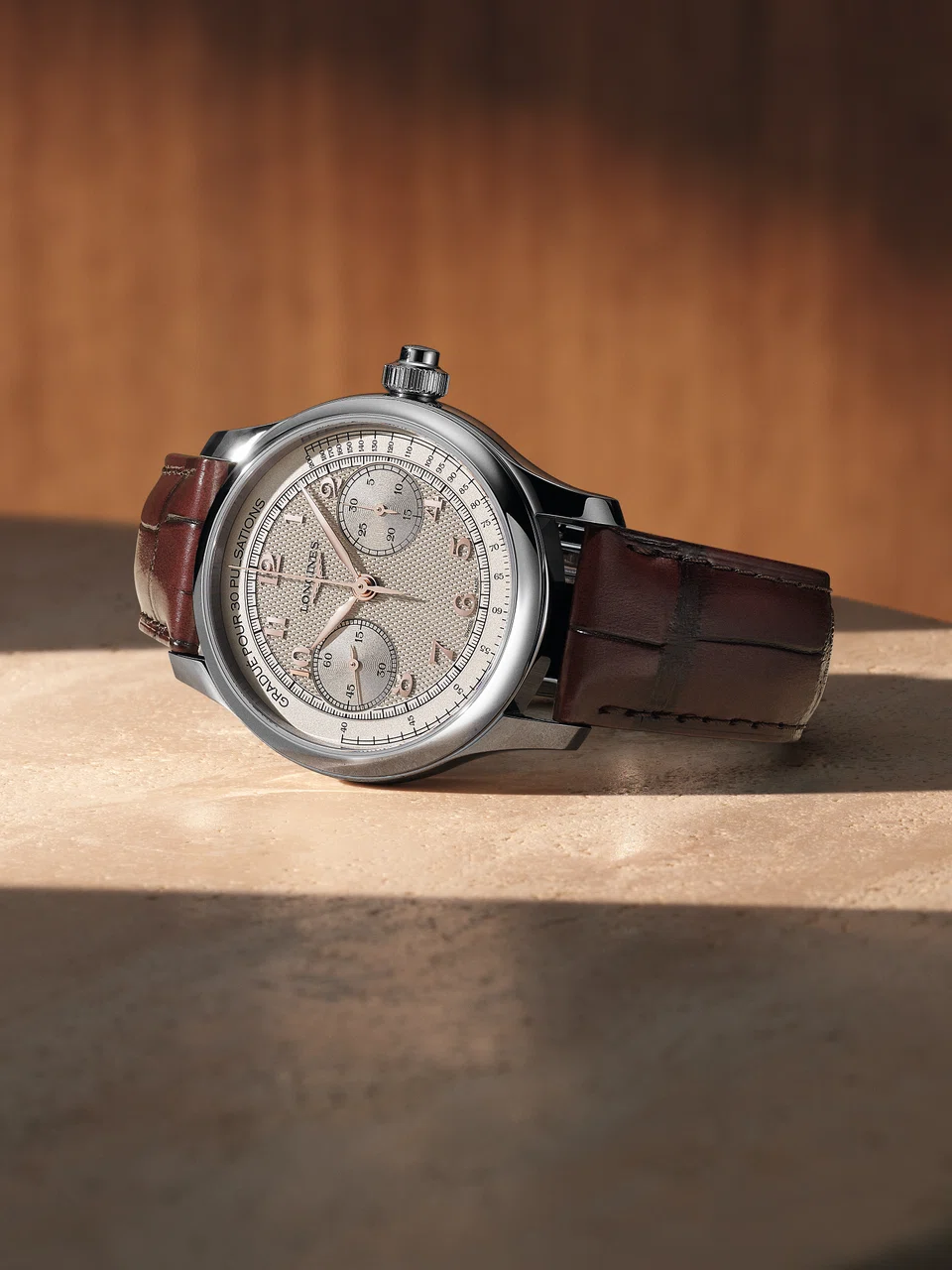
Launched more than 20 years ago, the Master Collection unites Longines’ classical styling and mechanical watchmaking expertise. The redesigned line introduces its first monopusher chronograph in two 41 mm steel versions, one of which features a silver opaline dial with a barleycorn guilloche motif, rose-gold-plated Arabic numerals and matching hands. A brown alligator strap complements the dial’s warm accents.
A button integrated into the winding crown controls the chronograph’s stopwatch function. Successive presses start, stop and reset the timing hands, keeping the case free of the separate pushers found on many contemporary chronographs. Small seconds at nine o’clock balance a 30-minute chronograph counter at three o’clock, while a central hand records elapsed seconds.
The pulsometer scale around the dial’s outer circumference allows the wearer to measure a heart rate by timing a set number of heartbeats – typically 30 – and reading the corresponding beats-per-minute rate directly from the scale. First developed for doctors and nurses before the advent of electronic heart-rate monitors, it enabled quick pulse readings using a wrist- or pocket-watch chronograph. Still functional today, it gives the vintage styling a connection to the practical origins of these watches.
Longines’ expertise in monopusher chronographs for the wrist dates back to 1911, a significant advance at a time when most chronographs relied on large pocket-watch movements. In 1913, it refined the concept with Calibre 13.33Z, recognised as the world’s first compact chronograph movement and developed in several variations noted for their precision and reliability. Its early wrist chronographs also accompanied pioneering aviators, including Amelia Earhart and Richard Byrd, establishing connections with aviation and exploration that would become an important part of the manufacture’s history.
The new model gives those references a contemporary setting. A concave bezel defines the case, while snail-engraved sub-dials and sandblasted detailing around the dial’s outer edge create contrasting textures.
Visible through the sapphire caseback is the Longines-exclusive L799.5, a new hand-wound movement with up to 68 hours of power reserve. The column wheel controls the chronograph’s start, stop and reset functions, while the lightweight and corrosion-resistant silicon balance-spring resists magnetic interference.
For a comfortable fit, the strap’s triple-folding safety clasp includes a micro-adjustment system.
The Conquest Heritage Central Power Reserve
An unusual power reserve display from a 1959 Longines watch provides the inspiration for the Conquest Heritage Central Power Reserve. Two rotating discs show how much running time remains before winding is needed, placing the information at the centre of the dial and making it a defining feature of the design. A baton-shaped indicator on the inner disc shows the remaining reserve against an outer scale graduated from 64 to zero hours. The outer disc turns as the watch is worn or wound, while the relative positions of the two discs track the available energy as the movement runs. The arrangement offers a distinctive alternative to the small hand and arc commonly used for this function.
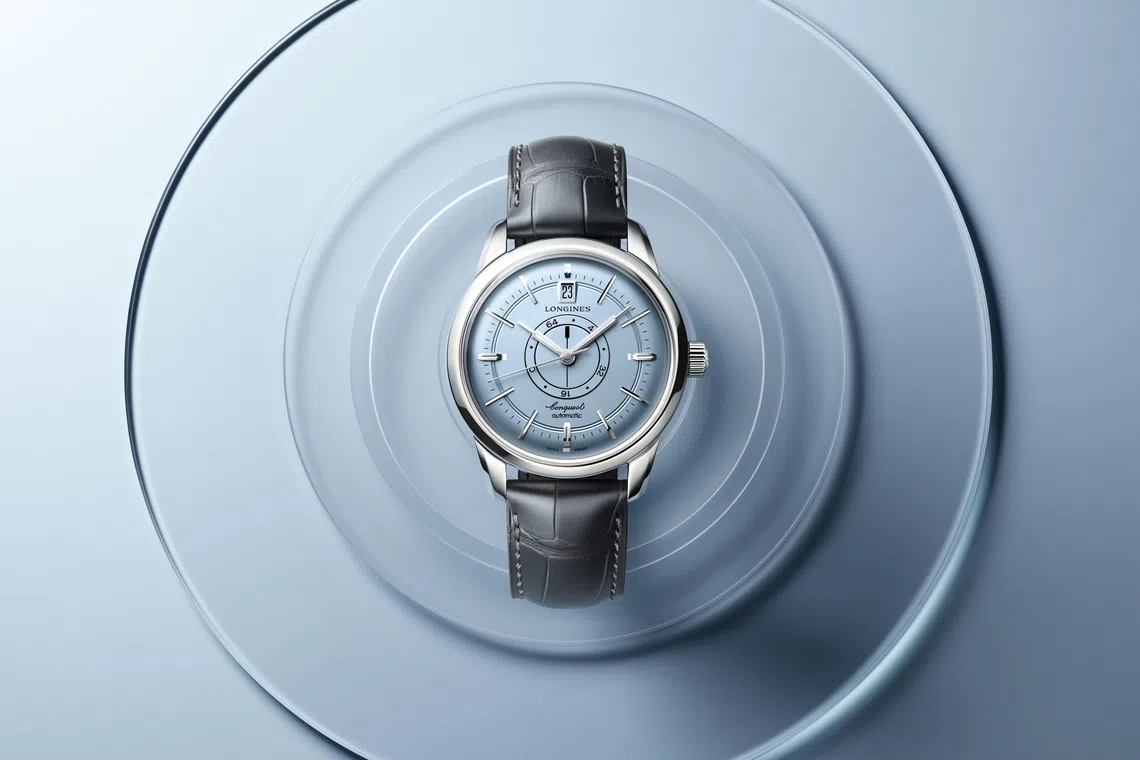
Longines revived the design in 2024 for the Conquest collection’s 70th anniversary. The latest version pairs a light blue opaline dial with a grey alligator leather strap and heritage pin buckle, giving the mid-century styling a fresh colour combination. The 38 mm steel case combines alternating satin-brushed and polished finishes, topped by a box-shaped sapphire crystal. Facetted applied indexes and luminous skyscraper-style hour and minute hands frame the central display, while a trapezoid-framed date window at 12 o’clock adds a distinctive touch. Powering the watch is the self-winding L896.5 movement, visible through a sapphire caseback and offering up to 72 hours of power reserve. Water resistance to 50 m adds everyday practicality to the heritage design.
The DolceVita
Launched in 1997, the DolceVita collection for women is inspired by a rectangular Longines watch created in 1927, blending balanced proportions and Art Deco character with relaxed elegance. The latest additions refresh the familiar design with patterned dials and three new strap colours inspired by Mediterranean landscapes and light. Here, a maple-red leather strap complements a 23.3 mm by 37 mm stainless steel case framing an ivory rose-gold flinque dial. Its geometric patterns catch the light, creating depth and a subtle sense of movement across the face.
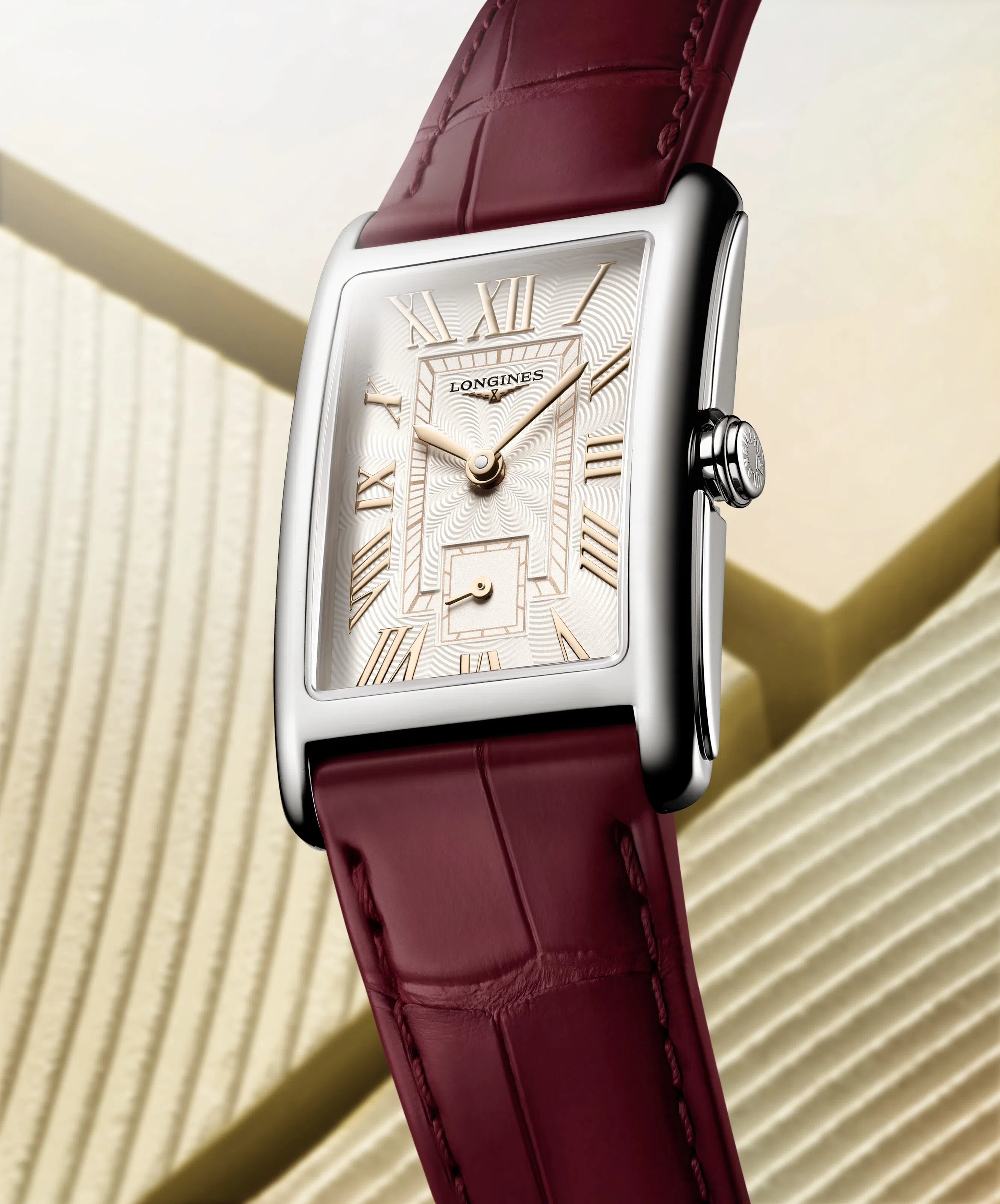
Rose gold-toned Roman numerals and matching hands lend warmth to the ivory background, while the signature small-seconds subdial at 6 o’clock adds a classic detail. An interchangeable strap system allows the wearer to change the watch’s appearance with ease. Powered by the L176.2 quartz movement and water-resistant to 30 m, the timepiece combines everyday convenience with the elegance of a classical dress watch.
The HydroConquest
Introduced in 2007, the HydroConquest represents a more recent chapter in Longines’ history. Inspired by maritime adventure, it combines robust performance with refined styling suited to active pursuits and dressier occasions. Ceramic bezels followed in 2018, while the GMT models launched in 2023 established the design direction developed further in the latest range.
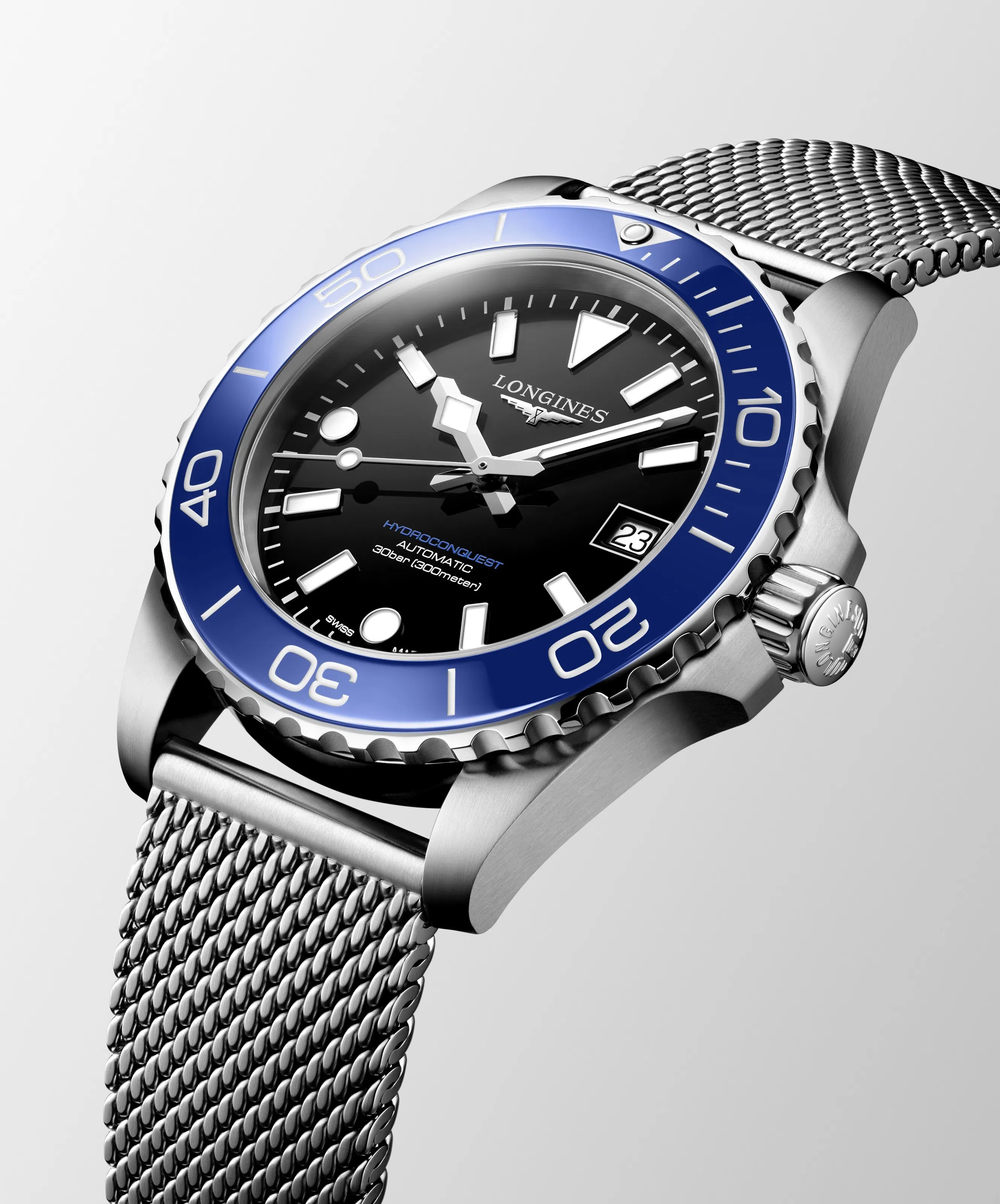
The extensively redesigned collection comes in 39 mm and 42 mm sizes. The featured 39 mm model combines luminous applied indexes with a unidirectional ceramic bezel, a screw-in crown and water resistance to 300 m. The bezel adopts a mechanism from the Ultra-Chron Diver for a more tactile feel when turned, with a luminous capsule at the zero marker improving visibility in low light. Stainless steel Milanese mesh bracelets also make their debut in the collection on three additional references. Brushed surfaces contrast against polished sides, while the tapered mesh construction offers comfort and breathability. Improved shortening links simplify sizing, with a micro-adjustable clasp allowing the wearer to further fine-tune the fit when needed. Powering the watch is the self-winding L888.5 movement with up to 72 hours of power reserve. Its silicon balance spring and other components provide resistance to magnetic fields that exceeds ISO 764 requirements by up to 10 times.
Decoding Asia newsletter: your guide to navigating Asia in a new global order. Sign up here to get Decoding Asia newsletter. Delivered to your inbox. Free.
Share with us your feedback on BT's products and services
TRENDING NOW

World’s largest offshore wind platform by Seatrium consortium on track to be completed by 2028

Is stamp collecting enjoying an analogue revival or are its best days over?

GovTech retrenches another 38 staff in second round of layoffs

MBS adjusted property Ebitda falls 20.6% in Q3 with fewer high-roller visits, weaker hold

