A short-term monitoring method that’s driving habit change for Singapore’s diabetics
A cheaper but still effective use of continuous glucose monitors is being adopted in local healthcare
[SINGAPORE] When eaten, a slice of bread can cause blood sugar levels to spike in one person, but not another. That’s because a confluence of factors, including one’s gut microbiome, insulin sensitivity, genetics, meal order and lifestyle factors, can produce different results.
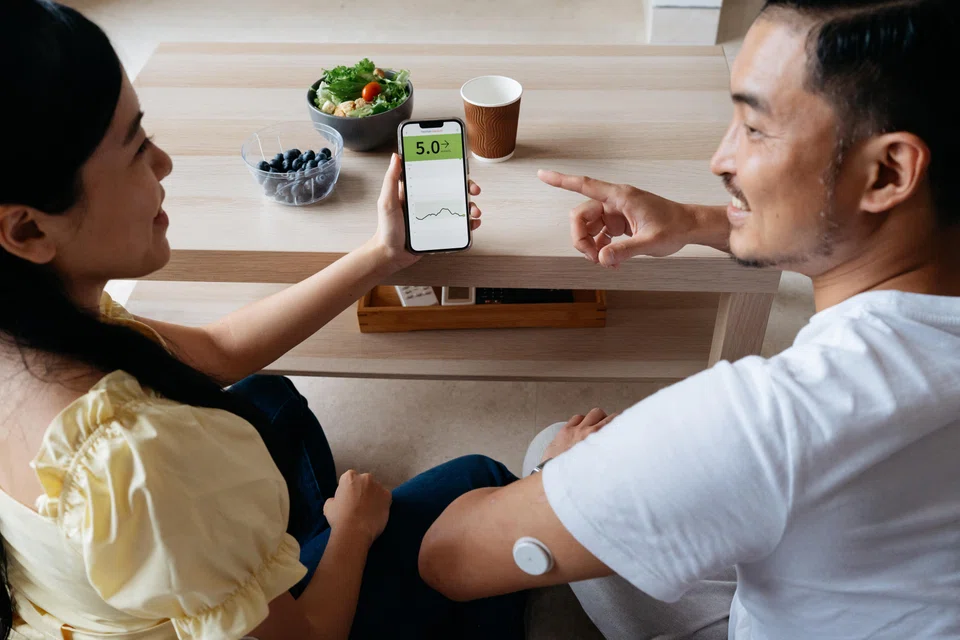
With the advent of continuous glucose monitors (CGMs), however, figuring out how one responds to food and exercise is no longer a guessing game.
CGMs comprise small transmitter discs, roughly the size of a 50-cent coin, usually worn on the back of the upper arm. Each comes with a sensor in the form of a very thin, flexible filament that’s easily and painlessly inserted beneath the skin using an applicator.
The filament measures glucose levels in the interstitial fluid and sends data to the user’s mobile phone app, showing them real-time trends.
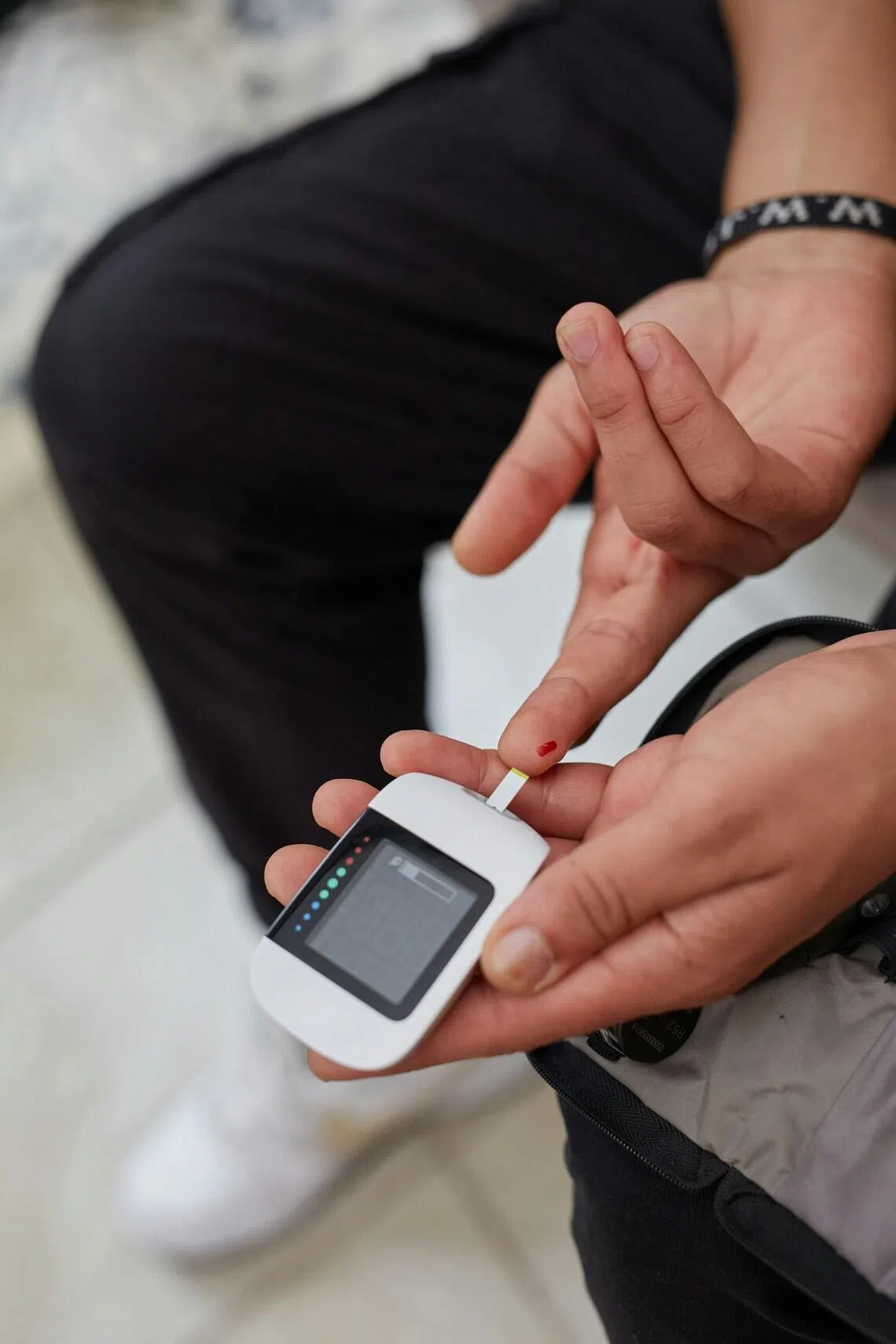
CGMs are accurate and remove the pain and inconvenience of finger-prick tests – which a Singapore survey has found that 51 per cent of patients don’t do because of the inconvenience, notes Dr Kenneth Lee, regional medical director at Abbott.
Another downside of finger-prick testing is that it provides only snapshots of glucose levels at that specific point in time.
By showing how a particular meal or physical activity affects glucose levels and whether a treatment change is working, CGMs give both doctor and patient a more complete and immediate view, even while the user is asleep.
“It does not mean the earlier approaches were ineffective,” says Dr Dinesh Mahendran, medical director and consultant endocrinologist at The Metabolic Clinic.
“Rather, it provides the information needed to fine-tune medication and makes lifestyle advice more specific. CGMs work because they de-mystify how our bodies process glucose, which is the cornerstone of diabetes management.”


But while CGMs have been available for years, their cost – at about S$100 for each sensor, good for around two weeks – can be prohibitive. Subsidies are available only to patients with specific conditions such as Type 1 diabetes, which is caused by an autoimmune disease.
However, the vast majority of diabetics in Singapore fall under Type 2 – where the body either resists the effects of insulin or doesn’t produce enough of it, leading to persistently high blood sugar.
Over time, this can harm nerves and blood vessels, leading to kidney damage and heart disease.
Even if cost is not an issue, the idea of wearing CGMs indefinitely – however discreet and painless – can also be off-putting to some.
A case for short-term use
To benefit from the use of CGMs while avoiding expensive, longer-term use, Singapore’s healthcare system has been moving towards structured and more affordable intermittent use of the devices in the past year, including in primary-care settings.
A programme introduced last October that ran till February 2026 at the National University Hospital (NUH) used just three CGMs over six weeks, with nurse-led coaching every two weeks.
The 56 participants had Type 2 diabetes and a median HbA1c – a test measuring blood sugar levels over the past two to three months – reading of 11.5 per cent. Diabetics should aim to go below 7 per cent.
The programme’s goal was not simply to help patients track data, but to also drive behavioural change when the patient engages with the information.
Since the way the body handles food varies between individuals and changes as one grows older, the CGMs’ ability to provide granular feedback on the body’s reaction means patients can adjust their diets, meal composition, exercise and medication.

“The first sensor builds awareness. The second tests behaviour change. The third reinforces it,” says Dr Khoo Chin Meng, head and senior consultant endocrinologist at NUH. “After that, many patients don’t need it all the time.”
Indeed, Nursyafiqah A Yazid, NUH’s advanced practice nurse and certified diabetes educator, says that by the time patients return for a review after two weeks of wearing their first CGM, they would have noticed changes to their glucose levels based on their diets and exercise. They also had many questions.
“Our main goal was to improve self-management behaviour, so this was very encouraging because it meant they were actively involved in their self-care instead of me telling them what to do,” she says.
A handful of the patients even did well enough to stop taking insulin.
The success of the programme led to its full implementation at NUH, where nurses or the hospital’s pharmacists – not just doctors – can initiate this short-term use of CGMs for interested patients.
Even when the patients returned for a review three months after their last CGM, their HbA1c came down by a mean of 1.5 per cent, which Dr Khoo says is “an amazing number” because many diabetes medications can’t even achieve such a reduction.
A similar study was done at National University Polyclinics (NUP) from September 2024 to June 2025. In this study, patients wore the CGM for a total of four weeks over a 12-week period.
The goal was to achieve a sustained reduction in HbA1c of 0.5 per cent, as this is linked to a significantly lower risk of developing diabetes-related complications over time.

Of the 30 patients recruited, 24 achieved a significant HbA1c reduction of over 0.5 per cent; 11 of them even notched a reduction of 2 per cent or more.
Dr Cheah Ming Hann, head of Jurong Polyclinic, family physician and consultant at NUP, says these outcomes “far surpassed what we had initially hoped to achieve”.
Following the success of the study, NUP also formally adopted the programme into its practice guidelines.
In addition, intermittent use of CGMs can also be initiated for pre-diabetics, pregnant women and diabetics who are travelling and want sensor readings to guide them on food choices.
Essentially, Dr Mahendran says, short-term CGM use does not make patients dependent on the technology; it shows them a pattern which they can learn from.
That’s because patients – empowered with an understanding of what food does to their bodies – are motivated to change their habits, such as by adjusting their meal composition, portion sizes, food sequencing and physical activity to reduce glucose levels.
True enough, six months after they tried the CGMs, most of NUH’s patients were still able to maintain about a one percentage point drop from their baseline glucose levels, even though they were no longer using CGMs.
A side benefit is that patients also tend to lose weight as they adjust their eating habits, adds Dr Khoo, who recommends patients use a CGM once every two months thereafter so they don’t regress.
For Mark Hoh, a six-week use of CGMs under Dr Ester Yeoh, medical director and senior consultant endocrinologist at Aspen Diabetes & Endocrine Clinic, made the consequences of his food choices and physical activity more visible and immediate.
“It made me much more mindful about my lifestyle choices and showed me that managing diabetes effectively requires more than just medication,” says the Type 2 diabetic of many years, who feels he has taken back control of his health.
As his diet and readings improved, his insulin prescription was reduced. He eventually switched to oral medication.
His HbA1c fell from 10.9 to 9.4 per cent during the six-week period, to 7.5 per cent a few months later, even though he was no longer using CGMs.
Dr Mahendran says that to help manage costs for patients who are paying out of pocket, CGMs can be used intermittently once these patients get a sense of how their body responds to stimuli.
He asks his Type 2 diabetic patients not on insulin to wear a CGM for two weeks before a consultation every three to six months, or after a treatment change, rather than wear it continuously.
Factors to consider
Doctors emphasise that crucial to successful intermittent use of CGMs is having a clear purpose.
“The patient should understand what we’re trying to learn,” says Dr Yeoh. “For example, whether particular meals or specific food items are causing post-meal spikes, whether activity is influencing glucose levels, or whether medication may need to be reviewed.”
Secondly, the data needs to be combined with education and appropriate follow-up. “A glucose graph alone may not tell a patient what action to take,” she notes. “The clinician or diabetes educator needs to help the patient identify meaningful trends, rather than react to every individual reading.”
Some patients may become anxious or check too frequently; others may agonise about every post-meal glucose spike without realising that glucose levels do rise after every meal.
“Education and a clear plan help patients focus on the patterns and actions that matter,” Dr Yeoh adds.
Intermittent CGM use may also be more suitable for people with Type 2 diabetes, especially those not using insulin. That’s because those on insulin or who are at greater risk of hypoglycaemia (low blood sugar) may require continuous monitoring.
“Evidence is now growing for CGM use in Type 2 diabetes,” says Dr Cheah.
“Falling device costs, driven by greater market competition, have further strengthened its case. As the prevalence of diabetes continues to rise in Singapore, CGM stands out as a powerful tool that enriches the care experience for patients and providers alike.”
Decoding Asia newsletter: your guide to navigating Asia in a new global order. Sign up here to get Decoding Asia newsletter. Delivered to your inbox. Free.
Copyright SPH Media. All rights reserved.