

Why 1 in 2 young Singaporeans who said ‘no kids’ now say ‘yes, please’: new study
The survey also uncovers significant fertility awareness gaps which need plugging early
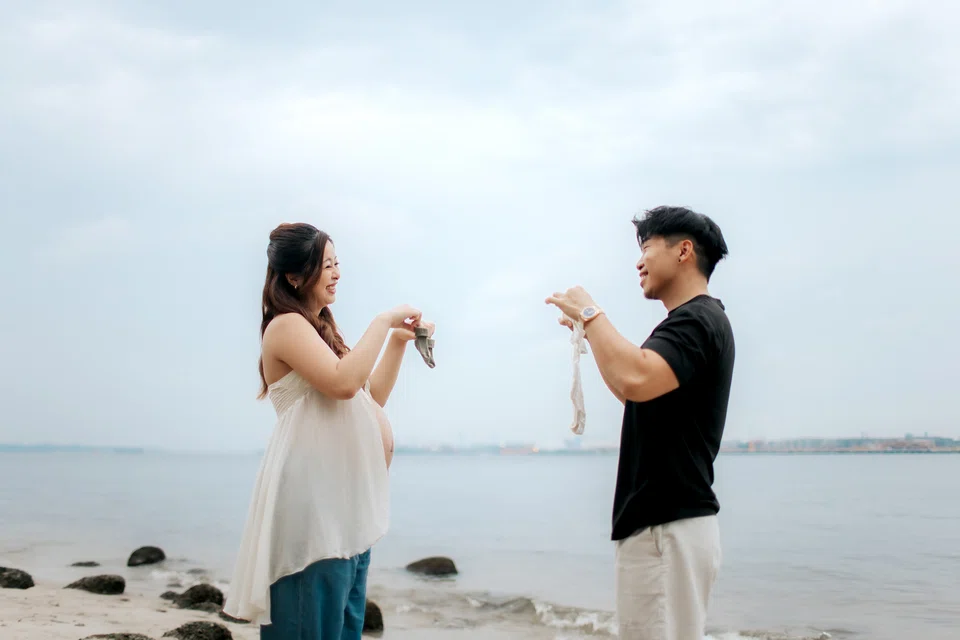
[SINGAPORE] When a woman found out that her daughter-in-law was finally pregnant, she was overcome with emotion. Wiping away tears, she said to the younger woman: “Xin ku ni le” (“It was hard on you” in Chinese).
Indeed, the eight-year journey to pregnancy for bank product manager Patrina Tan was an arduous one.
It started with a neutral attitude, which turned into a desire and then repeated disappointments when conception did not happen. In between, she also discovered she had severe endometriosis and underwent surgery twice.
In 2023, Tan and her husband Johnathan Chua, co-founder and CEO of digital media group Grvty Media, decided she should go ahead with elective egg freezing as a “back-up plan”.
Last year, after dealing with a fibroid issue, Tan finally started in-vitro fertilisation (IVF) and is now expecting their first child, due next month.
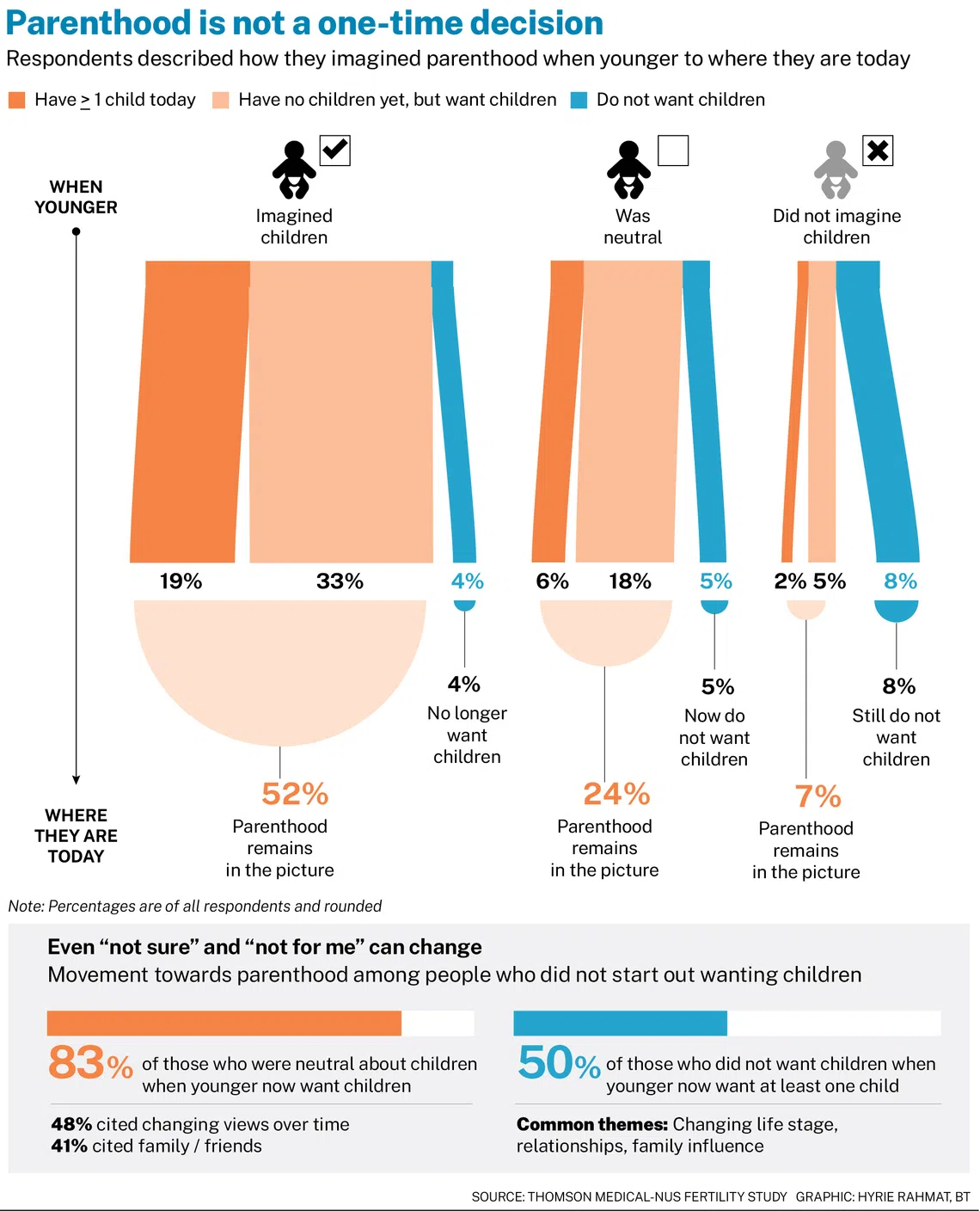
Like many, the couple, both 36, weren’t sure they wanted to be parents in the first place. In fact, a new study just released shows that parenthood is not a one-time decision. Instead, aspirations towards having kids are more fluid than often assumed, with 83 per cent of those who took a neutral stance and half of those who previously did not want children now desiring at least one.
There’s hope yet
While attitudes can move in either direction, it was more often towards wanting children. The survey by Thomson Medical and the National University of Singapore (NUS) was done in May and June this year, and involved 1,035 demographically representative respondents aged 18 to 39.
It found that 84 per cent of all respondents want at least one child, 51 per cent say their ideal is two and 16 per cent do not want any children.
Among respondents who currently have no children, 78 per cent remain open to having children one day, while 57 per cent of those who already have at least one child said having more children in future is important to them.



Seen in the light of Singapore’s dismal resident total fertility rate (TFR) which dropped to a historic low of 0.87 in 2025, these are reassuring signals.
For those who were previously neutral but now want kids, 48 per cent cited changing views over time; 41 per cent pointed to the influence of family and friends. Those who did not want children when younger and now desire at least one child flagged changing life stages, relationships and family influence as reasons.
Partner alignment is also key, with 76 per cent of all respondents saying it is important that a partner or spouse shares their views on parenthood.
“I think the prevailing attitude is that the low TFR is because people don’t want to have children,” says Reuben Ng, associate professor at the Lee Kuan Yew School of Public Policy, NUS and the study’s principal investigator. “But actually, that’s not true. People do want to have children and attitudes do change.”
He adds: “This means we can’t really just nudge people to have kids from the behavioural standpoint, but also need to understand the underlying attitude and address that.”
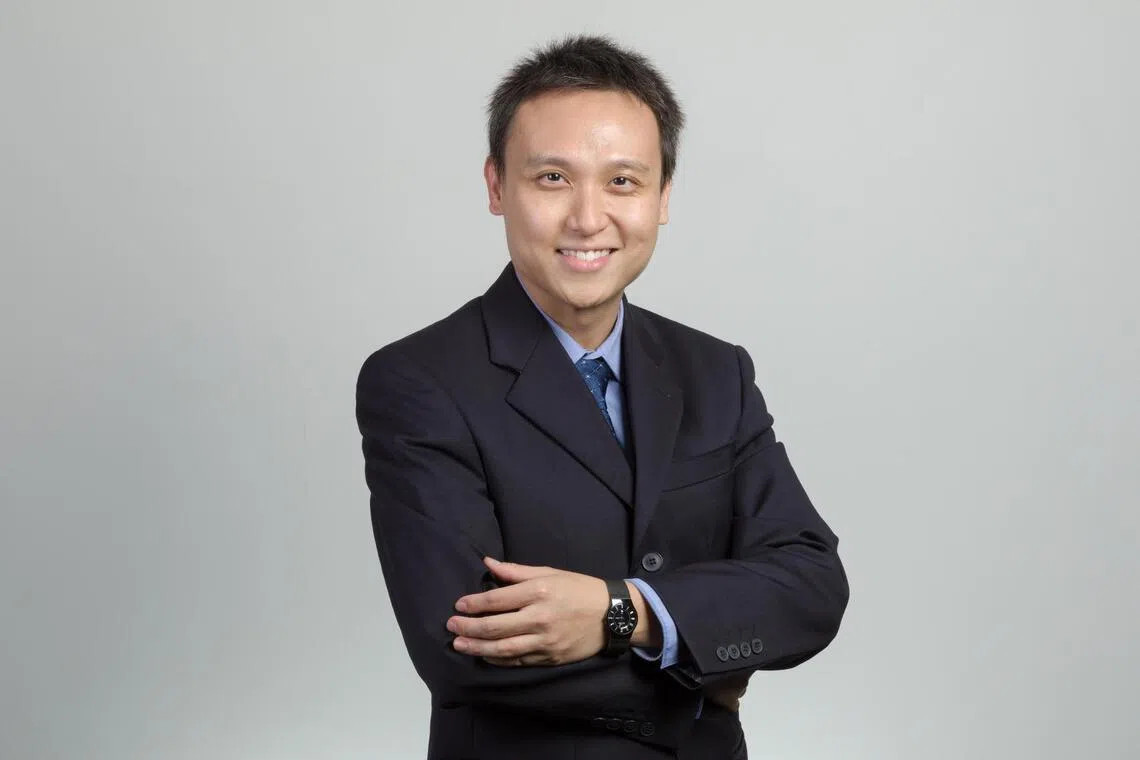
Despite Singapore society being a “risk-mitigating” one, Prof Ng says people still see children in their future.
“Costs are not abating, yet the desire to have children seems to be quite consistent, which is a good thing. What that means is we have to think about what else we can do on the value chain other than harping on cost.”
Truth is, the path towards parenthood aspirations is complex. Besides career and financial considerations, there are also thoughts about readiness in terms of time and attention, partner alignment and whether one is even suited to become a parent.
As father-to-be Chua explains: “It wasn’t necessarily ‘do I want a child?’. Growing older just helped us crystallise our thoughts and realise which parts are rubbish.
“And when we realised the only option available to us was IVF, we had to figure out if we really wanted to be parents because undergoing a medical procedure to conceive requires a different level of conviction.”
For Tan, it was a rollercoaster.
“At one point, I convinced myself that it’s okay, I will live life without kids. But when I became pregnant, it dawned on me that I was just lying to myself the whole time. I realised I wanted it all along, but just didn’t dare tell myself that.”
Mind the gap
What surprised Prof Ng was respondents’ confidence in fertility knowledge versus their actual fertility literacy. While 54 per cent feel well-informed about their fertility and reproductive health, only 10 per cent answered all five fertility literacy questions correctly.
For instance, 80 per cent know that a woman’s chance of pregnancy decreases with age, but only 29 per cent know that ovaries do not produce new eggs throughout a woman’s reproductive years. And only 57 per cent know that men’s fertility declines with age.
“The underlying essence is the misconception about how much (fertile) time we have,” he notes.
Respondents are aware of higher-profile fertility options such as IVF (69 per cent) and egg or sperm freezing (66 per cent), but are less familiar with foundational checks and surgical treatments such as polyp or cyst removal, which may be needed before trying for a baby.
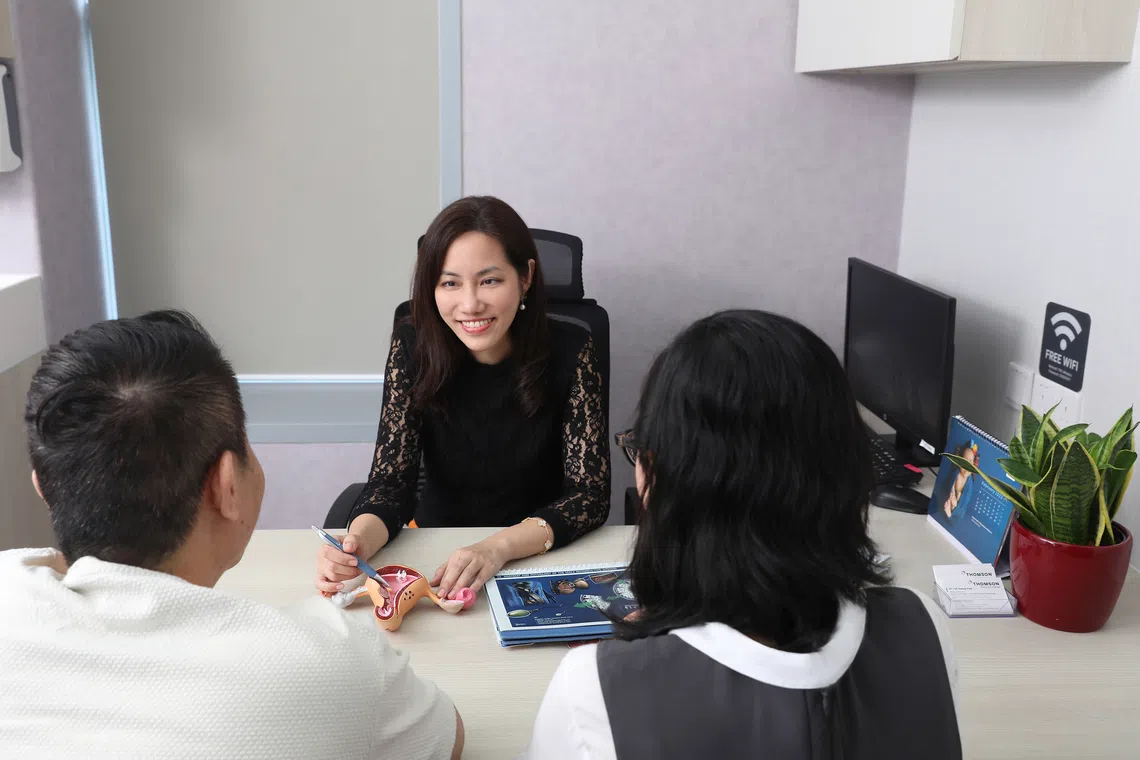
Obstetrician, gynaecologist and IVF specialist Dr Janice Tung has met many couples who assume pregnancy will happen naturally once they decide to try, and become very distressed when it does not.
“Another difficult moment is when a woman discovers a condition such as low ovarian reserve, endometriosis, fibroids or other factors that may affect fertility, and wonders if she could have asked questions earlier,” she says.
It is also tough when male-factor fertility issues such as low sperm count and poor semen quality are discovered, because many still assume fertility is mainly a woman’s issue.
“The hardest part is often the uncertainty,” she says. “And this is much worse when faced with time pressures.”
Chua and Tan can identify with that.
“The key thing we learnt is that most fertility issues are treatable, but require time,” says Chua, adding that those who want to be parents should get a fertility health check. That’s because he has friends who “know for a fact” they don’t want to be parents, yet when they realise they cannot conceive, break down in tears.
“People want it to be their choice not to have kids, as opposed to being told they can’t.”
Timely and relevant information
The good news is that the survey respondents are willing to seek help; they want fertility support to start earlier and extend beyond the clinic. Topping their wish list are financial subsidies for fertility screening, easier access to assisted fertility care and more fertility awareness education.
This reveals an opportunity to move fertility support upstream, before it becomes urgent.
But even then, information about fertility needs to be available at the point when it is relevant.
“For example, when people are dating, when they’re registering their marriage and things like that. Having the information is good, but it must also be timely,” says Prof Ng. “So we need a rethink of these things: Where’s the entry point that’s most relevant? What platforms can we have for people to ask questions and be informed?”
In addition, each person’s fertility timeline is different and conversations often involve a partner. Rather than mandating a particular age for fertility education or screening, Dr Tung says it’s important for people to talk about it and “ask better questions” when they are ready.
Fertility education doesn’t have to start in a clinic either, she adds.
“For young adults, it could be simple, evidence-based explainers on fertility health, menstrual health, male fertility, age-related changes and when to seek advice,” she says.
“For couples, it could be preconception conversations or doctor-led Q&A sessions. For workplaces or tertiary institutions, it could be general health talks that include fertility as one part of broader health literacy.”
Screening, however, depends on personal circumstances such as medical conditions, failure to conceive or a strong desire to preserve future options.
“Avoid making fertility feel frightening or prescriptive,” Dr Tung adds. “Understanding fertility health earlier simply gives people more information and options. What they do with that information depends on their personal circumstances.”
Indeed, Cassandra Loh, Thomson Medical’s acting CEO, says the healthcare provider has observed growing openness to fertility conversations, but also “significant anxiety”, which is reflected in the study’s findings.
Respondents associate assisted fertility with concerns such as cost, pain and difficulty finding a trusted provider.
“People are becoming more open to fertility conversations, but they also want guidance that is clear, realistic and personalised.”
Decoding Asia newsletter: your guide to navigating Asia in a new global order. Sign up here to get Decoding Asia newsletter. Delivered to your inbox. Free.
Copyright SPH Media. All rights reserved.

