

Rolex Oyster 100th anniversary: Inside the 2026 centennial celebration
Rolex unveils a commemorative Oyster Perpetual 41 to celebrate a century of the world’s first waterproof wristwatch and more

ROLEX’S game-changing Oyster case, which launched the world’s first waterproof wristwatch, is 100 years old.
Together with the Perpetual rotor, the self-winding system, it has spawned a family of watches on which Rolex has built its legacy.
These six new models are dressed and touched up to look their best for the centennial celebration. The Oyster Perpetual 41, the event’s commemorative watch, is unveiled in a reinterpreted yellow Rolesor – a mix of yellow gold and Oystersteel (Rolex’s special steel). The new Yacht-Master II is given a sleek and modernised makeover that guarantees it a grand entrance to the party.
The Oyster Perpetual 28 and 34 go full gold for the first time, while the Oyster Perpetual 36 is introduced with a new dial in multi-coloured lacquer with a Jubilee motif.
The new Cosmograph Daytona got a Rolesium overhaul, making it the first Cosmograph Daytona to appear in Oystersteel and platinum.
Oyster Perpetual 41
The yellow Rolesor outfit is just what the occasion calls for. It gives a vintage aura to the commemorative 41 mm watch, recalling its origins when, known simply as the Oyster, it was launched featuring the waterproof Oyster case.
On the new Oyster Perpetual 41, the polished domed bezel and winding crown are yellow gold, while the bracelet is all Oystersteel – unlike the usual Rolesor, which has the middle links in yellow gold.
Details evoking the Oyster’s centenary are evident. The number 100 is etched on the crown. On the dial at six o’clock is “100 years”, instead of the usual “Swiss Made” marking.
Each five-minute interval on the minute track on the sunray-finished dial is a green square, Rolex’s house colour. The Oyster Perpetual 41 is among the first in a new generation of Rolex watches to meet the brand’s boosted Superlative Chronometer certification, an assurance of the excellent performance of a Rolex timepiece. The enhanced in-house certification, which came into force in 2026, focuses on improved accuracy targets, more rigorous testing protocols at multiple positions and temperatures, and tightened production tolerances across the movement assembly process.


Yacht-Master II
This comes in cool Oystersteel for the centennial party. One of only three true complications in Rolex’s current catalogues (the others are the Sky-Dweller and more recently, the vintage-inspired Perpetual Padellone), the nautical chronograph first appeared in 2007. It is now “entirely” redesigned in looks and function. Rather than being diminished, the Yacht-Master II’s identity as a timer for yacht racing is reinforced with the changes. The watch, available also in yellow gold, is still 44 mm but has a new white lacquer dial, which is given a matte finish to reduce reflections. The hour markers are served by the applique indices typical of professional-category timepieces. The bezel, which rotates either way, is fitted with Cerachrom in blue ceramic.
The new look in many ways reflects a regatta chronograph that is easier to read and manipulate – in particular, the countdown critical to a race. The countdown scale is moved to the flange. It is positioned very precisely on the middle case – a feature for which a patent application was filed.
The countdown is programmed and operated simply with two side pushers – not with the rotatable bezel and Ring Command system of the earlier model. The countdown minute and seconds hands of the new Yacht-Master II also turn counterclockwise – a first for a Rolex timepiece. This makes the information they display – the time counting down towards zero – very clear.
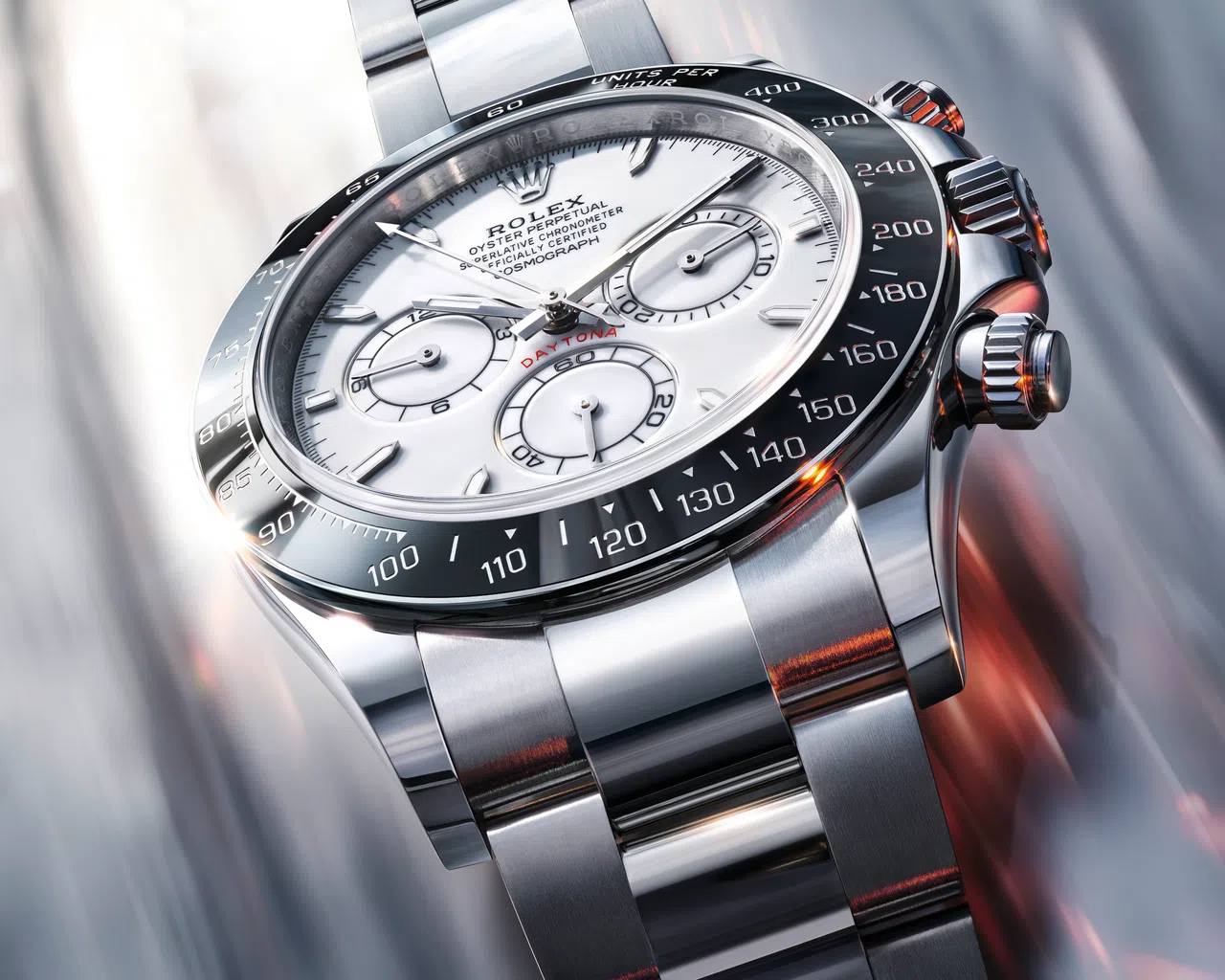
Cosmograph Daytona
There is no need to fuss over the details; the name itself is enough to command attention.
Yet Rolex is not leaving anything to chance when it wraps its legendary chronograph in Rolesium for the Oyster’s centennial. There is already a version in full platinum Daytona. The noble metal is now paired with Oystersteel. Rolex calls the combination Rolesium, a first for a Cosmograph Daytona watch.
Fashioned from Oystersteel for the most part – middle case and bracelet – this bold creation features an open caseback with a sapphire crystal dipped in anti-reflective coating, as well as a platinum caseback ring screwed down against the middle case. Circling the Cerachrom bezel is also a platinum band.
A Cerachrom bezel in an anthracite hue with a striking metallic gleam – a new colour Rolex developed – crowns the 40 mm case, which in turn frames a white enamelled dial. The graduation on the emblematic tachymetric scale, which is moulded into the bezel, has been restyled: the numerals are displayed horizontally – just like the original 1963 Cosmograph Daytona.
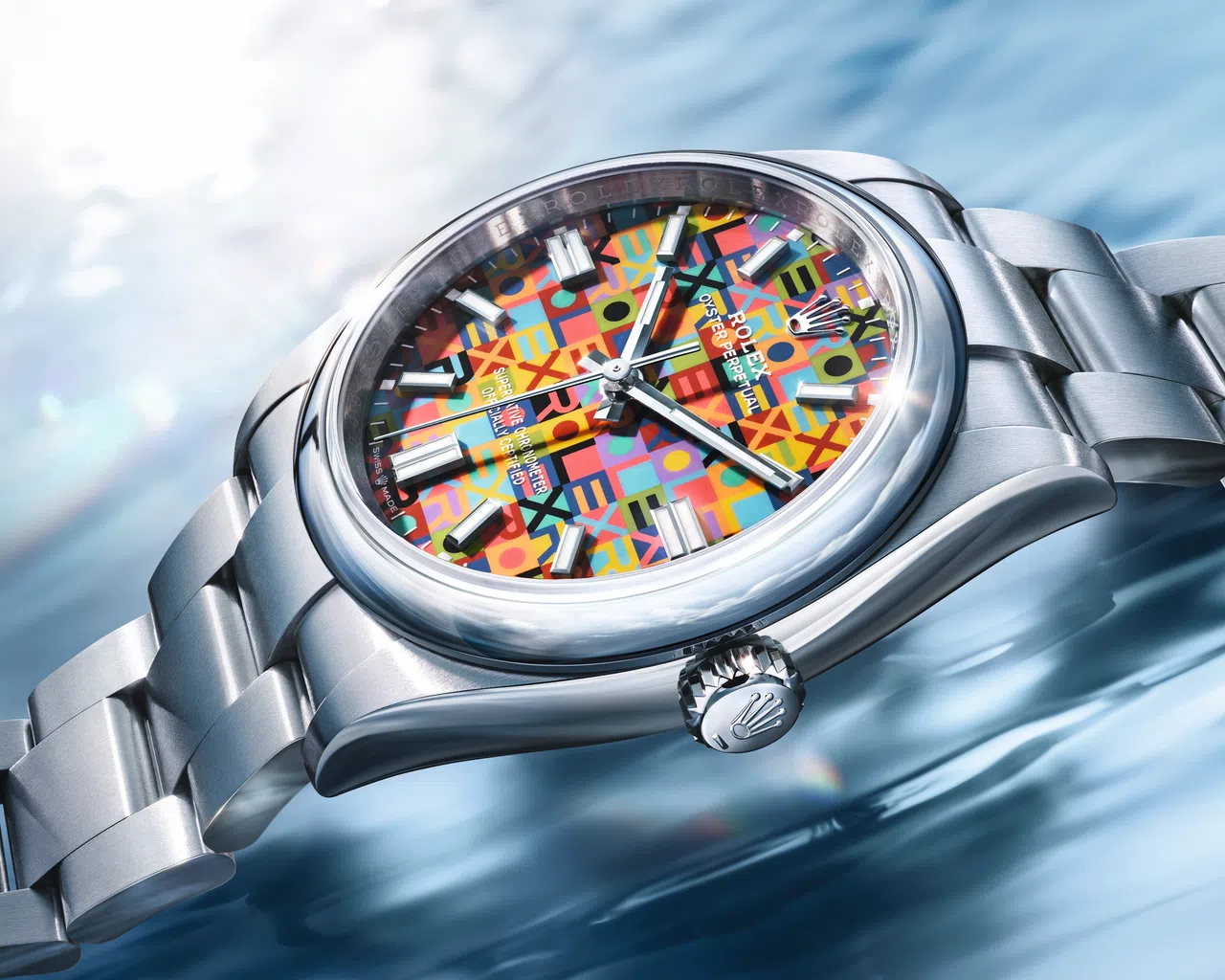
Oyster Perpetual 36
Colourful dials are not new to timepieces from Rolex. It was only three years ago that the brand unveiled an Oyster Perpetual model with a lacquer dial of many colours. Rolex goes further with the latest Oyster Perpetual 36 in Oystersteel, which flaunts a multicoloured lacquer dial in even more shades.
While the “Celebration” of the 2023 Oyster Perpetual reveals five colours in bubbles, against a bright turquoise background, the new 36 mm watch has a Jubilee motif dial displaying the Rolex name in a contrasting interplay of no fewer than 10 colours.
Rolex fans may be familiar with the Jubilee bracelet; they are less likely to be familiar with the Jubilee dial. The Jubilee motif is a pattern repeating the “Rolex” name across the dial.
It first appeared on dials of the Datejust and Day-Date models in 1978. Also known as the anniversary dial, it was on the watch toasting Datejust’s 40th year in 1985.
Typically, the Jubilee motif came in a single colour. The new Oyster Perpetual 36 puts a colourful spin on it with a repeating high-contrast pattern.

Oyster Perpetual 28 and 34
It is hard to imagine Rolex without the Oyster Perpetual. The Oyster case and the Perpetual rotor self-winding mechanism are the two critical building blocks for all its timepieces today. As the name suggests, the Oyster Perpetual is made up essentially of these two historic features; it is the purest expression of a Rolex watch.
Introduced a few years after the Oyster was invented, the Oyster Perpetual dispenses with embellishments like rotating bezels and date windows, keeping the focus on its pure, time-only design. The watch is water-resistant to 100 m. Its Oyster case is equipped with a Twinlock winding system with a double waterproofness system, while the hermetically sealed construction provides optimal protection for the automatic movement within.
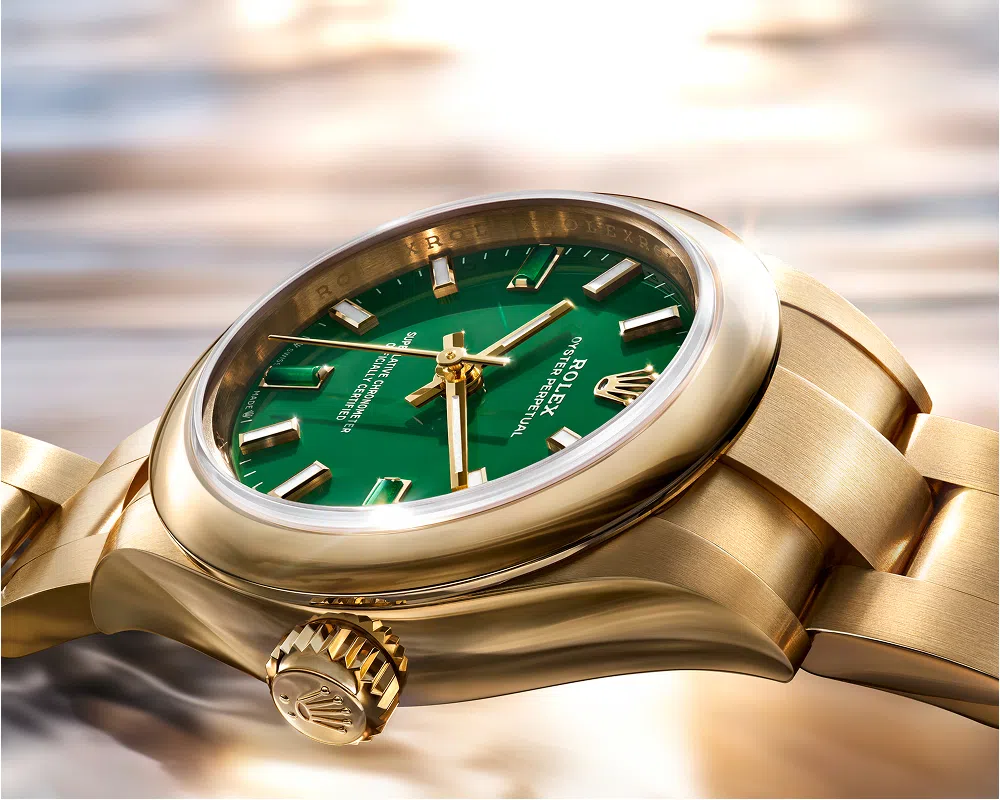
Once dominated by Oystersteels, the Oyster Perpetual collection now flaunts a stunning range of models in gold. The latest 28 mm Oyster Perpetual comes in 18-karat yellow gold, including the Oyster bracelet, while the 34 mm timepiece comes in 18-karat Everose gold (Rolex’s version of pink gold) with an Oyster bracelet.
What sets them apart is not simply the use of gold, but also the way the precious metal is treated. Instead of being mirror-polished, the gold on the two watches is satin-finished for a soft-textured shine.
They are the first Rolex timepieces in precious metal to be given this finish. The hour markers at three, six and nine o’clock on the dial are cut from natural stone, a first for Rolex.
Those in the Oyster Perpetual 28 are in heliotrope, a stone that reveals a variety of green hues.
In the bigger watch, they are cut from dumortierite, a mineral in alternating shades of light and dark blue.
Decoding Asia newsletter: your guide to navigating Asia in a new global order. Sign up here to get Decoding Asia newsletter. Delivered to your inbox. Free.
Share with us your feedback on BT's products and services
TRENDING NOW

World’s largest offshore wind platform by Seatrium consortium on track to be completed by 2028

Is stamp collecting enjoying an analogue revival or are its best days over?

GovTech retrenches another 38 staff in second round of layoffs

MBS adjusted property Ebitda falls 20.6% in Q3 with fewer high-roller visits, weaker hold

