Issue 134: Sembcorp’s well-missed target; investors dump ESG funds

This week in ESG: Sembcorp confirms sustainability profit target will lapse; record outflows for ESG funds
Sustainability targets
A good miss
Can missing a sustainability-related target be a good thing?
Sembcorp Industries has confirmed that it will miss a target to have 70 per cent of net profit coming from its sustainable solutions businesses by 2025. But failing to hit the objective doesn’t mean that Sembcorp is behind on its sustainability ambitions. Instead, it reflects an unexpectedly robust ballast that has allowed the company to aggressively pursue its green strategy.
In 2021, Sembcorp announced a major “Brown to Green” strategy, which included a set of 2025 targets, including the 70 per cent net profit goal.
Back then, the company’s sustainable solutions businesses – comprising renewables and integrated urban solutions at the time, with decarbonisation solutions added later on – contributed just 35 per cent of net profit. That percentage has barely moved, and as at end-June 2024 sustainable solutions still accounted for only 33 per cent of net profit from continuing operations earned in the first six months of 2024.
It’s therefore not a surprise that Sembcorp has since given up on that target.
Perspective
The profit target is a strategic ambition, so while it involves the sustainable part of Sembcorp’s business, missing the goal isn’t an underperformance on sustainability.
In fact, Sembcorp has met its original goals on sustainability assets and emissions.
Alongside the profit target in 2021 was a commitment to quadruple gross installed renewables capacity by 2025, from 2.6 gigawatts (GW) in 2020 to 10 GW in 2025. As at end-2023, Sembcorp already had 12.9 GW of renewables capacity in wind, solar and energy storage operational or in the pipeline. That is more than the company’s 6.1 GW of gas and diesel power capacity, giving Sembcorp a genuine claim to being a “renewables player”, as it describes itself.
Sembcorp had also set a target to lower emissions intensity to 0.4 tonnes of carbon dioxide equivalent per megawatt hour (tCO2e/MWh) by 2025, from 0.54 tCO2e/MWh in 2020. The company has since sold a coal-fired power plant business in India, allowing it to achieve 0.29 tCO2e/MWh in 2023.
Having hit those original targets early, Sembcorp in 2023 pushed them further. It’s now aiming for 25 GW of renewables capacity and emissions intensity of 0.15 tCO2e/MWh, both by 2028. Most of Sembcorp’s expected investments are also earmarked for the renewables business, with 90 per cent of its S$14 billion 2024-to-2028 planned investments to be allocated to its sustainable solutions business segments.
The fact is that Sembcorp’s business is greener today than it was in 2021 when the 2025 target was set, and the company remains committed to getting even greener.
Relative performance
Still, being green doesn’t change the fact that Sembcorp failed to raise its sustainable solutions business’ contribution to net profit to 70 per cent.
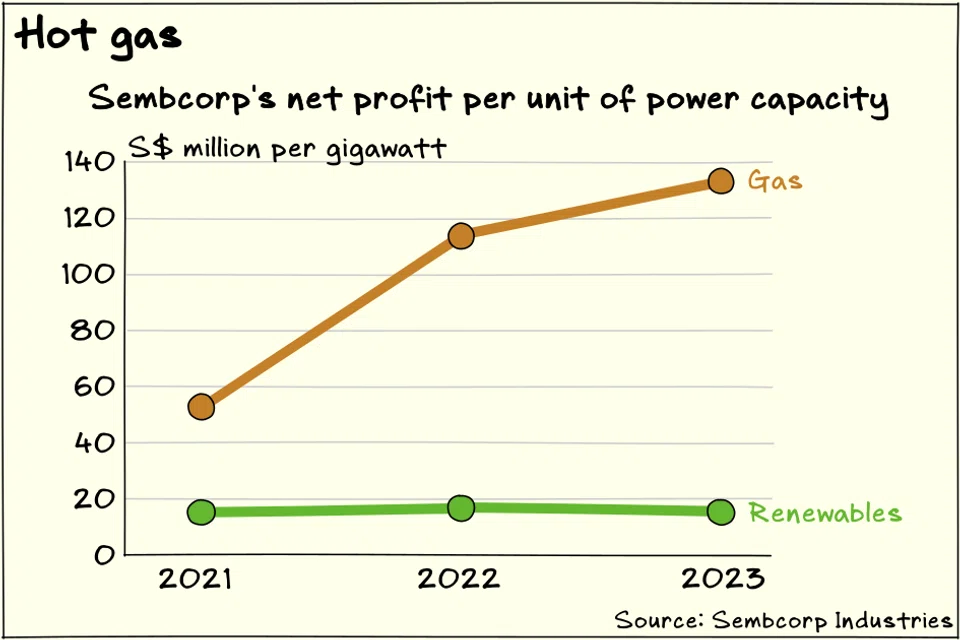
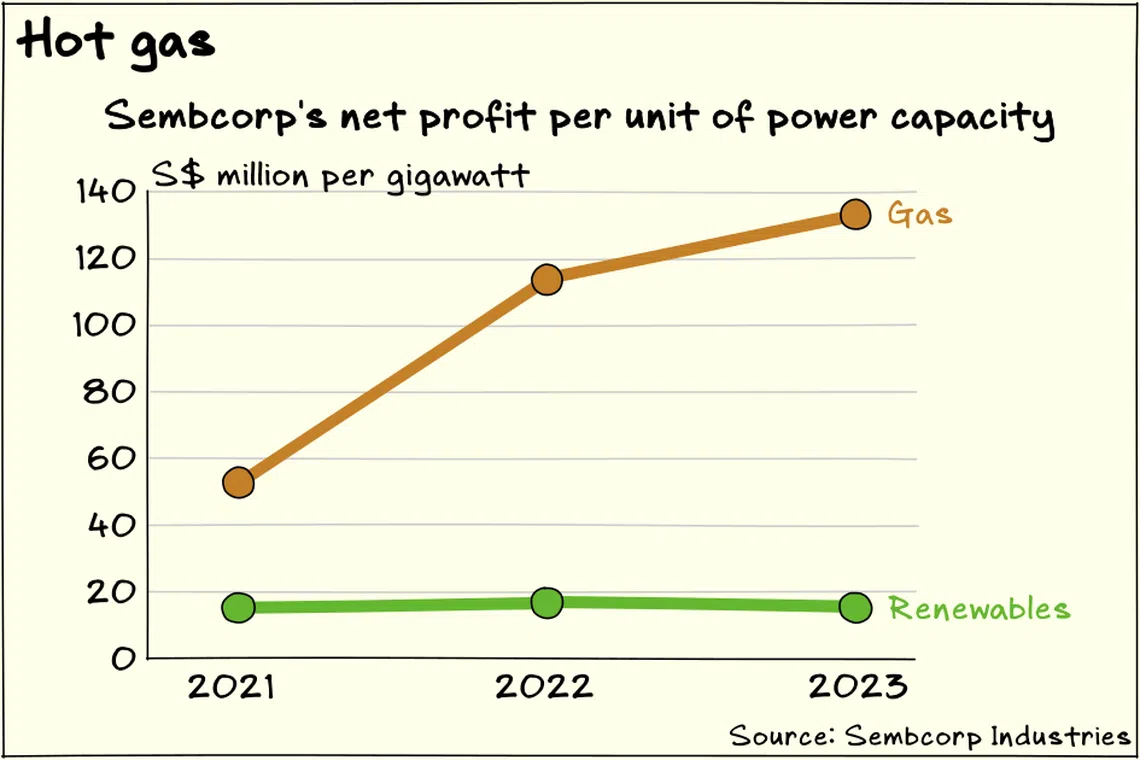
But the miss doesn’t mean that Sembcorp has failed to make money from its investments in renewables. In fact, renewables profit has grown at roughly the same pace as renewables capacity, with both metrics in 2023 roughly 3.5 times what they were in 2021. This means that Sembcorp has managed to maintain roughly the same rate of return on its investments in the segment.
The failure to hit 70 per cent has more to do with an exceedingly successful gas business. While gas capacity in 2023 was just about 1.1 times what it was in 2021, net profit from gas and related services had grown to 2.8 times what it was over the same period.
After Sembcorp set its original targets in 2021, natural gas prices increased in the wake of the Russia-Ukraine war. Prices in the Singapore electricity market also stabilised and improved. Sembcorp’s gas business has, therefore, performed unexpectedly well, even without significant increases in gas-fired capacity.
If there is one weakness in Sembcorp’s sustainable solutions businesses, it might be its integrated urban solutions arm. In 2021, Sembcorp aimed to triple annual land sales in this business to 500 hectares by 2025. That goal will also be missed.
In 2024, Sembcorp came up with a new set of targets for this business, focusing on land development and land bank expansion, and industrial properties. For the segment, Sembcorp is now targeting a net profit compounded annual growth rate above 15 per cent from 2022 to 2028 and a return on equity of 10 per cent in 2028.
Gas cushion
Transforming a large company into a renewable energy player can take time. Asia’s energy transition will also be a long-term process that will take place over decades.
Having a robust gas business is valuable support over such a long journey. Almost all of Sembcorp’s gas portfolio is contracted under long-term offtake deals, providing stable revenue as the company continues to invest heavily in renewables and urban solutions.
However, the strong gas business could present some challenges for Sembcorp.
From a sustainability perspective, continued exposure to gas could make it harder for Sembcorp to hit its emissions targets. Winding down the gas business is not entirely within Sembcorp’s control – the pace at which alternatives to fossil fuels become economically feasible in Sembcorp’s markets is also affected by global developments and local policies. If gas remains a major part of Sembcorp’s business and it can’t meet its emissions targets, Sembcorp might face difficult choices about the pace of its climate targets and the future of its gas business.
Sembcorp could also face shareholder pressure to de-prioritise the renewables business in favour of the more lucrative gas segment. The company will need to demonstrate that its thesis on sustainable solutions is still the right one.
Inevitable transition
For investors, Sembcorp’s missed target should be of little concern. The miss is the result of Sembcorp’s healthy gas business, which is a valuable asset at this stage of the company’s transition. Indeed, analysts at Citi and Maybank have retained their “Buy” calls on the stock in the wake of the confirmed miss.
However, natural gas is a transition fuel, which means the clock is ticking on its utility before it too will have to be phased out. Sembcorp will have to continue investing heavily in renewables to prepare for that future.
Sembcorp will announce its full-year results for 2024 on Feb 27 before the market opens.
Sustainable investing
ESG funds down but not out
Investment funds based on environmental, social and governance (ESG) principles suffered record outflows globally in the fourth quarter of 2024, according to Morningstar data.
This follows earlier reports that inflows into ESG funds in Asia slowed down through the first three quarters of 2024.
These trends reflect a broad pullback from the ESG space, which is facing challenges on multiple fronts. From the demand side, investor appetite has dulled somewhat as higher interest rates hit returns of ESG portfolios, especially those with significant exposure to the capital-hungry tech sectors. On the supply front, many fund managers – especially those with exposure to Europe and America – have become less willing to offer products under ESG-related labels.
In Europe, the blame has fallen on seemingly overly onerous regulations. In America, a hostile legislative environment towards ESG principles has driven the retreat.
But while the light might have dimmed for ESG, it hasn’t gone out.
A poll taken in October and November of 2024 among European and Asian institutional and intermediary distributors by Fidelity and the Crisil Coalition Greenwich found that a majority of respondents viewed ESG as an important factor for portfolio allocation in the next 18 months.
Respondents overwhelmingly picked decarbonisation or the energy transition as a sustainability theme they were focused on. The theme was ranked among the top three focus topics by 85 per cent of respondents, with 61 per cent highlighting it as their top-ranked theme. Corporate transparency and biodiversity were the next two most commonly cited themes.
However, 68 per cent of respondents cited difficulty measuring impact as among their top three barriers to sustainable investing. About two-thirds of Asian respondents said a lack of supply of quality strategies or products was a barrier, more than double the 31 per cent in Europe who identified the issue.
Other ESG reads
- Sembcorp to enter the Philippines’ renewable energy market via acquisition
- Banks’ carbon credit offerings will not turn the tide for the struggling market
- Kuok Maritime-led group launches electric supply boat as industry prepares for 2030 green target
- The inauguration of a new chapter in sustainable investing
- Top climate scientist declares 2 deg C climate goal ‘dead’
- Accountancy education must evolve quickly to prepare for a sustainable future