

Issue 166: GIC mainstreams climate adaptation investing; Singapore to tackle reporting of cloud services emissions
This week in ESG: Asian investors focus on financing climate adaptation and resilience; Infocomm Media Development Authority to support companies on digital emissions

Sustainable investing
Overcoming adaptation financing hurdles
Asian investors looking for the next big sustainability theme are increasingly focusing their lenses on climate adaptation and resilience.
Adaptation and resilience refer to climate action aimed at addressing the impact of global warming, such as cooling and flood infrastructure. They’re distinct from climate mitigation, which refers to climate action aimed at reducing global warming, such as building solar farms.
There are two major forces supporting the interest in adaptation and resilience.
The first is that the physical risks of global warming are increasing. Speaking at the Milken Institute’s recent Asia Summit, GIC senior vice-president for sustainability Wong De Rui notes that economic damages from climate disasters in the 2001-to-2024 period have increased four times from the 1980-to-2020 period under what experts consider to be “fairly mild” warming conditions.
“So imagine what’s going to happen when we see global warming accelerate,” he says.
The thesis is that the physical impact of climate change will force people to invest in adaptation and resilience. There’s a stronger sense of inevitability with adaptation and resilience than with climate mitigation, which relies heavily on supportive political will. In a sense, people and societies might waver about spending on fire prevention, but everyone wants a fire extinguisher when things are burning.
The second major force is the substantial financing and investment gap in climate adaptation and resilience. The Asian Development Bank estimates that climate adaptation in the Asia-Pacific region requires between US$102 billion and US$431 billion of financing annually, nearly half of which is for coastal and river flood protection. That is far more than the US$34 billion of adaptation finance committed in the region from 2021 to 2022.
In other words, the investors can see a fire coming, and how few fire extinguishers there are.
However, the size of the adaptation and resilience funding gap is a sign that executing on this idea hasn’t been easy for private investors, otherwise the amount of investments would be considerably higher.
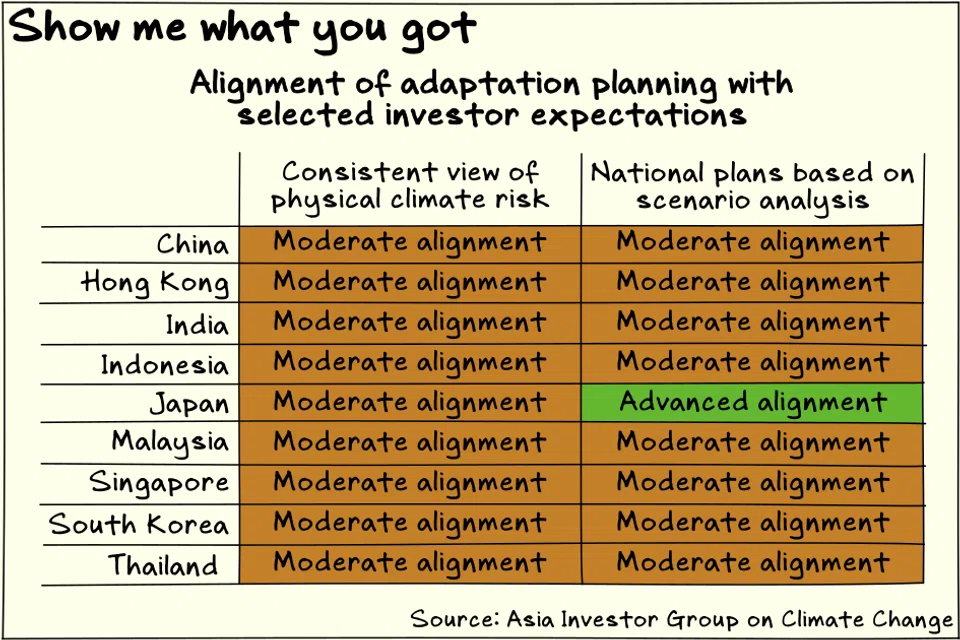
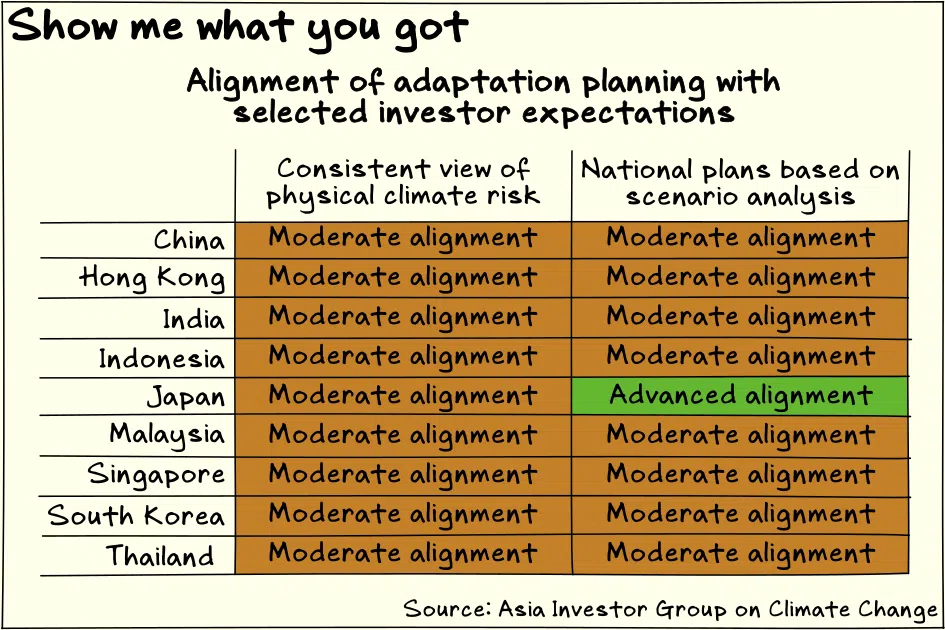
In March, the Asia Investor Group on Climate Change (AIGCC) highlighted the need for economies in the region to outline consistent national views on physical climate risks in a report that looked at nine key Asian markets. Out of seven broad aspects of adaptation policy examined by AIGCC, a consistent national view of climate risk was the only one where none of the nine markets demonstrated advanced level or progress or alignment with investor expectations.
In fact, AIGCC’s research shows that most of those countries have not filed National Adaptation Plans required under the Paris Agreement.
In a foreword to the report, AIGCC chief executive Rebecca Mikula-Wright stresses the importance of being “realistic” about why private-sector investment into adaptation and resilience isn’t higher.
“Only some adaptation and resilience assets and activities produce cash flows – even if they’re value-creating, protecting capital value and future revenues.
“Although protecting value is a very real and material reason to invest new capital, the business cases for such resilience investments rely on accurate climate science, scenarios and proper assessments of vulnerability and financial impact into the future. Given the system-level vulnerabilities to physical risk and the shared benefits of resilience, unlocking public and private capital will also need financial innovation and collaboration between investors, governments and business.”
When the United Nations Framework Convention on Climate Change (UNFCCC) called for feedback on scaling up climate finance to developing countries – also known as the Baku to Belem Roadmap – AIGCC in September submitted a set of recommendations focused on adaptation and resilience investments.
AIGCC’s key suggestions are:
- By 2028:
- After 2028
Efforts to overcome the obstacles mentioned by Mikula-Wright and others have increased over the past year.
In November 2024, the Organisation for Economic Co-operation and Development (OECD) released a Climate Adaptation Investment Framework to enable governments to pursue investments in adaptation. The framework is based on six “building blocks” to help governments develop their own frameworks.
Investors are also learning to take a more comprehensive view of adaptation and resilience opportunities.
While adaptation and resilience financing was initially focused more on large-scale projects often led by public entities, GIC has begun to think of ground-up spending on adaptation and resilience as a potential growth engine as well. For instance, many asset owners might need to improve fire protection or flood protection on their own, regardless of what their local governments are doing.
As GIC’s Wong explains, adaptation and resilience are not niche opportunities. The Singapore sovereign wealth fund has estimated that the enterprise value of companies providing such solutions might grow to US$9 trillion from US$2 trillion currently. Furthermore, GIC reckons that markets have yet to properly factor in the need for adaptation and resilience spending, and sees this as an “emerging investment theme”.
The 30th edition of the annual UN climate summit – popularly called COP30 – will take place in Belem, Brazil in November. Climate finance and adaptation and resilience are priorities this year, and the outcomes of COP30 could fuel further progress in adaptation and resilience financing.
Sustainability reporting
Complex cloud factors
One of the most challenging aspects of emissions reporting is measuring what is commonly referred to as Scope 3 emissions.
Scope 3 emissions refer to greenhouse gases indirectly produced along a supply chain that are a result of an entity’s activities. Scope 1 emissions are directly produced by the entity, and Scope 2 emissions are indirectly produced from purchased energy, heat and cooling.
Among the many different sources of Scope 3 emissions, those that are produced from cloud computing and data centres can be especially difficult to trace. Poor accuracy on cloud and data centre emissions can be especially problematic for a country like Singapore, which has a sizeable service sector. It’s therefore welcome news that the Infocomm Media Development Authority is looking into supporting businesses with reporting cloud services and data centre emissions.
Business travel is a common example of Scope 3 reporting. When a staff member of Company A flies to a conference in another city, the emissions generated from that flight fall under Company A’s Scope 3 emissions and under the airline’s Scope 1 emissions.
Precisely calculating the emissions attributable to one passenger is extremely difficult to do at scale, because the exact emissions depend on many factors. For instance, attributable emissions produced from the plane are split among all the things that the plane carries, so the number of passengers and cargo on a flight would affect how much Scope 3 emissions one passenger reports.
Considering factors like weather conditions and flight delays, it’s clear that it’s not practical to try to precisely calculate Scope 3 emissions for every single flight taken. Therefore, reporting convention uses good-enough estimations called emission factors, which are emissions per unit of activity based on average conditions. For example, an emission factor of tonnes of carbon dioxide equivalent per passenger kilometre allows emissions to be calculated for a trip simply by multiplying the emission factor by the flight distance.
To improve accuracy, emission factors can be modified for different circumstances. For example, known average load factors for a particular route means a more accurate emission factor can be worked out just for that route.
Working out emissions factors for cloud services and data centres faces similar challenges. Sending an e-mail triggers computing processes at multiple computers at multiple locations. Figuring out the exact emissions generated from an e-mail sent from Singapore to London requires knowing the path the information takes and the amount of data and computing load required, as well as the emission factor for the electricity used at each location.
There’s therefore a need to work out emission factors that strike the balance between accuracy and practicality.
Localised emission factors are one of the best ways to improve accuracy without sacrificing practicality. Singapore’s effort to build a Singapore-centric emission factor database is a positive step. Because of the interconnectedness of Singapore’s economy, it’s worth expanding the project into a regional database as well.
Other ESG reads
- Olam Food Ingredients well-placed to cushion tariff impact on food prices, says CSO
- Keppel-led consortium appointed for next phase of ammonia power and bunkering project on Jurong Island
- More than ‘saving the Earth’, climate action recast as energy savings amid AI boom
- Singapore’s public sector emissions down 1.9% in FY2024: report
- IEA trims renewables outlook as US policy shifts and China auction reforms weigh
- Nestle bows out of initiative to reduce dairy’s climate impact






