Issue 17: SGX’s new green ETF; pricing stranded assets

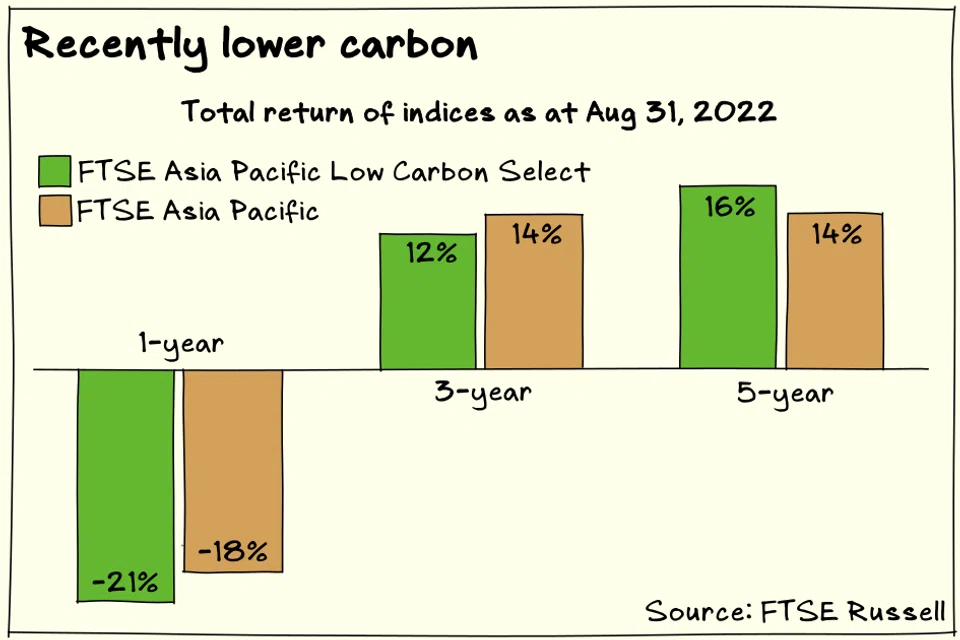
In this issue: Trying to understand the CSOP CGS-CIMB FTSE Asia Pacific Low Carbon Index ETF, while businesses confront the risks of their stranded assets.
Singapore
A new green ETF launches
The newly minted, rolls-off-your-tongue CSOP CGS-CIMB FTSE Asia Pacific Low Carbon Index exchange-traded fund (ETF) launched on Singapore Exchange (SGX) on Wednesday (Sep 28), with an initial S$150 million assets under management at listing.
Trying to figure out what exactly the index does can take some effort.
The index factsheet gives a helpful summary, that the index is “designed to reflect the performance of large and mid cap stocks in Asia-Pacific markets, and to obtain increased exposure to companies with low carbon characteristics”.
It also says: “Constituent weights are adjusted based on companies’ operational carbon emission intensity and fossil fuel reserve intensity performance.”
But would-be investors need to peruse a separate “overview” document to find out the index also considers companies’ ESG ratings. That sheet helpfully describes how the inputs translate into eligibility and weighting: The index overweights companies with better ESG ratings, underweights companies with fossil fuel reserves and overweights companies with lower greenhouse gas emissions intensity.
If you want to know the exact way that those inputs make their way into the index, you’ll need to read yet another document on ground rules. There you can contemplate prose like this: “Carbon Reserve Intensity is defined as the natural logarithm of the estimated CO2 equivalent greenhouse gas (GHG) emissions in metric tons generated by the combustion of a company’s fossil fuel reserves, divided by the full company market capitalisation (in USD). Data is from the latest published accounts at the data cut-off date. The Carbon Reserve Intensity measure is converted to a Z-Score and subsequently to an S-Score as detailed in FTSE Global Factor Index Series Ground Rules.”
See? Simple!
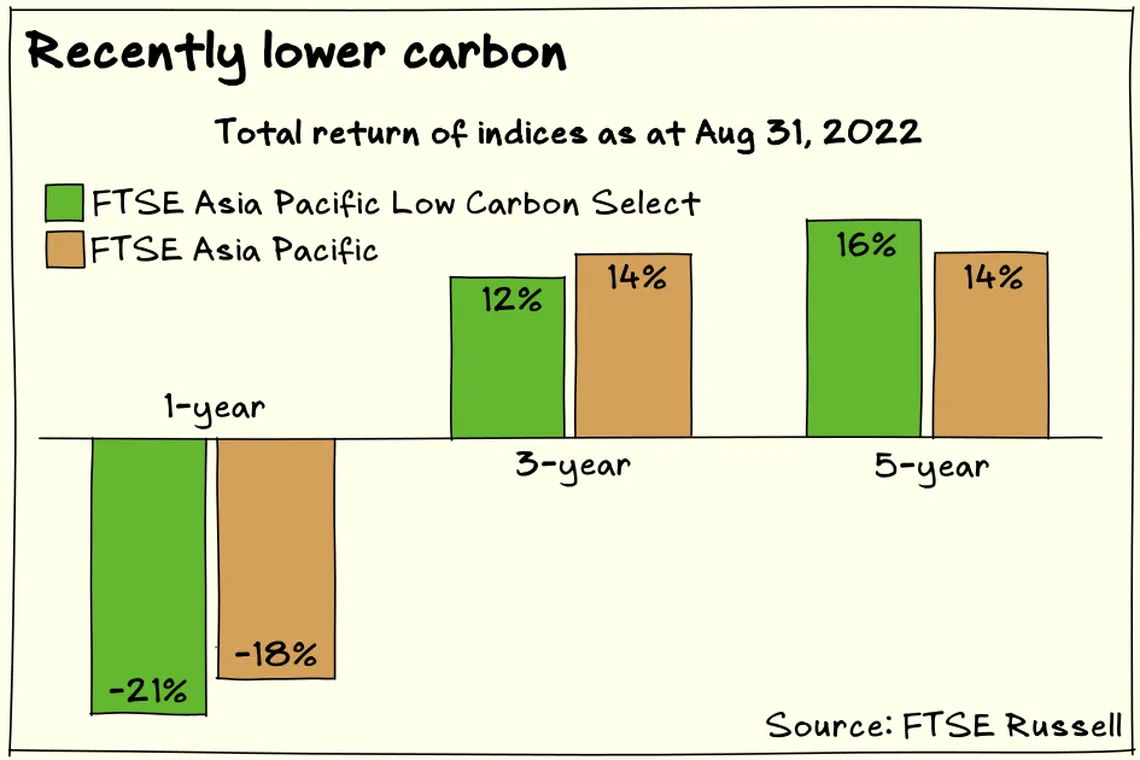
Understanding ESG indices and funds can be a pain, and it’s not entirely clear that the rules aimed at getting fund managers to disclose methodologies will be enough to clear up confusion and uncertainty in the marketplace. Take this index, for example: It takes 2-3 documents, located in different parts of the index provider’s web site, to read about how the index works.
Even if you can find the right document, you might encounter some highly technical language that is challenging to comprehend.
The other aspect of communication that tends to be overlooked is explaining impact.
The Low Carbon Index’s overview sheet repeatedly touts being able to improve ESG ratings, or reduce fossil fuel reserves, or reduce operational carbon emissions, but the catch is that this improvement is only against the underlying benchmark. For instance, the index aims to achieve a 50 per cent reduction in fossil fuel reserves relative to the underlying benchmark.
Those measurements are probably meaningful only if the investor is making this investment to try to improve the “greenness” of a portfolio. But a portfolio of shares in low-emitting companies doesn’t confer a claim on impact. If the investor is looking for an investment that has an impact on actual emissions and emission intensities, this ETF might offer few answers.
It’s that second kind of impact that ESG funds should perhaps do a better job of addressing. Reducing your portfolio’s emissions by switching out of brown investments into green ones gives you a nice-looking trophy shelf that you can show off to others, but you haven’t really changed anything with your investment.
Furthermore, critics have pointed out that public-equity funds don’t benefit the green companies whose stocks they own. These investments are in the secondary market, and the one who benefits from the fund buying a share is the shareholder who sold that share. The company gets no money from this investment, and so the benefit it derives is at best indirect (perhaps if the company wants to raise money and finds that its cost of capital has been lowered).
Other Singapore stories
- NEA’s direct emissions fall 20% on scale-down of Tuas Incineration Plant operations
- Sustainable investments could unlock Singapore’s US$91b of retail capital potential: report
South-east Asia
Pulling on strands
Businesses have been warned for a long time that they need to address the risk of stranded assets. It seems those warnings might finally be coming true.
Sembcorp Industries, for example, sold an India-based coal power unit not because the unit was no longer viable, but because of the company’s decarbonisation ambitions. Insurance companies are also starting to raise rates or decline coverage for problematic assets.
It is still early days, so there is still a significant degree of uncertainty about how these stranded assets should be priced. What is important is that businesses and investors are now coming to the conclusion that the risk from that pricing uncertainty is less than the risk of ignoring stranding.
Other South-east Asia stories
- Rising to South-east Asia’s energy insecurity challenge with FDI
- Asia to lead next decade’s global growth in renewable energy: Fitch Solutions