Issue 173: Coal confronts imperfect pathways; COP30 leaves world wanting more
This week in ESG: Coal Transition Commission tackles scaling solutions; COP30 wraps up with adaptation target

Energy transition
Coal transition’s uncomfortable solutions
Accelerating the energy transition in South-east Asia might require investors to accept some uncomfortable trade-offs when it comes to coal-fired power plants.
These could include keeping some coal plants to support grid flexibility, as well as compensating existing investors of coal plants.
One of the most effective ways to reduce greenhouse gas emissions would be to shut down coal-fired power plants, which represent about 35 per cent of global electricity generation.
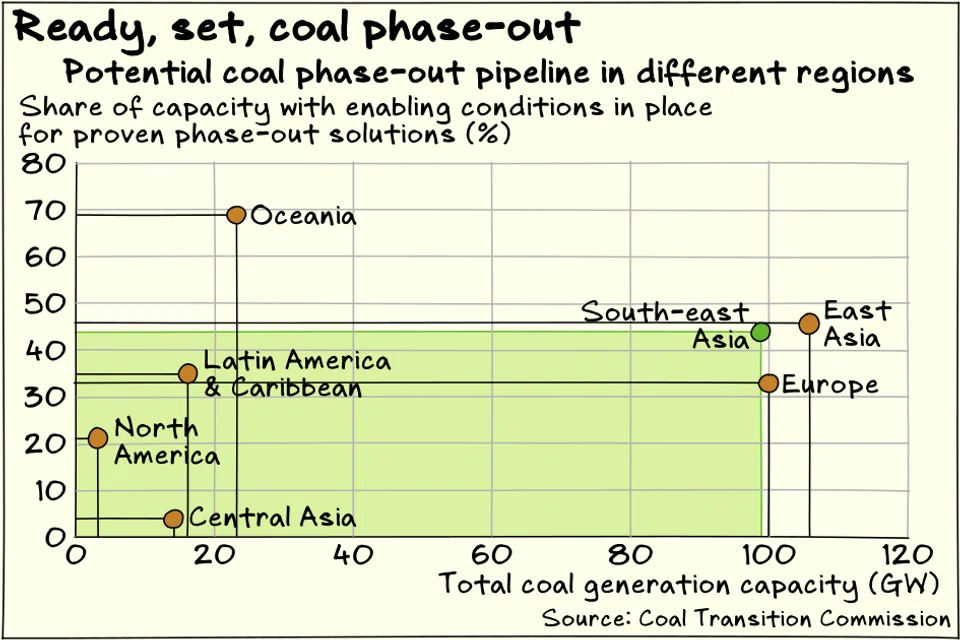
A new report by the Coal Transition Commission, which is co-chaired by Indonesia and France, suggests that about one-third of the world’s coal fleet outside of China, India and the United States could present “significant near-term opportunity” for early retirement and clean replacement. That proportion is higher in South-east Asia, where 44 per cent of the coal fleet falls under this category.
The report deemed significant near-term opportunity to reflect two key conditions. The first is that country-level factors are more likely to support early coal retirement. The second is that proven solutions, such as mechanisms already successfully deployed, can apply.
For example, most of the plants found to be potential near-term candidates for early retirement are owned by independent power producers and are young-to-mid aged. Because of their younger age, these plants are more likely to have opportunities to refinance debt, adjust existing contracts or tap into other revenue streams such as transition credits or results-based financing, the report says.
Despite that potential, coal-fired capacity continues to grow around the world, with capacity additions continuing to surpass retirements. In other words, the world continues to build more coal-fired capacity than it retires every year.
The report’s authors offered several recommendations to increase the pipeline of early-retirement projects.
- Countries with strong enabling conditions should focus on scaling up and replicating proven solutions.
- Prove out emerging solutions with high scaling potential.
- Innovate where existing solutions do not work.
- Build enabling foundations where needed.
- Be strategic about targeting concessional capital to catalyse other forms of financing.
- Improve ecosystem coordination.
While the report’s recommendations are important and insightful, they aren’t terribly surprising. Providing supportive policies and ecosystems, innovating and leveraging concessional capital have been on to-do lists for years. The challenge with coal phase-out is that turning these tasks into actual working outcomes hasn’t been simple. Sometimes, there are no perfect solutions.
A case in point comes in a sister paper to the Coal Transition Commission’s pipeline report. The second paper focuses on the role that coal flexibility can play in the energy transition.
Coal flexibility refers to the repurposing of coal plants to provide flexibility in cleaner grids. For example, a developing country that wants to rapidly shift its power sources towards solar and wind might struggle with providing consistent supply in its grid because of the intermittence of sunshine and wind. Providing grid stability through storage solutions such as batteries or pumped hydro might be prohibitively expensive for some developing countries or slow down their transition. In these cases, the second report explains, a coal plant could provide a secondary source of power capacity that can be quickly ramped up or down depending on needs.
Instead of phasing out all coal plants, coal flexibility suggests that it might make sense to keep and repurpose some of them so that they provide flexibility support instead of baseload to a greener grid.
It’s not hard to understand why coal flexibility can be highly problematic. Without adequate guardrails, coal flexibility could be abused as a Trojan horse to extend the life of existing coal plants.
Another potential hard-to-swallow solution is the compensation of coal plant investors in coal phase-out programmes. For example, the US$325 million Asian Development Bank-led phase-out of the Cirebon-1 plant in Indonesia involves making good holders of the plant’s debt and equity. For instance, shareholders could be paid a dividend that ensures early retirement of the plant does not result in any gain or loss to them.
The optics are horrible. Imagine asking a philanthropy for concessional capital, and explaining that the money is needed to make sure that shareholders of a coal plant don’t have to lose money when the coal plant is shut early.
But compensation to investors is a hard-to-avoid solution to power purchase agreements (PPAs) that can make it difficult for governments to simply shut down a coal plant, since shutting down the plants prematurely could place the government in breach of the PPAs. For instance, a Hong Kong law researcher found that many plants in developing countries have “take-or-pay” clauses which obliges the offtaker to pay for generated electricity even if the electricity isn’t used. These clauses exist to provide revenue certainty for plant developers, who might otherwise struggle to obtain financing, but when it comes to early retirement they become significant hurdles.
Governments might have to pay even more if they breach the PPAs and are taken to arbitration, so working out some compensation is usually the more optimal approach.
None of these solutions are perfect, but they could be the least imperfect solution when local circumstances demand it. The critical task for policymakers and deal facilitators is to figure out the guardrails required to overcome market apprehension.
COP30
Can’t win them all
The 30th edition of the annual United National Climate Summit – known as COP30 this year – wrapped up in Brazil to mixed feelings.
As with every summit, there were hits and misses. A new pledge for climate adaptation financing was mostly welcome, but COP30 couldn’t deliver on a roadmap to transition away from fossil fuels that some had hoped for.
Some key COP30 outcomes:
- A new target to triple adaptation finance to US$120 billion by 2035. This will be counted under an overarching US$300 billion goal for climate finance by 2035. The latest target replaces a US$40 billion target set four years ago in Glasgow that in all likelihood will be missed, so there is some understandable scepticism about the credibility of the new goal. Nevertheless, the fact that climate negotiators came to agreement signals intention to support climate adaptation investments over the next decade.
- Adoption of 59 adaptation indicators. These indicators will be used to measure needs and outcomes in climate adaptation and resilience, potentially facilitating investments in these areas. However, there has been some controversy about how indicators were finalised and modified from an initial list provided by experts. Crucially, some of the final indicators still need to be developed before they can be measured – some indicators have even been criticised as being unmeasurable – which might limit their usefulness.
- The launch of the Tropical Forests Forever Facility. Touting an endowment fund structure, the facility has secured US$6.7 billion in pledges from Brazil, Indonesia, France, Germany and Norway, with an eventual target of US$25 billion. The fund will invest its principal for profit, and use the returns to reward countries for protecting their forests.
- No fossil fuel transition roadmap. More than 80 countries sought a roadmap to wean the world of fossil fuels, but the initiative failed to make it into the final agreement after opposition from key parties, including major oil and gas producers and some emerging economies. Brazil has said that it will attempt to develop those roadmaps outside of the COP framework.
Other ESG reads
- More regulatory support is needed to encourage the use of transition credits in Asean’s decarbonisation process
- COP30: Singapore, Malawi sign preliminary carbon credits deal
- JTC, NUS to explore setting up new facility on Jurong Island to test green data centre innovations
- Brookfield builds decarbonisation platform in South-east Asia
- Li Auto adds to gloomy China EV outlook with revenue miss
- Asia’s path to climate leadership is clear – now the capital must align