

Issue 186: DBS takes systems approach to cutting emissions; families ripe for governance review
This week in ESG: Singapore bank says can’t scale decarbonisation on own; Family-sized need in Code of Corporate Governance review

Sustainable finance
DBS taps ecosystem for stubborn emissions
Singapore’s largest bank has a message on climate action: Everybody chip in.
In its 2025 sustainability report published this week, DBS confronts limitations in the bank’s ability to create positive climate impact.
In a section on “resetting the global conversation on climate action”, DBS observes that despite “significant advances in climate-related risk management frameworks, net zero strategies and reporting”, such progress on its own has failed to deliver real-world emissions reductions at speed and scale.
DBS attributes the struggle to the fact that even companies and institutions with ambitious decarbonisation goals operate within interconnected and inter-dependent value chains.
“To accelerate decarbonisation, we need to foster collaboration on a system-wide level,” DBS writes. “No one can tackle this alone.”
For the most part, DBS reports progress in growing its sustainable finance business and in lowering its major financed emissions.
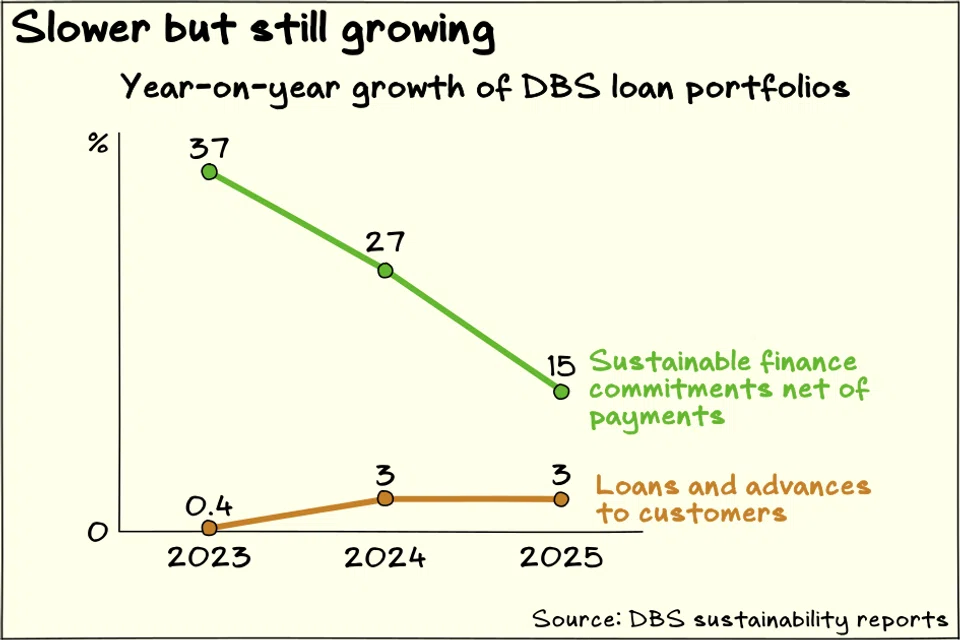
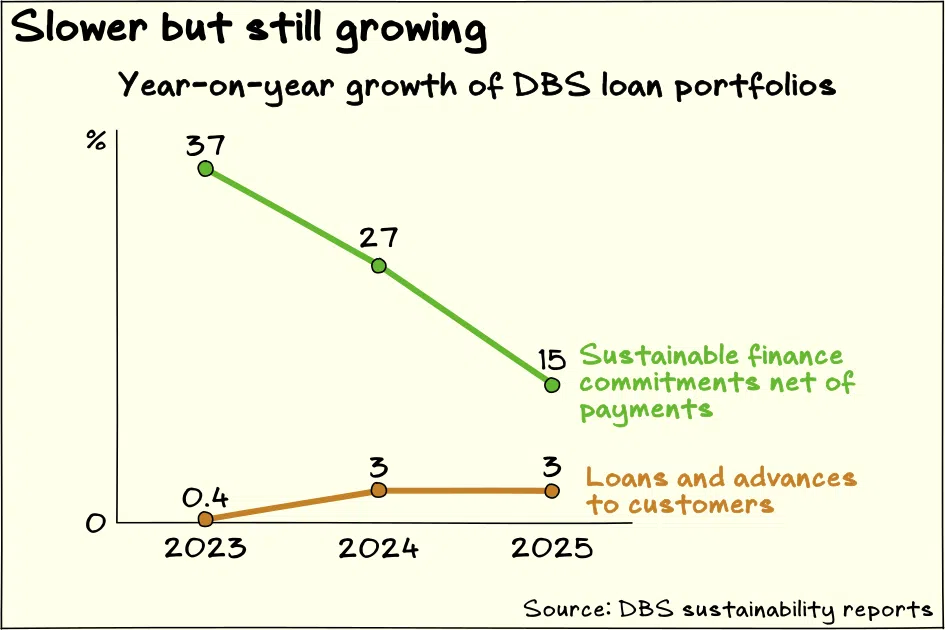
The bank’s committed sustainable financing net of repayments stood at S$102 billion as at end-2025, up almost 15 per cent from the S$89 billion extended a year earlier. Although the pace of growth was slower than the 27 per cent increase in 2024, sustainable finance remains one of the banks’ faster growing segments. In 2025, DBS’ total loans and advances to customers grew just over 3 per cent to S$445 billion.
DBS reports that it was on track towards interim financed emissions targets in five of seven sectors that it tracks – power, oil and gas, automotive, aviation and real estate.
But in aviation and in the remaining two sectors – steel and shipping – the bank highlights the need for other industry stakeholders to step up.
On aviation, DBS states: “To achieve our interim target by 2030, strong collaboration and ecosystem support will be required.”
On steel: “The entrenched technological and policy barriers facing the sector make it difficult for banks alone to drive the sector’s transition.”
On shipping: “The decarbonisation of the sector depends on coordinated action across energy and maritime sectors, robust policy support, and investment in production, bunkering infrastructure and new vessel design.”
DBS is therefore pursuing a whole-of-ecosystem approach to address some of these stubborn challenges. For instance, in aviation DBS has joined the multi-stakeholder Green Fuel Forward initiative launched by the World Economic Forum and Temasek-backed climate investment platform GenZero. In shipping, DBS joined ING, the Development Bank of Japan, AIM Horizon Investments and the Global Centre for Maritime Decarbonisation to raise US$35 million of commitments for a vessel retrofit fund.
An ecosystem strategy can be a powerful way to address a problem as complex as decarbonisation. Tackling decarbonisation at the systems level can improve the odds of success since the process typically aligns multiple shareholders, and solutions can be more comprehensive. But bringing various stakeholders to the table is only a first step, albeit a critical one.
To get the stakeholders to agree, it is important that solutions are fair.
A case in point is the Indonesian Just Energy Transition Partnership (JETP) deal, which brought together public and private financing commitments from developed countries to fund the early retirement of coal plants in Indonesia. Despite extensive negotiations and the involvement of many non-profits, consultancies and investors, a planned project that had advanced the farthest was cancelled by Indonesia, throwing the future of the programme in doubt.
In a recent op-ed, OCBC sustainability head Mike Ng discusses the difficulties of scaling up the early retirement of coal-fired power plants. Ng argued that current approaches are “financially imbalanced” because they place most of the economic burden on national utility companies.
Using the example of the debt restructuring of the Paiton coal plant in the early 2000s, Ng said the restructuring succeeded because all parties agreed to concessions to keep the project viable. The national utility company accepted a longer power purchase agreement tenor, shareholders took lower returns and lenders adjusted terms of their loans.
“The principle was simple: shared sacrifice to preserve long-term value,” Ng wrote.
Stakeholders must also be aligned.
For example, in debt restructuring, everybody loses if the deal falls through, so there is a strong incentive to agree to a more equitable distribution of the pain. But with decarbonisation, incumbents often have little need to budge if no-deal scenarios mean reversion to the status quo.
Perhaps another essential piece of solving decarbonisation problems is that stakeholders with levers that can move climate action in the right direction should use them. Policymakers should incentivise positive action and discourage inaction. Tax carbon. Remove fossil fuel subsidies.
Banks and investors also need to step up. They need to be more demanding of businesses, and only release their capital to businesses committed to decarbonising.
Corporate governance
Family matters in governance code review
Singapore’s ongoing review of its Code of Corporate Governance is an opportunity to strengthen practices at family-controlled companies.
As Monetary Authority of Singapore managing director Chia Der Jiun explains, the review focuses on two angles. The first is how the Code can better emphasize boards’ roles in shareholder value creation and investor engagement. This is in line with a broader effort to boost interest in Singapore’s stock market.
The second angle is to look into strengthening provisions on corporate culture, board effectiveness and risk management.
Beyond the review, Singapore Exchange is also considering mandatory disclosures related to shareholder value, such as dividend policy, investor relations policy and the link between remuneration and value creation.
Many family-controlled businesses are at risk of underperforming on many of those aspects of corporate governance when there is a conflict of interest between the family and minority shareholders. This is especially so in many Asian family-controlled businesses where control of management and succession is still very much decided within the families, and where formal family governance structures and outside talent are rarely utilised.
A number of governance issues are specific to family-controlled businesses. The first is the risk of profit extraction, such as when a business employs too many family members or pays them too well, or both.
For example, Corporate Monitor, an independent corporate research firm led by governance expert Prof Mak Yuen Teen, recently published a report on remuneration for family members in property investment group Hong Fok Corp. The report finds that six members of Hong Fok’s controlling Cheong family are among the 10 highest paid employees of the company, and they collectively took home 16 per cent of Hong Fok’s revenue in 2024. The firm also finds that Hong Fok’s co-chief executives, who are family members, are among the highest paid among industry peers despite an underperforming business.
Another significant risk is when family conflicts spill over into the family. The 2025 fight between City Developments (CDL) executive chairman Kwek Leng Beng and chief executive Sherman Kwek – the former is the father of the latter – unleashed a lawsuit and accusations of impropriety on both sides. Both sides eventually made up, but not before exposing cracks in the property group’s leadership.
A third risk for family-controlled businesses lies with succession, where family members may not be the best candidates for key leadership appointments, or where external managers have struggled to be accepted by the family. At the height of the CDL saga, the elder Kwek sought to oust his son as chief executive, calling into question Sherman Kwek’s performance.
It’s reasonable to argue that governance could and should be stronger at the family-controlled businesses listed in Singapore for which similar risks to Hong Fok and CDL are lurking out of sight. The role of independent directors should be especially examined for such businesses, given that they are one of the most important safeguards against these family-related risks.
The focus areas of the review – value to shareholders, culture, board effectiveness and risk management – are all particularly relevant to family-controlled businesses, and present a timely chance to address a governance gap in the market.
Other ESG reads
- GIC-backed Greenko Energies weighs US$1 billion India IPO: sources
- Sembcorp’s A$3 billion Alinta loan fuels Australia’s funding boom
- In charts: Singapore’s energy and chemicals sector in focus as Middle East conflict escalates
- Climate risks increasingly pose threat to insurance markets, broader financial system: MSCI Institute
- Demand for carbon credits may climb if Middle East war drags on
- Market volatility highlights Indonesia’s overlooked climate and resource risks
TRENDING NOW

If Europe goes to war, the fallout will be felt in East Asia
Stocks to watch: Seatrium, MIT, Keppel Reit, Clint, UI Boustead Reit, Digital Core Reit, ST Engineering

Chairman’s role in spotlight with raft of proposed new rules for Singapore boards

Mapletree Industrial Trust posts 6.6% drop in Q2 DPU to S$0.0297

