

Issue 20: Lendlease’s high-end greening; ESG bonds’ outperformance

In this issue: Why green makes sense for Singapore developers, while sentiment is high on ESG bonds issuance in South-east Asia.
Singapore
Going where the grass is greener
Why are so many Singapore real estate players near the top of the Global Real Estate Sustainability Benchmark (GRESB) rankings?
The 2022 edition of the GRESB rankings, a widely recognised benchmark, included Singapore player CapitaLand Ascott Trust as the global sector leader for hotels for the second time running. Frasers Property Group’s Frasers Property Industrial, Lendlease Global Commercial Reit and Suntec Reit were regional leaders for the industrial, retail and office categories, respectively.
It’s not a bad showing for Singapore real estate, especially given the Singapore market’s small size.
That outperformance could be related to the fact that land is expensive in Singapore, which makes the cost of greening a building less onerous compared against the total cost of developing a project.
Lendlease Asia chief executive Justin Gabbani explained the mathematics to The Business Times. By his reckoning, about 60 to 70 per cent of a building’s cost in Singapore is the cost of the land itself. That percentage is closer to about 20 per cent in places such as Malaysia and Sydney.
The absolute dollar cost of greening a building is the same regardless of the value of the land the building sits on. Where the land costs more, the “green cost premium” — the cost of going green — becomes a lower percentage of total development costs.
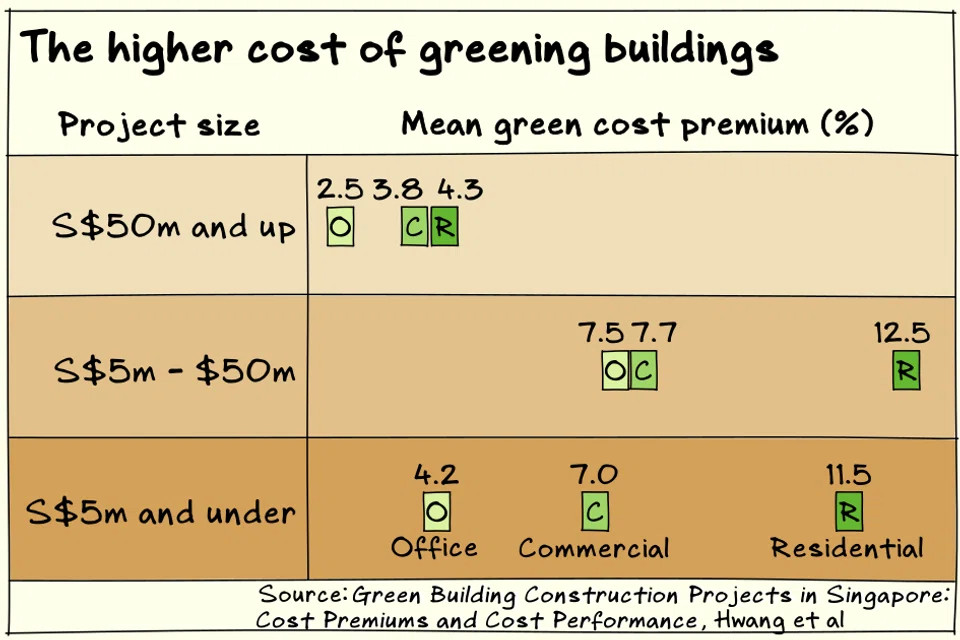
But land isn’t the only factor when it comes to green cost premiums; what kind of project gets built on the land matters too. In a 2017 paper, researchers polled construction, valuation and surveying professionals in Singapore. Respondents said green cost premiums as a percentage of total project size were lowest for the largest projects. Green cost premiums were also highest for residential projects, and lowest for office properties.
These green cost premiums matter for developers. If the developer chooses to absorb the cost, it means lower profit margins. If the developer chooses to pass the cost on to tenants or buyers, a lower cost premium means each unit will be less expensive relative to the market and therefore easier to rent or sell.
These dynamics could yet change to make greening easier in smaller projects in smaller markets. Carbon pricing that is more aggressive could lower the green cost premium, since non-green buildings would become more expensive. Demand for green buildings could also increase as tenants and buyers place greater value on sustainability.
Until then, large projects in premium property markets around the world would appear to be at the front of the line when it comes to greening.
Other Singapore stories
- HDB launches new five-year green senior bond at 4.09%, capped at S$1.2b
- Singapore residents say ESG issues important, but few act on it: survey
South-east Asia
A larger slice in a smaller pie
The aggressive interest rate hikes by major central banks around the world have made 2022 a dismal year for bond issuance. But ESG bonds have been somewhat of an outperformer, gaining market share in a smaller pie, according to market data compiled by JP Morgan.
ESG bond issuance made up about 28 per cent of overall supply in Asia excluding Japan in the year to Oct 17, 2022, according to the investment bank. That was a significant improvement from the 20 per cent share in 2021. In 2023, the bank expects ESG paper to account for between 35 and 40 per cent of overall bond issuance in the region.
Sovereign issuance of green bonds has been a major factor in the growth of the ESG bond market. Singapore, for instance, sold S$2.4 billion of its first sovereign green bond in August.
Another factor has been the sustainability-linked structure, which has allowed companies that do not have green assets or projects to take part in the ESG bond market. While green or social debt may be used only by issuers for eligible projects or purposes, sustainability-linked bonds and loans do not have restrictions on the use of proceeds. Issuers — even if they do not have green or social projects — instead agree to coupon rates that change depending on whether they are able to achieve ESG-related targets.
The idea that more than a third of the bond market could be ESG-based would have been unheard of less than a decade earlier, when ESG was still a niche more often associated with public relations and corporate social responsibility. But while the mainstreaming of ESG is encouraging, there is also significant concern about greenwashing driving a good part of growth in the past few years.
Is greenwashing a problem? Yes. Is it a known problem? Yes. Is there widespread effort to solve the problem? Yes. Is the problem solvable? Probably. Progress never comes quickly enough.
Other South-east Asia reads
- Climate fintech: Good progress in S-E Asia, but time to double efforts
- New fund to invest in “highest integrity” carbon credits, to restore nature and speed up climate action






