
ESG Insights

Issue 210: Sembcorp’s India unit lodges IPO prospectus; moving past 1.5 deg C

This week in ESG: Sembcorp Green Infra to raise up to 37.5 billion rupees; landmark report says global warming will breach key threshold

Summarise
Kenneth Lim
Published Fri, Sep 4, 2026 · 07:00 PM
    • Sembcorp Green Infra plans to repay about a quarter of its borrowings with its initial public offering proceeds.
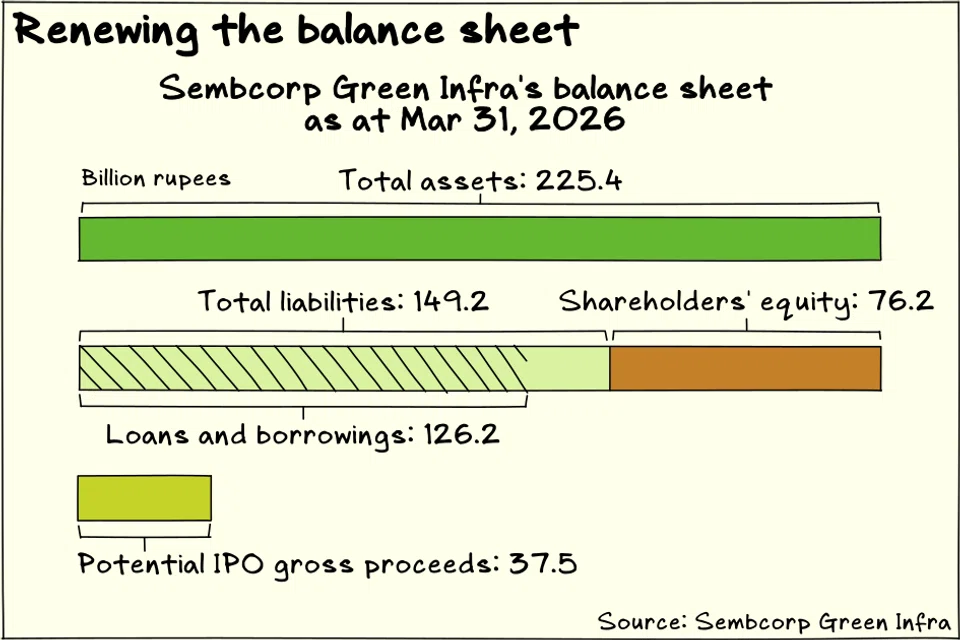
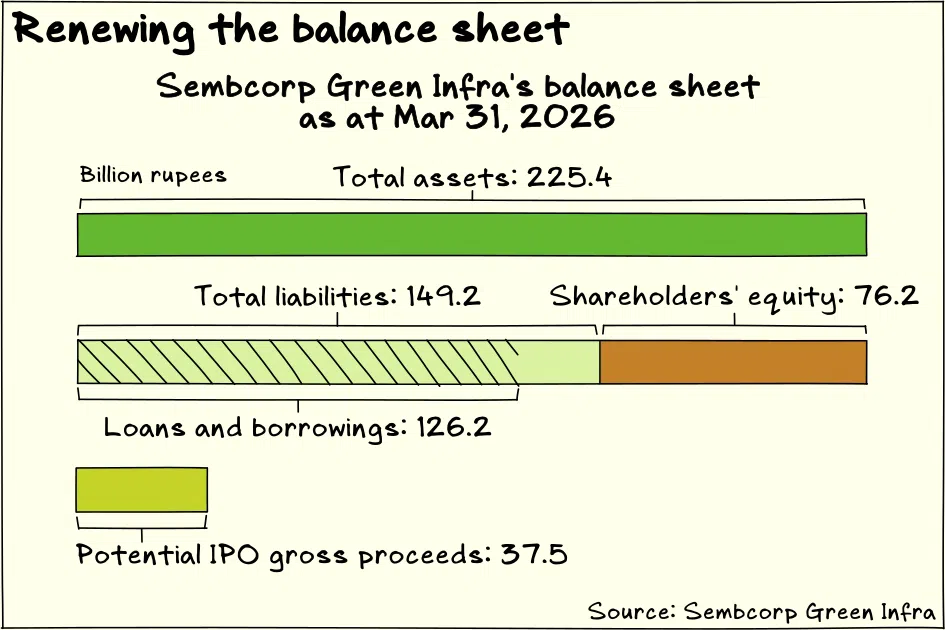
    • Sembcorp Green Infra plans to repay about a quarter of its borrowings with its initial public offering proceeds. ILLUSTRATION: KENNETH LIM

    Sustainable investing

    Sembcorp’s spin-off targets balance sheet
    A successful listing of its Indian renewables unit is likely to strengthen Sembcorp Industries’ market value and balance sheet, even if the Singapore energy player is not selling any stake for cash.

    Analysts see potential for the initial public offering (IPO) of Sembcorp Green Infra (SGI) to catalyse a higher valuation for the spun-off subsidiary, while the application of listing proceeds towards debt repayment will deleverage both companies’ balance sheets.

    SGI has filed a preliminary prospectus in India as part of the listing process, although no listing date has been set.

    The IPO will fully comprise newly issued shares because Sembcorp, which owns all of SGI, will not be selling any shares through the listing. This means that Sembcorp will not be receiving any cash from the listing, so Sembcorp shareholders looking for a special dividend from the spin-off might not want to get their hopes up.

    Nevertheless, Sembcorp stands to gain from two aspects of a successful IPO.

    The first stems from the IPO proceeds. SGI plans to raise up to 37.5 billion rupees (S$500 million) through the IPO, with about 30 billion rupees of the proceeds earmarked for reducing SGI’s debt.

    The amount of debt paydown will reduce SGI’s loans and borrowings – which stood at about 126 billion rupees as at end-March 2026 – by about a quarter. If the IPO was completed on March 31, 2026, SGI’s net assets would have increased by about 40 per cent to 106 billion rupees from 76 billion rupees.

    The deal will also flow into lower debt for Sembcorp on a consolidated basis. SGI’s loans and borrowings as at end-March represent roughly a fifth of Sembcorp’s loans and borrowings as at end-2025. The direction of the impact on Sembcorp’s balance sheet is clear, even if the magnitude is still uncertain. Sembcorp’s fiscal year ends on Dec 31, while SGI’s ends on Mar 31, so there is some misalignment in the companies’ reported finances. Furthermore, the number of shares that will be offered has not yet been set, so Sembcorp’s post-IPO stake – and its share of SGI’s assets and liabilities – cannot yet be calculated.

    CGS International analysts Meghana Kande and Lim Siew Khee calculate that SGI will save about S$30 million of annual interest cost savings from 2028 onwards following the debt repayment, based on existing average finance cost of about 7 per cent.

    The deleveraging matters for Sembcorp and SGI because the companies’ growth hinges on securing new energy projects and strategic acquisitions. Stronger balance sheets both lower the cost of financing as well as increase the capacity to raise capital to finance projects.

    As at end-June, Sembcorp has 6.6 gigawatts (GW) of renewables capacity under construction across its renewables portfolio. India’s pipeline stands at 3.6 GW of hybrid projects.

    The IPO’s other potential benefit for Sembcorp is the potential for a higher valuation for SGI. The CGS analysts estimate that the market currently values SGI at an enterprise value about nine times its earnings before interest, tax, depreciation and amortisation, which is below the 13 times multiple ascribed to its renewables peers. The IPO could therefore value SGI higher, which would drive a positive re-rating of Sembcorp’s share price based on a sum-of-the-parts valuation.

    DBS analyst Pei Hwa Ho reckons that SGI could command an enterprise value of about S$5.5 billion and about S$1.5 billion to S$2 billion in equity valuation. That could translate into a 5 to 10 per cent upside in Sembcorp’s valuation.

    DBS is maintaining its “buy” call on the stock with a S$7.30 target price on Sembcorp. CGS is maintaining its “add” rating with a S$7.15 target price.

    But those benefits can be collected only if the SGI IPO is completed, which is not an inevitability. Sembcorp had previously sought to list SGI’s predecessor in 2018, but withdrew in 2019 as it said it wanted to inject new equity into the business.

    The good news is that while the broad Indian stock market has not been stellar over the past year, energy stocks in India are outperforming. The Nifty 50 index, for instance, is down about 3.2 per cent in the 12-month period to Sep 3. However, the Nifty Energy index is up almost 10 per cent over the same period.

    There is more at stake for Sembcorp than potentially boosting its balance sheet and share price. Given that this is attempt No 2 to list SGI, a successful IPO will reassure Sembcorp investors about the group’s ability to recycle capital. Another withdrawal, however, will call that ability into question, with good reason.

    Climate change

    Moving on from 1.5 deg C

    A landmark report by the United Nations Environment Programme (Unep) is the first major look into how to rein in climate change even after it exceeds a key warming threshold.

    Titled “Limiting Overshoot”, the report addresses the reality that global temperatures will probably exceed 1.5 degrees Celsius over pre-industrial levels by 2030, a level of warming beyond which irreversible damage is expected. Given these circumstances, the report seeks pathways to limit the exceedance and to eventually return global temperatures back to safer levels.

    A key message is that overshooting is no reason to give up the climate fight. The extent of climate-related damage is a function of how long temperatures stay at unsafe levels, so continued mitigation and removal of greenhouse gas emissions remain top – and even more urgent – priorities.

    Adaptation and resilience are important as well, beyond the obvious need to protect society from climate-related damage. The report notes that effective adaptation and resilience also help to protect the means and will to continue investing in climate mitigation, and are therefore crucial levers.

    The report notably addresses the just transition, which refers to the principle that climate action should be fair and balanced against social and economic needs. The just transition is especially relevant in developing Asia, where resources for climate action are scarce but where vulnerabilities to climate damage are high.

    In a foreword, Unep executive director Inger Andersen writes: “Countries with greater historical responsibility for climate change should act the fastest and with the greatest ambition. And, as many nations and communities will likely face permanent changes, we will require a fundamental rethink to long-term governance to ensure that those who have contributed least to global warming are not left to bear its greatest burdens.”

    The energy transition is critical to this endeavour, but the businesses and investors that can scale it up need better support. Policymakers must send clear signals and commit to long-term strategies that will outlast election cycles, to reduce the uncertainties and risks that keep capital away.

    As Andersen argues, wealthier nations need to step up. But developing nations cannot use a lack of support as an excuse for inaction. Businesses, too, should set climate strategies and ambitions that appropriately address their risks and opportunities.

    The economic case for being forward on climate action is increasingly compelling. This year’s heatwaves in Europe and Asia, flash flood in Nepal and powerful El Nino season are just a glimpse of how unpredictable, inescapable and catastrophic climate-related damage can be. Boards of directors that aren’t treating climate change as material are falling short in their duties, and will be called out by other stakeholders sooner rather than later.

    Other ESG reads



