Issue 214: Singapore’s gas power pipeline; South-east Asia’s renewables pivot
This week in ESG: PacificLight Power begins construction on S$1.2 billion gas-fired plant; Zero Carbon Analytics examines region’s post-Iran war energy policies

Energy transition
Singapore’s struggle to wean itself off natural gas
Singapore continues to build natural gas electricity capacity to meet growing energy demand as greener alternatives remain elusive at scale, but each new gas plant makes it more challenging for the country to meet its climate goals.
Construction has begun on a new S$1.2 billion gas-fired power plant, a 670-megawatts (MW) gas-fired plant by PacificLight Power’s PLM Power unit. The new plant is expected to begin operations in 2029, and will boast Singapore’s largest and most efficient single power generation unit.
The plant will also be integrated with an 80 MW lithium-ion battery energy storage system (BESS) that will allow the plant to quickly respond to variances in supply and demand conditions, which enables the utilisation of the plant’s larger and more efficient gas turbine plant without destabilising the grid.
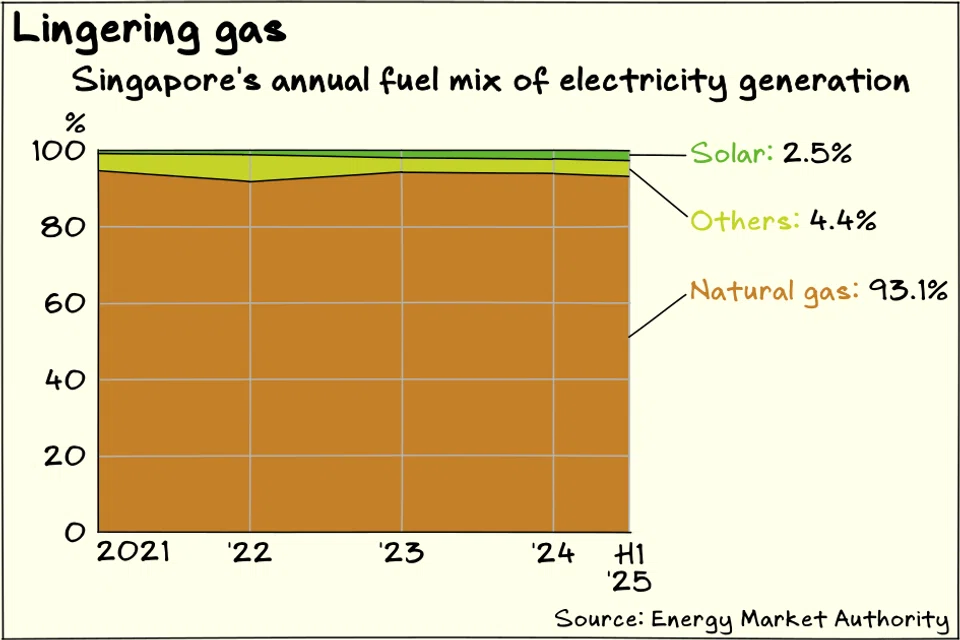
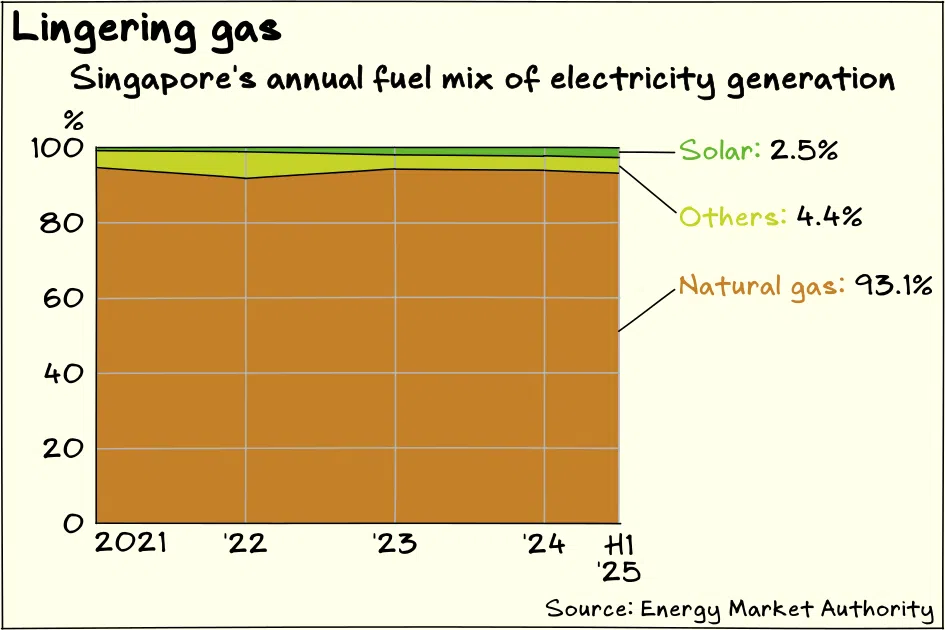
Singapore generates more than 90 per cent of its electricity from natural gas. While solar’s share of generation has grown rapidly over the past few years, it accounts for only about 4 per cent of Singapore’s generation at the moment.
Over the coming decade, Singapore expects peak electricity demand to grow at a compounded annual growth rate of about 2.9 to 6.5 per cent a year. To meet that increased demand, Singapore projects that total energy supply will grow by about 2.7 gigawatts (GW) to 14.5 GW by 2030 from about 11.8 GW in 2026. The projection assumes effective supply of only about 600 MW from an expected 3 GW peak of solar capacity, reflecting an effective capacity of 26 per cent for solar generation. This implies that more than three-quarters of the additional electricity generation in the coming five years will come from natural gas.
The trouble with the natural gas-dominated new capacity is that natural gas produces substantial amounts of greenhouse emissions when burnt to power the turbines. Singapore, which reported national emissions of about 55.5 million tonnes of carbon dioxide equivalent in 2023, has pledged to reduce emissions to around 60 million tonnes of carbon dioxide equivalent (MtCO2e) by 2030 after peaking earlier. By 2035, the goal is to reduce emissions to between 45 MtCO2e and 50 MtCO2e, and then to hit net zero emissions by 2050.
Power accounts for almost 40 per cent of Singapore’s emissions. Unfortunately, the power sector’s emissions could remain elevated for the next few decades, for a few reasons.
The first is that gas power plants can run for more than 30 years. The plants being built today will probably still be active and producing greenhouse gases when 2030 and 2035 come along, and even when the 2050 target rolls around.
The second is that, even though the newly built gas power plants can be converted into hydrogen plants in the future, it is improbable that low-carbon hydrogen will be a viable alternative to natural gas by 2035. The International Energy Agency has found that low-emissions hydrogen production projects that have been committed, and with strong potential to be in operation by 2030, have shrunk to about six million tonnes in 2026 from 10 million tonnes in 2025, due to delays in investment decisions. The agency concludes that low-emissions hydrogen will not be able to meet announced ambitions by 2030, and recommends that governments update hydrogen strategies and long-term deployment targets to reflect the new market realities.
Natural gas is supposed to be a transition fuel for Singapore’s energy sector. But Singapore might continue to rely on the fuel well past 2030.
In Singapore’s defence, natural gas is the country’s least worst option at the moment. The country has raised its solar target, but the reality is that domestic solar’s contribution is limited by the country’s cloud cover, limited land area and high population density. Low-carbon electricity imports via regional power grids are progressing only slowly due to complex issues relating to cross-border policies and financing. In terms of emerging low-carbon alternatives, nuclear has shown the most promise in terms of viability, but the process of getting an operational nuclear plant is expected to take many years and bear a hefty price tag.
The energy transition is proving to be a long quest for Singapore, partly because the country has limited influence over some key factors, such as energy policy in potential electricity exporting countries and the pace of development of green hydrogen.
A couple of actions may be appropriate. The first is a review of the national climate targets to assess whether they are still realistic. The second is to look for ways to sharpen the energy transition strategy by focusing resources on pathways – such as electricity imports and nuclear energy – that have proven to be more promising since the original strategy was first constructed.
Energy transition
South-east Asia sets course for renewables
An analysis of South-east Asian policies in the wake of the Iran war shows the region laying down more renewable energy policies than fossil fuel directives.
The findings certainly reflect stronger intent among South-east Asian governments to pursue renewable energy, but turning intention into results is a whole other matter.
Zero Carbon Analytics finds that Indonesia, Malaysia, Singapore, Thailand and Vietnam have announced 37 renewable energy and electrification policies since the start of the Iran war, and only 29 fossil fuel policies in the same period.
The study also finds positive signs of implementation progress. For example, the Philippines imported more than double the amount of solar capacity from China in the first five months of the war compared to a year ago. In Vietnam, rooftop solar companies noted a significant increase in consultations after the country raised a cap on selling excess solar power to the grid.
The analysis is encouraging for the region’s energy transition, and suggests that the Iran war may have triggered momentum towards a more sustainable energy profile for the region. The reframing of renewable energy as a matter of energy security and resilience – instead of climate action – has also put wind behind the sails.
However, the region will need to ensure that it can sustain the momentum even after the fossil fuel supply shock inevitably dissipates either when the conflict ends or when supply chains fully adapt to a new reality.
Addressing financing hurdles will be critical to that endeavour. The energy transition is and will be costly, and policy support to reduce the frictions for financing is essential to allow the needed investments to take place.
In addition, the region has to commit to meaningful carbon pricing, otherwise the appetite for the transition will wane when fossil fuel prices are no longer exorbitant while the pollutive impact of oil and gas can continue to be externalised.
Finally, governments must address the social and economic disruption of the energy transition, by helping to alleviate cost pressures and providing support for affected workers.
Other ESG reads
- Energy investment set to rise at 94% of Singapore businesses: Schneider report
- Building a more connected and sustainable South-east Asia
- Thai flood damage seen at US$320 million
- Vietnam’s data-centre investment rush faces reality check on power and site constraints
- T Rowe seeks to ring-fence US$165 billion emerging-market portfolio from El Nino fallout