

Issue 216: Singapore’s multi-fuel bunkering bet; listed companies hazy on haze risk
This week in ESG: Singapore to conduct ethanol bunkering pilot; no visible haze in listed companies’ climate risks

Energy transition
Managing the transition to a multi-fuel bunkering future
As Singapore plans for a multi-fuel future for the maritime sector, its challenge is to be both versatile and efficient so that it can defend its status as a bunkering hub in the coming decades.
That means building up capabilities for different fuels while investing strategically to ensure that supply and demand are closely matched.
Singapore Senior Minister of State for Transport Murali Pillai says that the country is exploring the use of liquefied biomethane as a marine fuel, alongside plans to conduct its first ethanol bunkering operation and the release of guidelines for ammonia bunkering. Singapore is also expanding capacity for liquefied natural gas (LNG).
One of the maritime industry’s biggest decarbonisation challenges is how to replace the fossil-based marine fuel that powers vessels with greener alternatives. LNG, ethanol, methanol, methane and ammonia are among the leading candidates, while old classics like wind have also been incorporated into some modern designs.
Murali’s declarations, made at the Singapore International Bunkering Conference, reflect a bet that there will not be a single winner out of those alternatives.
Indeed, a recent analysis by the Global Centre for Maritime Decarbonisation (GCMD) – an international think tank based in Singapore with funding support from industry and the Maritime and Port Authority of Singapore – looks at different scenarios for the maritime fuel transition and none of them lead to a single dominant fuel by 2050.
“The future fuel landscape remains fragmented across all fuel types and in bunkering locations,” GCMD says in its report. “Shipowners that lock into a single fuel pathway today risk assets stranded by regulatory or cost outcomes.”
GCMD identifies four key signposts that affect uptake of alternative fuels:
The levelised cost of hydrogen is a primary determinant of the cost for low-carbon methanol and ammonia;
The cost of carbon dioxide obtained from biomass, which affects the cost of bio-methanol;
The cost trajectory of bio-methanol, which can be used in the near term and provide a bridge to greener electro-methanol in the longer term. Electro-methanol is produced using green hydrogen and captured carbon dioxide.
Regulatory treatment of ethanol in fuels based on food crops, which has a “binary” impact on ethanol’s penetration in marine fuels.
The cost and carbon footprint of the different fuels also varies depending on available resources, which can vary by region. GCMD expects that bio-methanol will be “cheapest along global sea lanes, with Asia being the most cost-competitive”.
Ammonia bunkering will be more likely along Asia sea lanes due to low production costs in China and India, while bio-ethanol will be linked to US supply chains due to low American production costs.
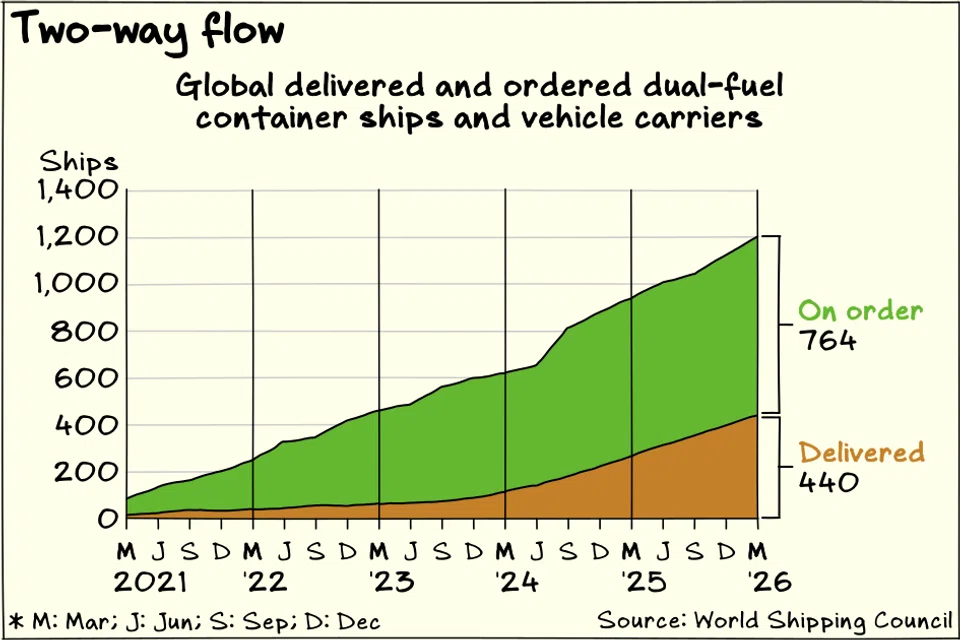
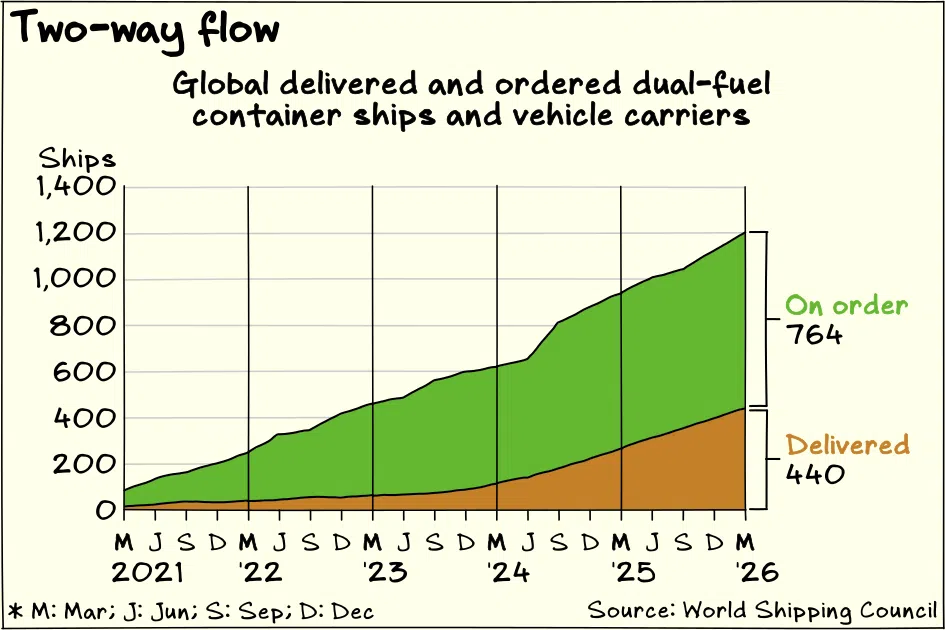
Because there is so much uncertainty around those factors right now, ship owners are increasingly ordering dual-fuel vessels that can use existing marine fuels as well as one of the alternatives. However, since there is no single dual-fuel combination dominating the orders, different fuel mixes will likely be required for many years after these vessels are built.
Data compiled by the World Shipping Council shows that 94 per cent of vehicle carrier orders and 78 per cent of container ship orders by deadweight tonnage are for dual-fuel ships as of March 2026. There were 440 dual-fuel vehicle carriers and container ships on the water at the time of the data, and 764 on order.
Most of the dual-fuel container vessels on order are for conventional-and-methane and conventional-and-methanol engines. There is one container ship on order with ammonia capability.
It’s not hard to see why Singapore is taking a multi-fuel approach under these circumstances. If Singapore is to remain a bunkering hub, it will need to cater for the different potential fuel types in the pipeline.
But actually building the infrastructure and supply chains to provide multiple fuels can be costly, which makes it important to time investments and expenditures to match demand. At the moment, the vast majority of dual-fuel engines are still running on conventional fuel.
GCMD explains that conventional fuel is still significantly cheaper than low-carbon alternatives at the moment, which means that most dual-fuel vessels are still not switching.
The economics could change and green alternatives could become cost-competitive if emissions were taxed aggressively enough, GCMD says. The maritime sector is considering the possibility of imposing a US$700 per tonne of greenhouse gas emissions penalty under a proposed net zero framework, but international consensus is missing. The industry could make a decision in December at a meeting of the Marine Environment Protection Committee.
Amid that uncertainty, being too aggressive on building out infrastructure for alternative fuels when demand is still absent might make it difficult to recover costs, which would make it more difficult to maintain a commercially sustainable bunkering hub.
Singapore manages that risk by focusing on capability building for now. For instance, Singapore has developed a technical reference for ammonia bunkering, and is carrying out pilot bunkering trials for different fuels. The aim is to start building the software now to shorten the time to delivery when the need arises.
The economic and logistical realities of producing low-carbon fuel for ships means that green bunkering in the future will comprise a more heterogeneous landscape than the conventional marine fuel system we have today. But knowing what the end state might look like is only one part of the challenge; navigating the transition is the other, just as important part.
Climate risk
Risk disclosures on haze need more visibility
Singapore-listed companies may need to give more deliberate consideration to the haze as a risk to be managed, and assure investors of those considerations.
The prolonged season of the transboundary air pollution currently besieging Singapore, Indonesia and Malaysia has disrupted a swathe of activities. For example, the haze has led to severe curtailment of outdoor activities and suspended flights.
Of course, this is not the first time that South-east Asia has encountered the haze, with the severe outbreak in 2013 leading to the enactment of Singapore’s Transboundary Haze Pollution Act. In fact, Singapore is so familiar with the haze that it has well-established guidelines on when pollution levels are unhealthy and the appropriate health and safety responses at those levels.
Yet many listed companies’ disclosures do not seem to directly address the risk posed by the haze, even for companies that would seem to be more exposed to such risk.
For instance, theme park developer Sim Leisure Group’s sustainability report identifies extreme weather as a material physical climate risk, but only considers that risk in the form of extreme rainfall and increased flooding. The bulk of the company’s revenues are from Malaysia and Singapore, where haze conditions pose an ongoing threat to guest numbers as well as worker health and safety at its outdoor theme parks.
ISOTeam, a building maintenance and estate upgrading group with a leading presence in building painting works, performs substantial work outdoors. Its climate-related disclosures discuss heatwaves, water stress and sea level rise as key physical climate risks. There is no mention of the haze.
Investors might be concerned that a company deems sea level rise, which may only manifest at a serious enough level many years into the future, important enough to disclose but not the haze, which occurs almost every year at varying levels of severity.
This is not to suggest that companies have not been dealing with the haze. In fact, both of the mentioned companies have been around long enough to be familiar with serious haze events of past years.
But leaving the haze out of disclosures can create a gap in investors’ appreciation of how a company manages climate risk, and raise questions about the thoroughness of a company’s assessment of climate risks. This is increasingly relevant with rising temperatures expected to raise the severity and frequency of serious haze events, even if human activities are still a major underlying cause of the haze.
The haze is also a reminder that companies need to be especially conscientious when it comes to assessing their exposure to climate risk, and not overly rely on convenient boilerplate risks. One of the biggest dangers of climate change is unpredictability, so prudent companies should be assessing the exposure of various aspects of their businesses in detail.
Other ESG reads
- Singapore lithium battery recycling startup Neu Battery Materials raises US$7.6 million
- Cost over climate: Most Asean firms scaling back decarbonisation plans as higher energy prices bite
- Singapore’s low-carbon electricity 2035 target is ‘aspirational’: EMA
- Gridlock or growth? The Asean Power Grid faces a critical window of opportunity
- LNG, stronger regional power links key to Asean’s energy resilience: Shell
TRENDING NOW

NEA identifies 7 firms responsible for haze fires, notices issued urging action: Grace Fu

DBS remains analysts’ pick ahead of Q3 earnings after Singapore banks’ share slump

High Court rules against Julius Baer’s Singapore trust arm in US$50 million family trust dispute

Could stablecoins be the future of money?

