Issue 218: Potential winners in Singapore’s grid investment plan; Singapore governance code review reveals proposals
This week in ESG: Singapore announces five-year Energy Infrastructure Plan; Corporate Governance Advisory Committee, Singapore Exchange launch public consultation

Energy transition
Energy sector’s brightening prospects
You know how there’s sometimes a superstar at work, and when this person leaves, it takes a few people to do the same job that one used to handle?
Fossil fuels are kind of like that superstar for energy, and headlines from Singapore International Energy Week suggest that it will take a multiple-alternatives strategy to transition away from the old standard.
Anticipation of an energy future marked by diversified technologies and rapidly growing demand could build a long-term bull case for energy-sector companies such as Sembcorp Industries, ST Engineering, Keppel Corp and EGP Energy.
Demand-led build-out
One of the most consequential announcements by Singapore is a comprehensive five-year Energy Infrastructure Plan that lays out a development strategy for the energy sector.
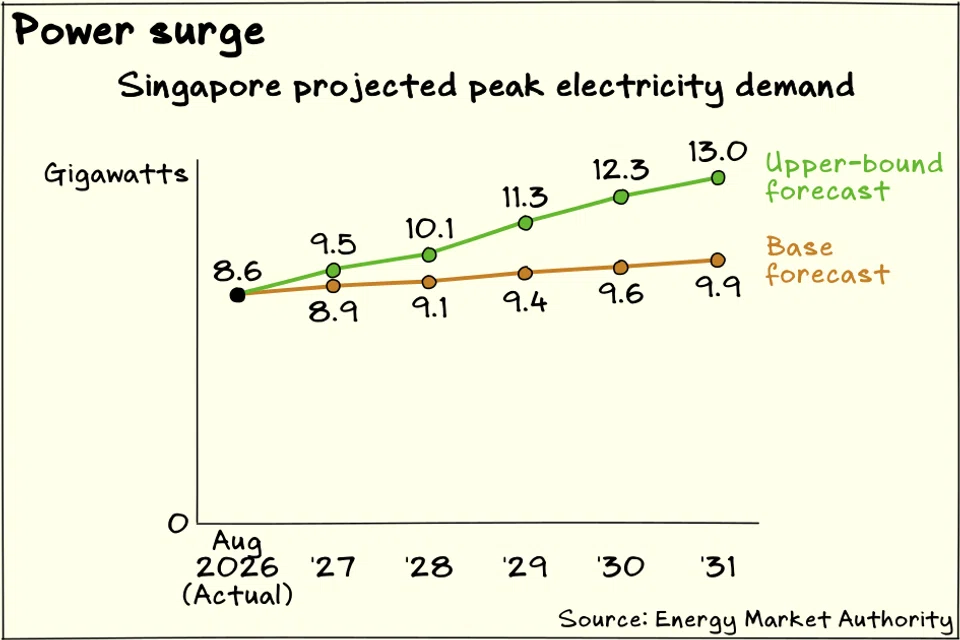
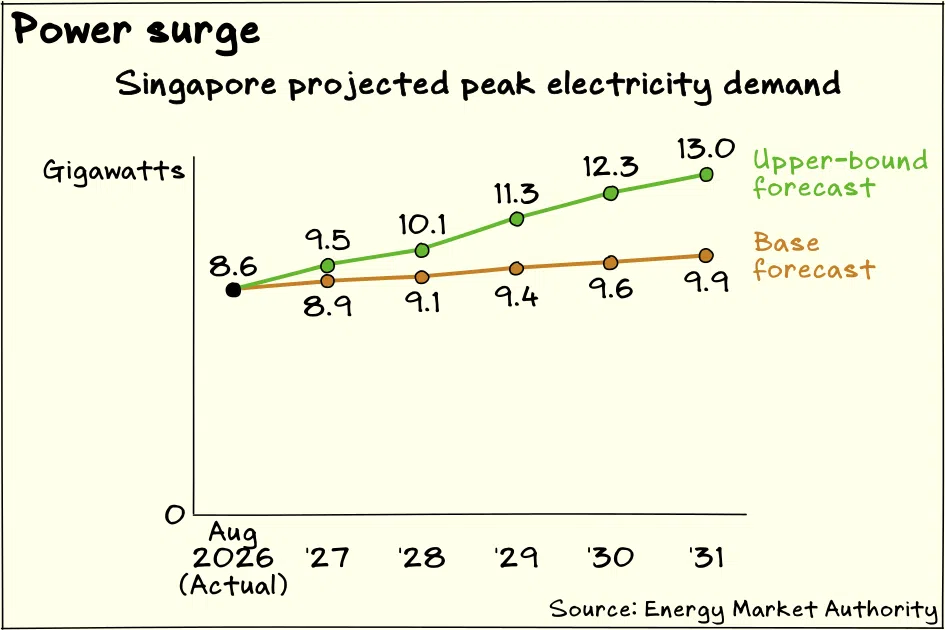
The impetus for the plan is that Singapore expects peak electricity demand to increase by 15 to 51 per cent over the next five years, with a forecast for peak demand to grow to between 9.9 and 13 gigawatts (GW) by 2031 from 8.6 GW as at Aug 2026. The main drivers of that increase are economic growth – underpinned by semiconductor industries and data centres – and the electrification of the transport sector.
In line with the rest of South-east Asia, Singapore faces a ballooning hunger for electricity, and this is driving massive investments that span not just different types of generation technologies, but also the different parts of the grid.
On the generation side, natural gas remains the main source of electricity. Singapore will open five new gas plants between 2026 and 2031 and is studying the feasibility of expanding its first liquefied natural gas terminal at Jurong Island.
In terms of low-carbon alternatives, Singapore has set a new 2035 target of 4 GW peak (GWp) for solar capacity by 2035, with its current 2.3 GWp capacity well on track towards the current target of 3 GWp by 2030. The country is also stepping up development of nuclear capabilities, and expanding research into geothermal solutions.
On transmission and distribution, Singapore’s new plan includes S$5.3 billion of expected investments between 2025 and 2029 to expand its power grid, which is 11 times the amount spent in the preceding five years. That money will go towards building seven new transmission substations by 2031, adding about 1,400 km to the transmission cable network and strengthening the distribution network. Furthermore, Singapore is looking into the feasibility of more than tripling the length of its cable tunnels from about 50 km today.
Multi-technology mix
The future energy landscape is likely to look significantly more heterogeneous, for a couple of reasons.
The first is that a portfolio approach is proving to be better from an energy security and resilience perspective. In Singapore’s case, disruptions from the Iran war and Indonesia’s throttling of gas exports are a clear reminder about the fragility of supply chains. Those vulnerabilities exist whether Singapore is importing green electricity, nuclear fuel or solar and battery equipment.
The second reason behind heterogeneity is that many of the options are imperfect. Nuclear is a relatively technologically mature and low-carbon source of energy, but it is also costly. Solar is relatively cheap, but Singapore’s solar capacity is much too little for the country’s needs. Hydrogen-based alternatives are costly as well, and some hydrogen carrier options such as ammonia come with significantly higher physical risks due to the dangers inherent in the fuel. Natural gas has a high carbon footprint, but it is available in the short term, a potential source of back-up power in the future and is the least carbon-intensive of the fossil fuels.
Any strategy to reduce reliance on fossil fuels may necessarily have to rely on a mix of options in order to be adequate, secure and resilient.
The same applies to energy storage systems. Researchers at the University of Utah suggest that a hybrid system that combines lithium ion batteries, pumped hydro storage and underground hydrogen storage may be more effective and cost efficient than single-technology solutions. The reason is that each storage technology is optimal under different conditions, and a hybrid approach allows the grid to better utilise the right tool at the right times.
Potential winners
The policy momentum suggests that the energy sector stands to receive significant investments in the years ahead, a substantial amount of which will be driven by the public sector. Public sector involvement could be as buyers, subsidy providers or as regulators and policymakers. Furthermore, the investments will flow to a broad swathe of the sector.
Those conditions could be especially favourable for companies that have broad capabilities across the infrastructure and energy space, as well as firms that have a track record of winning public-sector work.
Singapore-listed players Sembcorp, ST Engineering, Keppel and EGP Energy are some of the companies that could benefit.
Already, Sembcorp and ST Engineering have announced a knowledge exchange and potential partnership with Canada’s AtkinsRealis on tie-ups in the nuclear energy sector. Sembcorp, Keppel and Tuas Power Generation have also clinched a contract to import and supply biomethane as part of a 300-megawatt pilot to seek an alternative to natural gas under a sandbox framework.
Sembcorp’s utilities unit is also in a consortium with Malaysia’s national oil company Petronas and state utility Tenaga Nasional and with Vietnamese national oil company Petrovietnam Technical Services Corp that has just received conditional approval to import 1.3 GW of low-carbon electricity from Vietnam and Malaysia.
EGP Energy has been one of the best-performing initial public offerings on the Singapore market this year. On Oct 5, OCBC Group Research initiated coverage on the stock with a “buy” recommendation, citing the transmission and distribution equipment supplier’s strong presence in the Singapore extra high voltage and high voltage switchgear market.
Noting EGP Energy’s S$296.2 million order book at the time, OCBC analyst Heidi Mo said that the company’s 30-year relationship with Singapore’s national grid operator provides “capex visibility through 2030”.
Corporate governance
Singapore governance review aims at chairpersons, concurrent seats
A cap on concurrent directorships, stronger safeguards when board chairs are not independent and discouraged use of performance-linked share compensation for non-executive directors are among the recommendations by Singapore’s Corporate Governance Advisory Committee (CGAC) after a 17-month review.
Singapore Exchange (SGX) and CGAC are seeking public feedback on those recommendations. The public consultation ends Jan 27, 2027.
Key takeaways:
- Cap concurrent directorships at five: CGAC recommends limiting the concurrent listed-company directorships held by any director to five. The consultation seeks feedback on whether the cap should be mandatory under the listing rules or comply-or-explain as a provision to the Code of Corporate Governance. The official estimate is that about 25 directors in 2024 held more than five board seats in listed companies. For context, in 2025 there were about 3,100 board directors on Singapore-listed companies.
- Safeguards against non-independent chairs: A proposed listing rule change will make it compulsory for boards with non-independent chairs to appoint a lead independent director. An analysis by the Singapore Institute of Directors shows that in 2025, 70 listed entities, or just over 11 per cent of listed companies, had non-independent chairs but did not have lead independent directors.
- Independent chairs on key board committees: The review recommends listing rule changes to mandate that the audit, nominating and remuneration board committees be led by independent directors and comprise a majority of independent directors. More than 95 per cent of these board committees already have independent chairs, and almost all have independent directors in the majority.
- Capital management policy disclosure: The review recommends that companies maintain a capital management policy and to disclose it in the annual report, but is seeking feedback on whether this should be mandatory under the listing rules or comply-or-explain as a Code provision. If accepted as a listing rule, this will subsume a pending requirement effective January 2027 for companies to maintain and disclose a dividend policy.
- No performance-based share compensation for non-executive directors: A proposed Code provision will state that non-executive directors should not receive performance-based share-based incentives and rewards. The aim is to avoid compromising the independence and objectivity of directors who are supposed to be overseeing performance outcomes. Non-performance-based share-based remuneration, such as share options that are not contingent on performance targets, would still be allowed. A study by the National University of Singapore’s Centre for Investor Protection of 510 listed entities shows about 16 per cent have non-independent, non-executive directors participating in share-based plans. Less than one per cent allow independent directors only to participate in share-based plans. About 62 companies allow independent directors to participate.
- Enhanced risk disclosures: A proposed new Code provision will recommend that companies disclose a board assessment of principal and emerging risks and how those risks are managed.
On the whole, the elevation of a number of practices from comply-or-explain Code provisions to mandatory SGX listing rules represents a slight tightening of corporate governance practices. However, some have observed that the practices being elevated are mostly already widely adopted, which means that those elevated rules will not generate significant improvement from the current state of corporate governance.
The recommendations also include adding commentary about “intended outcomes” in response to feedback from focus groups that companies are not always clear about governance outcomes sought by the Code. For example, the Code on board membership will include an explanation that “a formal and transparent board appointment process, overseen by an objective and strongly independent nominating committee, ensures optimal board composition and progressive renewal”.
Other ESG reads
- MPACT, Singapore Land enter top tier of global ESG benchmark for real estate; Hongkong Land slips
- Natural gas to stay for the long haul beyond 2050: Singapore International Energy Week panellists
- Seatrium, Karpowership to develop floating power, digital infrastructure solutions in Singapore
- Plantation stocks trading at ‘sizeable’ upside after haze-induced sell-off: OCBC
- Rent premiums for greening offices higher in Hong Kong than other cities, least likely in Singapore