Issue 220: COP31’s electric dreams; Singapore tweaks green finance rules for data centres
This week in ESG: United Nations climate conference kicks off in Turkey; Singapore-Asia Taxonomy updates criteria

COP31
Aiming for a pragmatic electrification goal
Pragmatic or ineffective?
Negotiators are huddling in Turkey for this year’s United Nations climate conference under an atmosphere of muted expectations, as governments are too busy dealing with global turmoil to prioritise global warming.
The challenge is to find a common path towards credible long-term outcomes while addressing short-term needs so that climate progress is calibrated but not abandoned. This should mean continued commitment towards net-zero emissions while allowing flexibility on how to get there, prioritising renewable energy and grid improvements, and unlocking investments in climate adaptation and resilience.
Singapore Minister for Sustainability and the Environment Grace Fu says that reaching a global agreement at the conference known as COP31 will be more difficult than in previous years.
“The headwind is getting stronger, not weaker,” she says.
Indeed, the war in Iran and the massive data centre build-out driven by artificial intelligence has placed energy security at the top of mind for most governments. While this has helped to spur interest in renewables, it has also extinguished plans to phase out coal in countries like Indonesia that have domestic sources of the high-carbon fuel.
The economic uncertainties brought about by a fractured global trade system and the energy-led inflationary shock have also dampened growth expectations and lowered fiscal headroom for climate-related spending and investment.
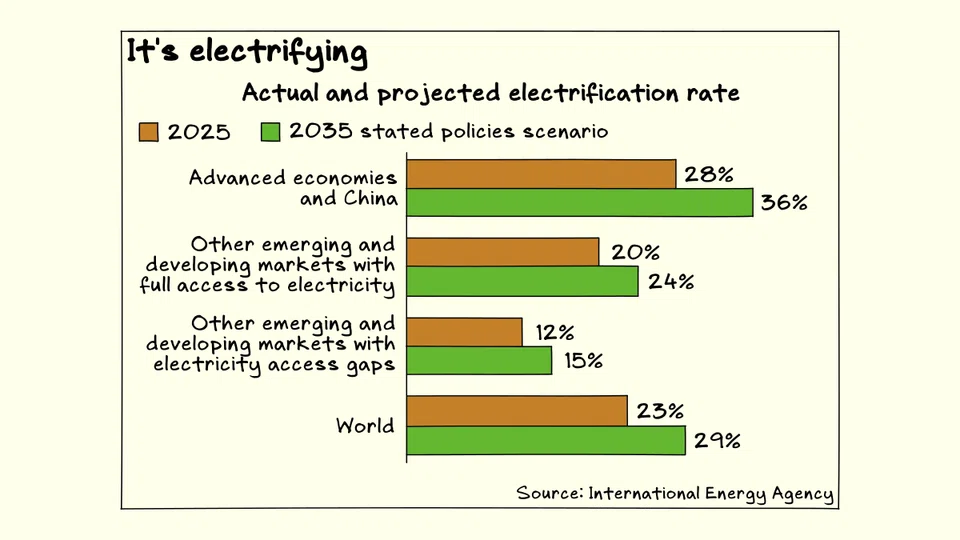
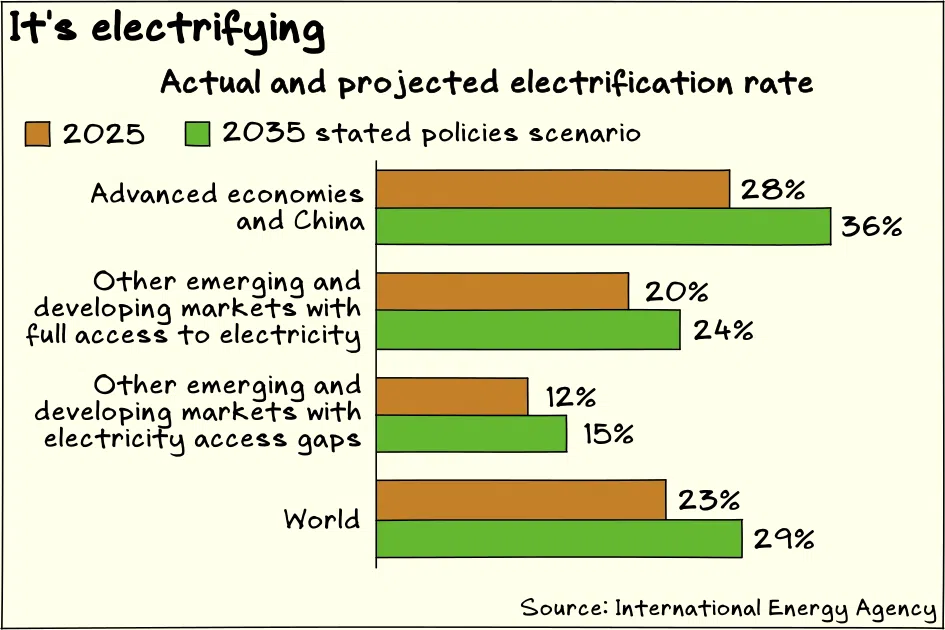
Under such circumstances, the joint presidents of COP31 – Turkey and Australia – are pushing for a “35-by-35” goal to raise the share of global energy demand met by electricity to at least 35 per cent by 2035, from about 20 per cent at the moment.
It’s a target seemingly picked because it seems easy to accept in the face of all these headwinds. After all, the International Energy Agency estimates that current policies are already on a trajectory to reach 29 per cent electrification by 2035, so while going for 35 per cent might take more effort, it is still somewhat feasible. The increasingly competitive pricing of electric vehicles and battery solutions, as well as the data centre boom, suggest that the world is already headed in the right direction.
The COP31 presidents are also suggesting that the target give parties the flexibility to decide the energy supply mix, which will allow countries at different stages of development and with different levels of resources to choose energy transition pathways most appropriate to their circumstances.
Therein lies the rub. Setting an electrification target without binding it to emissions reductions or a higher share of renewable generation risks creating a meaningless goal, because electrification supported by renewables generation has a substantially different impact on emissions reduction from electrification supported by fossil fuel generation. It’s like ordering a cake without specifying the occasion it’s meant to celebrate or the type of cake desired. You’ll get your cake, but it might not be the one you were hoping to eat.
The rigour of the 35-by-35 target is likely to be a source of much debate, but a pragmatic goal that nudges all countries in the right direction is better than no agreement. Nevertheless, there can be a fine line between a pragmatic consensus and a meaningless one. Negotiators will have to work for the former.
The first step is to connect electrification with emissions goals, because mitigating greenhouse gas emissions is ultimately the objective of the climate conference. Without that north star, an electrification target could end up going nowhere.
Low-carbon generation must be an integral part of electrification, although the pace at which the transition occurs could afford some flexibility to countries that need it. Many developing countries will fall into that category. However, COP31 needs to deliver better support for emerging and developing countries to build low-carbon electricity generation and to modernise and improve their grid infrastructure to handle the increased electricity demand and to firm their network to handle the intermittency of renewable energy.
The high curtailment rate of renewable energy in certain parts of China demonstrates the importance of upgrading electrical grids when renewable generation scales up. Grid modernisation is an important enabling investment even in electrification strategies that are still heavily reliant on coal or natural gas generation. That is because the grid will be able to handle more renewable power in the future.
Beyond electrification, COP31 needs to take steps towards raising investments in climate adaptation and resilience. The current expectation is that global warming will overshoot the 1.5 deg C threshold. Emerging and developed countries – such as those in South-east Asia – are especially vulnerable to disruptions from climate change. The adaptation investment gap remains significant and needs to be closed.
Being pragmatic should not mean becoming less ambitious. Rather, it should be about realigning ambitions towards more viable areas. Electrification is a fine goal in the current environment, but it should be aimed strategically.
Sustainable finance
Looking past data centres’ efficiency
Singapore’s sustainable finance eligibility criteria for data centres may have a blind spot when it comes to assessing a centre’s impact on surrounding communities and ecosystems.
An update to the Singapore-Asia Taxonomy for Sustainable Finance – which sets the conditions under which various economic activities can qualify for sustainable financing – includes revisions to criteria for data centres that better recognise trade-offs between power and water efficiency.
Data centres are either air-cooled or water-cooled. An air-cooled data centre can be very water-efficient but will be less efficient in its electricity usage; conversely, a water-cooled data centre consumes more water but is more efficient in its power usage.
A data centre development outside Singapore pursuing green financing under the earlier version of the Taxonomy had to meet the platinum rating under Singapore’s Green Mark Scheme for data centres with regard to power efficiency, as well as a single water efficiency hurdle.
The revised green financing criteria relaxes power efficiency requirements for data centres built with tighter water constraints, encouraging optimisation of resources instead of improving one aspect at the expense of the other.
But while the taxonomy ensures that data centres obtaining sustainable financing under its criteria are broadly efficient, it does not have a robust approach to address the external impact of data centres on their surroundings.
Consider recent negative news coverage of official investigations into Google’s felling of forests in Finland for its data centre, as well as NextDC’s delays to projects amid community protests in Australia. The fact is that a large data centre has a substantial impact on its surrounding environment and communities by virtue of the scale of its physical footprint, of its emissions and of its absolute consumption of resources, regardless of the data centre’s efficiency.
Some additional criteria worth considering could be requirements for environmental impact assessments or community engagement to be carried out and adjudicated, or compliance with local policies that adequately cover those impacts.
External impact presents a risk if not properly addressed. Investors holding what they think is a sustainable bond may find the funded project generating negative impact, which could affect the value of the asset.
Other ESG reads
- COP31: Temasek-backed CIX launches procurement service for Singapore-eligible carbon credits
- COP31: Singapore launches blended finance initiative to fund climate adaptation in South-east Asia
- Haze in 2026 estimated to cost Singapore S$2.32 billion, up 4% from 2015: experts
- Who should pay for Singapore’s cross-border power links?
- Is your board too polite to be effective?