

Issue 94: ESG investing evolves; ex-MAS sustainability champions land close by

In this issue: Major investors are standing firm on ESG principles, which suggests that the pushback against ESG investing isn’t a retreat but a reangling, while two of the key advocates for the sustainability strategy of Singapore’s central bank are now holding important roles elsewhere in the country’s leadership.
Please note: The ESG Insights newsletter will take a break on Apr 5 and return on Apr 12.
ESG investing
Down, but not out
The ESG investing movement appears to be struggling as weak returns and political opposition in the West have led the three-letter label to fall out of favour among the investment community.
But the reality is more nuanced. The hype surrounding ESG investing has certainly died down, but its principles remain firmly embedded in investors’ decision-making. For instance, Temasek’s head of ESG investment management Park Kyung-ah said addressing sustainability is a “must-do” to “capture the tailwinds of a megatrend that’s underway”.
What might appear from headlines to sound like backtracking on ESG principles is in fact an industry looking for ways to improve how it applies those principles.
Show us the money
There’s an economic reason ESG has soured for many. Morningstar data showed ESG funds experienced a net outflow of US$2.5 billion globally in the fourth quarter of 2023, a historically sharp retreat for the sector.
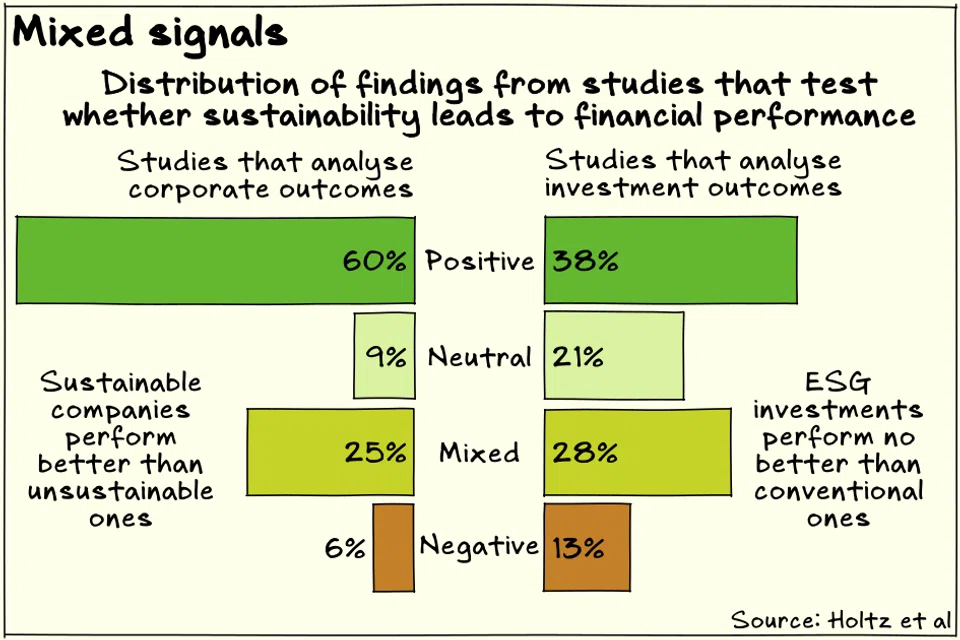
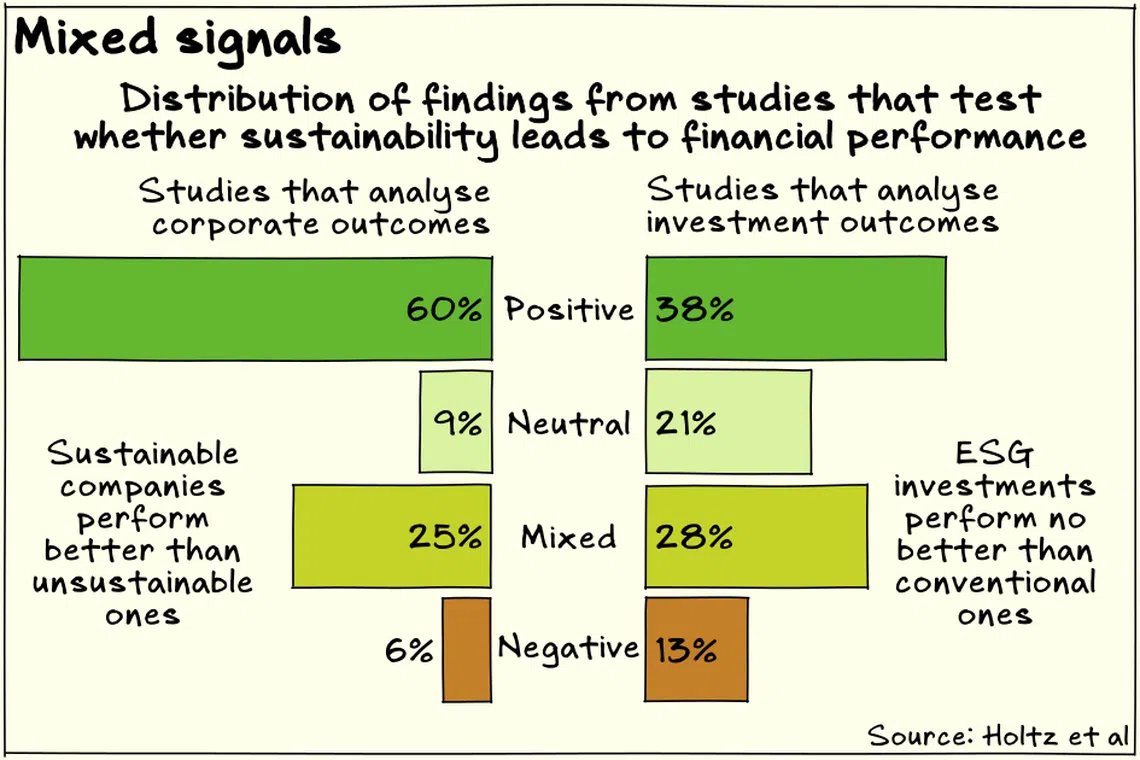
The reality is that ESG-focused investing hasn’t been great. In a 2023 review of more than a thousand research papers, US-based researchers found that sustainable investing did not outperform conventional investing.
In what appears to be a paradox, sustainability had a “robust and positive association” with better financial performance at a company level. However, while sustainability seemed to be good for companies, those benefits didn’t seem to carry over to investment portfolios.
Those results do not necessarily mean that ESG investing has no benefits; instead, the underperformance could be due to the way ESG principles are applied. The researchers noted that portfolio approaches based on “ESG integration” – such as where ESG factors are considered alongside more conventional traits – appeared to show better outperformance than approaches based on screening or divesting.
Some ESG investments are also not purely profit-driven. Impact investors, for instance, might be willing to accept a lower risk-adjusted return in exchange for impact.
Furthermore, the performance of ESG integration strategies could be dragged lower by an overall dearth of quality ESG data. As sustainability reporting improves, it is possible that investors will become better at distinguishing ESG performance – which could lead to a clearer difference between ESG and non-ESG investment strategies.
Three’s a crowd
ESG investment returns could also be negatively affected by attempts to combine environmental, social and governance factors.
The ESG concept was developed as an umbrella term for all the non-financial factors that could be material for a company. Although such a grouping is useful as an academic shorthand, it hasn’t been as helpful in developing investment ratings.
That’s because of the core ESG principle of materiality. Materiality means the ESG factors that are important can vary widely from company to company, and from investor to investor.
One-size-fits-all ESG ratings, however, use the same weighting formula to assign ESG scores to companies with different material risks and opportunities. A well-run oil and gas company with a strong board and excellent support for its workers can be added to an ESG portfolio despite doubling down on fossil fuels.
As Robeco wrote in a recent article: “Many ESG investment strategies fail to focus on financially material ESG information. In other words, ESG factors that could have a significant impact – both positive and negative – on a company’s business model and value drivers, such as revenue growth, margins, required capital and risk.”
There is, therefore, a broad move towards thematic approaches to ESG investing. Funds that are focused on electric vehicles are an example. That means more “E”, “S” or “G” funds, and fewer “ESG” funds.
Muddy politics
The other driver of the ESG pushback is political. Right-wing politicians, especially those in the US, have been particularly active in opposing all things ESG.
The politicians have not always been effective, although they occasionally get their way. Earlier this month, the Texas Permanent School Fund said it would pull out its US$8.5 billion invested through BlackRock because the school fund deemed BlackRock to be boycotting fossil fuel energy producers.
ESG’s political opponents are in the minority globally, though. Europe has gone the furthest in enacting sustainability-related laws, and the bloc isn’t stopping.
China is leading the world in solar and electric vehicle production. South-east Asian governments are all talking the talk and in many instances walking the walk as well on climate change. Singapore has made sustainability a core pillar of its economic strategy.
The investors at the top of the food chain are also mostly not budging. Large deployers of long-term capital such as Temasek are uniquely exposed to whole-of-economy risks and opportunities, so climate change and sustainability are material to their portfolios.
For instance, the Norwegian Government Pension Fund Global said it will divest its interests in Jardine Matheson and its related companies Jardine Cycle & Carriage and Astra International due to concerns about the impact the conglomerate’s gold mining activities in Indonesia has had on the habitats of a severely endangered species of orangutan.
Still, it’s unwise to ignore half of the largest economy in the world. A lack of political will in the US has wide-reaching implications, because countries that are too aggressive on addressing sustainability and climate change could affect the global competitiveness of their companies.
These considerations will filter into scenario analyses. The threat of policy-related transition risks in the short and medium term might not be as great as previously predicted, but the threat of physical risks due to global warming – such as the price and availability of crops – could be higher.
The bottom line
There have only ever been two reasons for ESG investing: profit and impact.
Some investors reckon that paying attention to ESG factors means taking a more comprehensive view of an investment’s risks and opportunities, and should therefore lead to better returns. Some investors are purpose-bound and think their investments should be consistent with ideas of stewardship and corporate citizenship. The two reasons are not mutually exclusive, and both are often held to be true by many investors.
In the current environment, however, it’s profit that has taken priority. Sure, do good whenever possible; but make money first.
In many ways, that is positive for ESG investing. Delivering better value can pave a more sustainable path for the movement. The shift can come at the cost of impact, though. For instance, investors might be less reluctant to take a more activist stance with their investments.
In February, State Street and JP Morgan Asset Management pulled out of the Climate Action 100+ as the climate-focused investment bloc asked members to take more direct action in pushing portfolio companies to address global warming.
As with most sustainability and climate solutions, there are always trade-offs, and the trade-offs are often complex. The challenge is in finding the right balance of cost and benefits.
Other ESG investing reads
- Only 14% of sustainability-linked bonds aligned with key climate goal: report
- Global fixed income market still heavy on carbon-intensive financing
Singapore & S-East Asia
Ex-MAS sustainability champions stick around
Singapore has appointed former central bank chief Ravi Menon as its first ambassador for climate action and as a senior adviser to the National Climate Change Secretariat (NCCS), effective Apr 1.
Menon, who stepped down as managing director of the Monetary Authority of Singapore (MAS) this year, will represent Singapore at international climate action platforms and will advise NCCS on whole-of-government climate policies and actions.
Menon is no lightweight when it comes to climate issues. During Menon’s tenure, MAS developed a sustainable finance taxonomy that included a framework for transition finance. He also previously chaired the Network of Central Banks and Supervisors for Greening the Financial System, as well as the Asia-Pacific Advisory Board of the Glasgow Financial Alliance for Net Zero.
Together with recently elected Singapore President Tharman Shanmugaratnam, Menon’s appointment means two of the key people who oversaw MAS’ sustainability vision over the past few years will continue to hold roles in Singapore’s leadership. President Tharman was chairman of MAS from 2011 to 2023, when Menon was also managing director.
Informal anecdotes from industry players paint Tharman and Menon as instrumental in driving MAS’ pursuit of sustainability as a core growth strategy for Singapore’s financial ecosystem.
No surprise on that front. The speed with which MAS has moved on developing Singapore’s sustainable finance capabilities – especially in transition and blended finance – suggests strong support among its leadership.
What’s occasionally underappreciated is that MAS cannot accomplish its sustainability strategy on its own without some help from other arms of the government.
The sustainable finance ecosystem will struggle to grow if the Manpower Ministry doesn’t provide support on talent development and hiring. It would be challenging to build a vibrant carbon market if the appropriate ministries aren’t also helping to build credible frameworks and agreements for cross-border carbon accounting.
Menon’s new role ensures his successor at MAS, Chia Der Jiun, can continue to count on broad government support for the financial regulator’s sustainability strategy.
Other Singapore & S-E Asia reads
- Climate Impact X’s CEO resigns; global search for successor begins
- Vietnam boosts coal imports as it promises investors no more power cuts






