

After the American order: How mid-sized states could become middle powers
Amid great power rivalry, these nations must sustain existing forms of international cooperation and build new ones
THE end of the post-1945 Pax Americana concludes 80 years of global stability and opportunity.
US President Donald Trump has been endorsing the notion that big powers have spheres of influence, instilling fear among smaller states that they will once again fall victim to the predations of the large.
Indeed, three countries hold the commanding heights of the sources of global power: the US, China and Russia.
By flexing their muscles and threatening the return to a world of great power domination, the Big Three are forcing mid-sized countries and their smaller counterparts to adapt, build up countervailing strengths, and find ways to sustain existing forms of international cooperation while building new ones.
“In terms of capacity, middle powers must be in the middle of and have influence over something bigger than themselves, whether this is a region, an economic sector or delivering some sort of global outcome.”
This presages the dawn of a period, in which mid-sized states might escape the orbit of the big and help the world chart a different future.
Defining middle power
Yet, if middle is just an intermediate point between the largest and smallest countries, as measured by population, gross domestic product or military capability, then we are only describing mid-sized countries.
To identify countries with middle power, we need to identify their interests and their capacities.
In terms of interest, middle powers want to resist the return to a world where “might is right”.
In terms of capacity, middle powers must be in the middle of and have influence over something bigger than themselves, whether this is a region, an economic sector or delivering some sort of global outcome.
The combination of their interests and capacity to pursue them means that middle powers desire, and could prove pivotal to the emergence of, a new world order, in which they will have a central voice and a stake.
Some are big, such as India and Brazil, while some are small, agile and well-situated by geography, including Israel, Qatar, Singapore and the United Arab Emirates.
Some really are mid-sized, such as Argentina and Mexico in Latin America, Indonesia and Vietnam in the Asia-Pacific, and Egypt, Pakistan and Saudi Arabia in the Middle East.
Then, there are America’s largest allies.
They include Canada in North America; France, Germany, Italy, Norway, Poland, Spain, Turkey and the UK in Europe, with Ukraine emerging as a strong new middle power alongside them; and Australia, Japan and South Korea in the Asia-Pacific.
Stepping forward
To navigate the new global disorder, these nations are charting distinct paths to assert their influence.
Non-aligned or multi-aligned countries are successfully triangulating between China, with Russia on its side, and the US.
For instance, Indonesia introduced a ban on the export of nickel, trying to encourage Chinese companies and others to establish joint ventures to process the nickel onshore.
The country wants to leverage this into developing its own battery manufacturing industry and ultimately, its own electric vehicle sector.
Similarly, Saudi Arabia and the UAE are vying to become leading players in the artificial intelligence revolution, using the lure of their cheap energy and their big co-investment potential from their sovereign wealth funds to attract US cloud and AI companies.
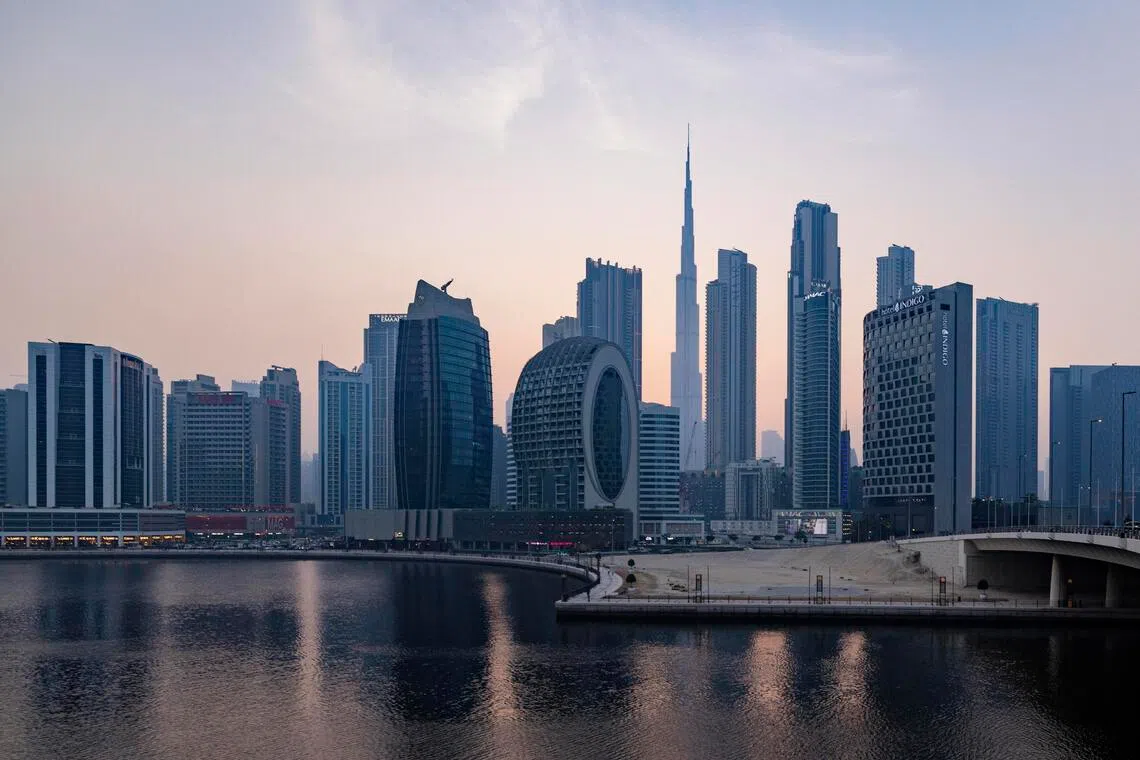
But they are finding ways to do this without excluding China completely from the process.
India is trying to strike a trade deal with the US, but has brushed off Trump’s pressure to reduce its oil imports from Russia.
Moreover, it has chosen not to partner US or Chinese companies to develop its AI sector. Instead, it is launching a large language model with French AI company Mistral.
Meanwhile, US allies are being forced to step forward as more assertive and autonomous middle powers within their regions.
For example, Ukraine continues to stall Russia’s military progress and hit its energy and military-industrial infrastructure with homemade drones. And it is sharing its drone technology with its European allies.
Japan in late 2025 said that it would double its defence spending to 2 per cent of GDP by March 2026.
It has since gone ahead with the purchase of 400 Tomahawk cruise missiles from the US, while deploying new hypersonic missiles capable of striking the Chinese mainland.
By making these investments, Japan is dealing itself a seat at the table.
Elsewhere in the Asia-Pacific, Australia’s new national defence strategy commits the country to spend A$425 billion (S$389 billion) over the next decade on a strategy of denial, aimed at China.
Stronger together
The last two years have shown that mid-sized countries can be middle powers only if they do the one thing that they, unlike great powers, truly have the incentive to do: be stronger and more powerful together.
Mid-sized countries are striking new strategic partnerships, in many cases, among themselves. For instance, Saudi Arabia now has a formal strategic mutual defence agreement with Pakistan, and a 10-year drone deal with Ukraine.
Mid-sized countries also depend on interconnected markets. While most countries have a trade to GDP ratio of 40 to 50 per cent, EU members’ ratio is close to 100 per cent, and Singapore notably has a massive ratio of 320 per cent.
Therefore, middle powers must try to be the modern day Lilliputians holding down the Gulliver, and hold together the Bretton Woods structures.
To this end, there are now 61 members of the multi-party interim appeal arbitration arrangement within the World Trade Organization (WTO), including Singapore and the UK.
This provides a safety valve framework to WTO members to resolve their disputes, and bypasses the earlier US decision to block the appointment of new judges.
In a similar vein, alongside New Zealand, Switzerland and the UAE, Singapore established the future of investment and trade partnership with 16 member countries.
Because most regional organisations such as Asean are still a consensus-based system, they are struggling to get to the next level of regional cooperation. This makes these efforts by groups of middle powers to keep the multilateral trade system alive even more important.
They are also building their own intraregional and intra-middle power trade agreements, such as India-EU and Brazil-EU.
Challenges ahead
Nevertheless, the biggest risk to mid-sized countries is fractured domestic politics, driven often by fiscal fragility.
Public debt levels in the UK, France and Italy are above 100 per cent of GDP. Pakistan and Egypt spend 40 per cent of their public expenditure on debt interest, while Mexico, India and South Africa spend close to 20 per cent.
Furthermore, all middle powers have ageing populations, and Global South countries have very precarious middle classes. Democratic politics are struggling with disinformation and with big powers trying to use this moment of uncertainty to try to weaken them.
Ultimately, mid-sized countries can only take advantage of this moment of transition by doing three things.
First, they need to buy time, even if this means having to be accommodative to Trump and to Chinese President Xi Jinping.
They need time to invest in their security and economic resilience, build domestic support for the necessary political trade-offs, and establish or reinvigorate the international partnerships that will give them real leverage in the world.
Second, they have to “hang together”. Mid-sized countries can become middle powers by serving as hubs for economic rule-making and security cooperation within their regions.
Lastly, they need to be strong to be powerful. Mid-sized countries will only be middle powers if they take the tough, politically painful decisions domestically to be able to engage outside together constructively.
Lacking the benefits of huge economic scale or the domination of the commanding heights of defence, technology and energy, they are going to have to work much harder to arrive at positions of influence over their destinies.
The writer is a distinguished fellow with Chatham House (the Royal Institute of International Affairs, London), where he was director and chief executive from 2007 to 2022. He is also a distinguished fellow with the Asia Society Policy Institute, and senior adviser to the Center for Strategic and International Studies in Washington, DC.
This is an edited excerpt of his Distinguished Public Lecture organised by the S Rajaratnam School of International Studies. Sir Robin Niblett visited RSIS under the S Rajaratnam Professorship in Strategic Studies in May.
This essay is part of New Global Order, a series which explores how the changing world landscape is reshaping business, politics and beyond.
Decoding Asia newsletter: your guide to navigating Asia in a new global order. Sign up here to get Decoding Asia newsletter. Delivered to your inbox. Free.
Share with us your feedback on BT's products and services
TRENDING NOW
Companies still in search of AI use cases with worthwhile ROI, says Broadcom’s CEO
Malaysian king buys stake in Singapore-listed mining firm expanding into rare earths

Once staunchly pro-China, Malaysian Chinese businesses are now distancing themselves from Beijing
Singapore’s wealth management success should extend to everyday families

