

Bank on AI-resilient Singapore property via deep-value listed property groups
CDL and UOL are among names worth considering

[SINGAPORE] Artificial intelligence is a game changer. Nations and companies that lead in AI might reap huge gains.
Therefore, equity investors could be right to give AI giants lofty valuations. And it may not be too late to start investing in AI leaders.
However, picking winners among AI players can be tricky. Also, might regulations and public backlash stymie its growth?
Imagine incidents of AI going rogue and wreaking huge damage, which lead to governments clamping down or consumers turning their backs on its use.
Certainly, equity investors playing the AI theme should be prepared for wild gyrations in stock prices of AI plays. Perhaps investors could balance their exposure to such plays with investing in deep-value plays, which are safe and may not see much disruption from the technology.
Unfortunately, safe plays such as government bonds might not be all that safe amid ballooning government debt in many countries.
Investments in US Treasury securities are backed by the US government.
However, its growing debt could become unsustainable, especially if interest rates stay higher for longer. Also, investors might gradually shift from US dollar assets in an increasingly multipolar world.
Investors could consider exposure to Singapore dollar bonds that are issued by the government and strong corporates – as they are backed by the strong Singapore dollar – as well as physical property in the Republic.
Political stability and a strong fiscal position help underpin the local currency’s strength.
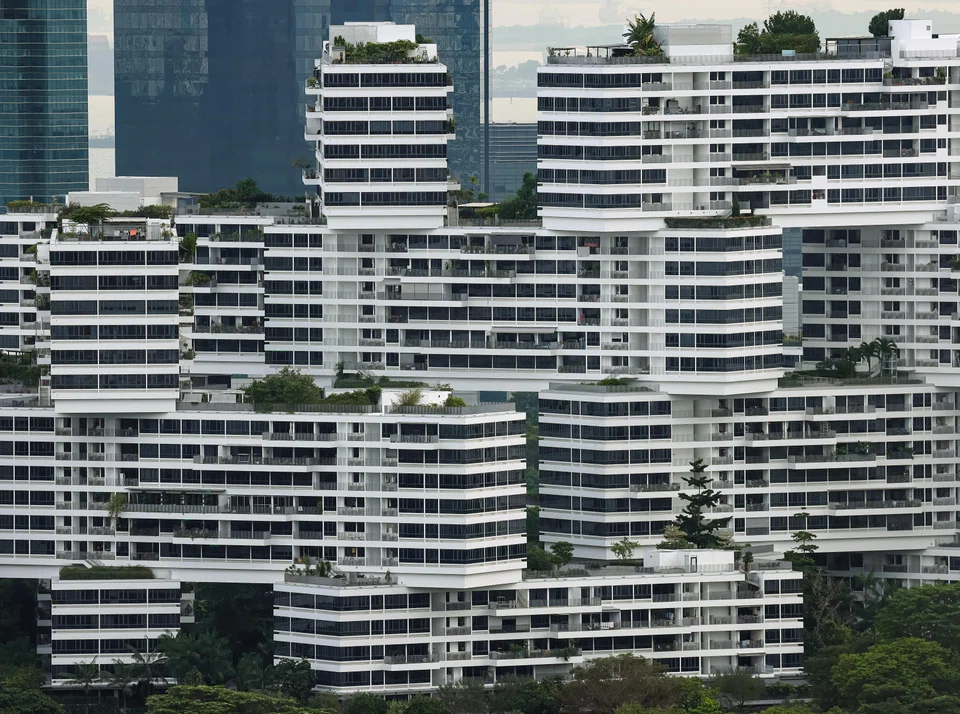
Within the property space, the housing segment may be the most resilient to AI-induced disruptions.
AI could be highly disruptive to work spaces, retail spaces, and manufacturing and logistics facilities, among others.
But even as lifestyles change because of the technology, people are likely to continue to channel much of their income and savings into owning a high-quality home. In a fast-changing world, the clamour for a comfortable space to rest and unwind will be strong.
Many people may also use a home to grow and operate one-man businesses in the age of AI.
Barriers to physical property investment
However, investing directly in private homes in Singapore is tough. For one, net yields in a nation with a high rate of homeownership among residents are low – possibly 2 per cent or less.
More importantly, tight rules make investing in Singapore homes challenging.
A Singapore citizen pays additional buyer’s stamp duty (ABSD) of 20 per cent on a second home and 30 per cent on a third and subsequent home.
Meanwhile, the ABSD rates for a non-permanent-resident foreigner and an entity buying any home are 60 per cent and 65 per cent, respectively.
While ABSD does not apply to purchases of non-residential properties, yields in non-residential properties are also generally low because of the Republic’s safe-haven status.
Listed property groups
An investor who is keen to get Singapore property exposure could consider buying shares in listed property development and investment companies.
An investment can be made in established Singapore property groups at a substantial discount to book value.
Take City Developments Limited (CDL) and UOL Group , two Straits Times Index constituents whose core business includes property development in Singapore.
As at market close on Tuesday (Oct 20), CDL traded at S$7, a 35 per cent discount to its end-June net asset value (NAV) per share of S$10.74.
The discounts to end-June restated NAV per share of S$17.94 if fair-value gains of investment properties were included, and S$20.09 if fair-value gains of investment properties and hotels were included, are even steeper.
UOL’s share price of S$7.74 at Tuesday’s close was a 45 per cent discount to its end-June NAV per share of S$14.20.
Of course, deeply undervalued property groups may persistently trade at substantial discounts to book value. This is especially if the groups’ boards of directors do little to unlock value and reward shareholders.
But what is interesting is that there appear to be winds of change across boards of major listed property groups, which are focusing more on delivering better returns to shareholders.
Value-unlocking moves
Perhaps what Hongkong Land – founded in 1889 and a member of the Jardine Matheson Group – is doing to improve shareholders’ returns is inspiring others to follow suit.
In late October 2024, the group, which has a secondary listing in Singapore, unveiled its new business strategy. Key elements of this include:
- Expanding its investment properties business in Asian gateway cities;
- Recycling capital from its build-to-sell segment to finance new integrated commercial property opportunities;
- Strengthening strategic partnerships to support its expansion and identifying third-party capital to fund future growth; and
- Updating its capital allocation framework to enhance shareholder returns.
Hongkong Land, which trades below book value, has seen its share price more than double from where it was when it unveiled the strategy.
CDL’s refreshed strategy for 2027 to 2029, aimed at delivering sharper strategic focus, stronger capital discipline and sustainable long-term shareholder returns, did not draw a positive share price response from investors.
Still, by sharing a clear road map with measurable outcomes, CDL could over time win favour with investors, provided that management executes well on the strategy.
Clearly, too, major shareholders are confident in the value of their property groups.
For example, executive chairman Chua Thian Poh has been gradually increasing his stake in Ho Bee Land by purchasing more shares in the group.
GuocoLand chairman Quek Leng Chan has also been raising his deemed interest in the group via share purchases.
Helped by share purchases made by his spouse, the total shareholding interest of Wing Tai Holdings chairman and managing director Cheng Wai Keung has crept up over time.
No doubt, there is much value in the assets held by numerous Singapore-listed property groups. And while visibility may at times be low on how the groups will unlock value, investors are buying into the groups with an abundant margin of safety.
As more property groups rightly work on unlocking value, because this is crucial to get a competitive edge and the right thing to do for shareholders, investors should consider raising exposure to locally listed property development and investment groups.
Importantly, major Singapore property groups are AI-resilient and deeply undervalued, which could help investors seeking portfolio diversification.
The writer owns shares in CDL and UOL
TRENDING NOW

Philippine power giant First Gen rebuffs foreign offers, plans up to US$2.6 billion in expansion

Once staunchly pro-China, Malaysian Chinese businesses are now distancing themselves from Beijing

Nearly half of Singapore workers put in at least six unpaid hours a week: survey
Vietnam’s data-centre investment rush faces reality check on power and site constraints

